
On this page
A language app, a photo editor and a mobile game give people different reasons to install. Their social accounts should make different promises too. One can turn language practice into entertainment. Another can teach a visual result worth trying immediately. A third can invite people into a challenge they understand before they know the product name.
The best AGD marketing strategy for your app is the one that connects those reasons to repeatable editorial work and a measurable product journey. Account-Generated Distribution (AGD) is an organic growth model where content is distributed through a network of purpose-built social accounts instead of relying on a single brand account or external creators for reach. You can still use a brand account, creators and paid campaigns. The additional work is designing the distribution network around clear account roles.
This guide compares practical strategies using public Duolingo and Canva material, then gives you a brief and measurement ledger to adapt. These are outside examples, not TokPortal customers or proof that the brands use the AGD label. The recommended account structures are our interpretation and planning advice. No private install data is available for these cases.
Sources & real examples
Public accounts, original posts and primary references. Each example is linked where it is discussed.
View all 9 sources and review notes
- Duolingo main TikTok ↗
Public account identity; no private conversion data.
- Duolingo Japan TikTok ↗
Public local editorial surface; no inferred audience geography.
- Duolingo Japan apology post ↗
Original skit and the captured six-month frame.
- Canva Shorts ↗
Verified channel inspected in the browser on 8 September 2026.
- Canva carousel tutorial ↗
Original tutorial and captured product interface; no install results claimed.
- Apple campaign links ↗
Campaign attribution scope and reporting thresholds.
- Apple custom product pages ↗
Tailored store presentation and page analytics.
- Google Play custom store listings ↗
Unique listing URLs and translation behavior.
- TikTok recommendations ↗
Primary recommendation guidance, not a reach guarantee.
Start with the product moment, then choose the account
Write the smallest useful thing someone can accomplish with your app. For a design tool, it might be turning a few ordinary photos into a coherent carousel. For a language app, it might be understanding a phrase they expect to hear on a trip. For a game, it might be solving a particular obstacle. That moment should be understandable on screen, without a paragraph of positioning.
Then ask who could keep publishing interesting material around that moment. A demo account needs a supply of genuine demonstrations. A character account needs a point of view, performances and stories. A local account needs someone who understands the language and everyday references. Naming a new account is easy; supplying its next ten worthwhile posts is the commitment.
For your first brief, complete this sentence: “People should return to this account because it repeatedly helps them ____.” If the answer is only “learn that our app exists,” the editorial promise is too weak. Find the recurring benefit, entertainment or curiosity that makes the account useful between product announcements. Your install CTA should follow naturally from that benefit.
Duolingo: a product can support more than one editorial identity
Open Duolingo’s main TikTok account and its Japan account. The shared owl provides a visible brand connection. The Japanese profile and its posts give you a concrete second editorial surface to inspect. This is more informative than an abstract instruction to “localize your content.” There are actual choices of language, performance and situation to examine.
The Japanese apology skit makes missed practice into a visual joke through increasingly repeated bowing figures. The selected frame below is at the six-month stage. It gives the product’s practice habit a recognizable comic situation. It is not a screen recording of a lesson, and the analysis does not require pretending it is one.
For an app team, the transferable idea is a relationship between editorial identity and product behavior. You could build a comic series around the frustration your app addresses, while another account teaches a real task. Those accounts would share a product destination but give viewers different reasons to follow. That is a useful AGD design exercise; copying the owl or assigning translated captions to interchangeable profiles is not the exercise.
Before opening a local account, write three situations that would make sense to the intended audience. Ask a fluent reviewer to explain the joke or utility without consulting your English script. If all three ideas require the same global video underneath, your team may have a translation workflow rather than a distinct local editorial role. Keep researching until the local account has something of its own to contribute.
Canva: show the result and the work that makes it possible
The Canva Shorts feed includes tutorials about gaming ads, carousels and other design tasks alongside broader creative discussions. It is not an exclusively tutorial-only account. The carousel tutorial provides a particularly useful example: the captured frame shows the actual design interface, including templates and elements, inside the lesson. The product has a visible role in making the outcome.
That distinction matters for apps whose value is easiest to understand through a transformation. A product interface can be part of the story rather than an end card. The viewer sees what they would be learning to do. This observation says nothing about the video’s install conversion rate, and a public tutorial cannot establish which device or subscription a viewer later uses.
To adapt the mechanism, choose an outcome a viewer can recognize immediately. Show the starting material, the action inside your app and the finished result. Let each episode solve a different problem: a birthday invitation, a product comparison, a trip recap. These are proposed briefs, not descriptions of a Canva campaign. Record your own actual workflow and make clear which features are available in the version you show.
A demo-led account can stay coherent while the examples change. That is useful when you have many product use cases but a small production team. Build a shot checklist rather than a script that changes only a noun. The next video should contain a fresh demonstration, with its own decisions and result. For a deeper account-format decision, use the formatted versus chaotic AGD comparison.
Which AGD strategy fits your app?
Feature
Good fit
What you must supply
Demo-led account
Character-led account
Local editorial account
Challenge or gameplay account
“Best” here means fit for your product and team, not a ranked list of vendors. Choose a role you can sustain with original material. A polished character concept is a poor operational choice if nobody can write or perform the next episode. A demo series is a poor choice if your team can only show the same onboarding screen repeatedly. The constraint is the work you can make well.
Do not turn every row into another account immediately. Write several credible episodes for the strongest role, then identify what a second role would contribute that the first cannot. If the same post fits both briefs without meaningful changes, combine the briefs or sharpen their differences. Use the account and content isolation worksheet to make that decision explicit.
For a proposed game campaign, one account might explain solutions and another show the tension of a real attempt. For a proposed utility-app campaign, one might teach a recurring task and another answer a specific professional audience’s questions. These structures are hypotheses to test. The number of accounts should follow a content and operating plan, not a claim that a particular account count unlocks reach.
Keep the promise intact from the post to the store page
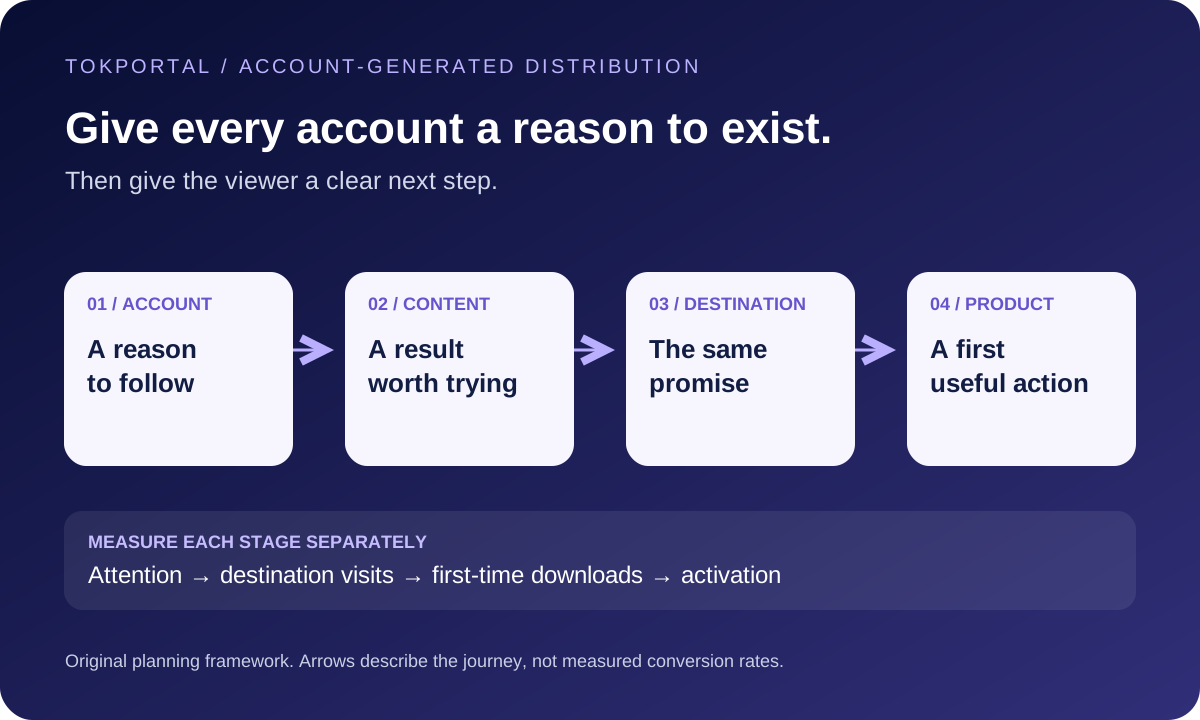
The next screen should continue the reason the viewer cared. If a tutorial teaches a carousel, a destination dominated by unrelated features makes the reader reconstruct the connection. If an account speaks to beginners, its destination should make the first useful action easy to recognize. Review the post, profile, link destination and first app session together rather than treating the social clip as the whole campaign.
Apple’s custom product pages support tailored screenshots, previews and promotional text, with page-level analytics. Google Play custom store listings can be reached through a unique listing URL; Google also explains that these listings are not automatically translated. Check the current setup requirements in the linked documentation before designing your handoff.
For each account role, write the destination promise in one sentence and identify the screen that delivers it. Use a supported link placement on the relevant social account, then test the path on the intended device. Record redirects, language, country availability and the first action after installation. A desktop preview alone cannot tell you whether a mobile visitor reaches the right place.
Measure the journey without turning every view into an install
Keep platform attention, destination visits, downloads and activation as separate observations. A large view count can coexist with weak install intent. A smaller tutorial may answer a more specific problem. Neither interpretation is proved by the counts alone: you need the destination and product observations, recorded for comparable periods, to assess whether the campaign is doing the job.
Apple’s campaign-link documentation describes campaign tokens, a 24-hour first-time-download attribution window and minimum reporting thresholds. Follow those rules when interpreting its dashboard. A web UTM on your landing page is useful for web reporting, but it does not by itself establish attribution through installation and later app use. Document the measurement method your product actually implements.
Your ledger should identify the account role, original post URL, publication time, observation time, destination and activation definition. Keep missing values missing. A suppressed report, broken link or absent event is not evidence of zero demand. If several sources can claim the same user, reconcile them before reporting a total. Report first-time downloads separately from returning users, and distinguish an activated user from someone who only opened the app.
Choose an activation event that reflects value: finishing a first design, completing a lesson or reaching a meaningful game milestone. These are examples, not universal definitions. Fix the event definition before comparing roles, and give cohorts the same opportunity to mature. Otherwise a post published yesterday can appear worse simply because its users have had less time to act.
For the implementation steps, use how to track organic TikTok app installs across AGD accounts. It provides separate iOS and Android setup briefs, a versioned account-link ledger and device-state checks.
Turn observations into the next production decision
Run a review that ends with a specific change. If a demo attracts attention but visitors do not reach the store, inspect the link and the clarity of the next action. If store visits are visible but downloads are weak, review the destination promise and supported device or market. If people download but never reach the value event, inspect onboarding before multiplying the social output.
Those are diagnostic questions, not automatic explanations. A small sample can fluctuate, and a missing report can be a measurement issue. Compare complete observations before rewriting your strategy. For attention within an account, use the relative-performance guide to compare posts at similar ages instead of using one selected peak as the standard for everything that follows.
When a creative mechanism looks promising, commission a fresh execution: another real problem, a different example or a deeper answer to a recurring question. Preserve the useful mechanism and change the substance. Do not assume an account’s result transfers unchanged to a different audience. Record what you expected, what was observed and what the next test would clarify.
Plan the operating workload before adding distribution
Organic distribution still has costs. Include research, recording, editing, localization, account operations and measurement in your planning. The absence of an ad invoice does not make production free. Estimate capacity from the work your team can deliver, then use the distribution planner for the current TokPortal operating assumptions. Keep your own creative costs alongside that estimate.
TikTok’s recommendation documentation describes multiple signals and eligibility considerations. It does not give this campaign a guaranteed reach threshold. Treat account preparation and native publishing as operational work, with clear responsibilities and quality checks, rather than promising that a fixed warming schedule or a local device guarantees a particular audience.
The handoff to an operator should contain the approved asset, account role, caption, intended market, source permissions and destination. Add a way to record the resulting public post URL and any delivery issue. That record links the editorial decision to the later review. Automation is useful when it preserves those connections instead of scattering exports, captions and results across separate conversations.
Your AGD app campaign worksheet
From account promise to activated user
PRODUCT MOMENT
What useful result can a viewer understand on screen?
Who needs this result?

ACCOUNT ROLE
Reason to follow:
Editorial owner:
Three original episode ideas:
What this account will not post:
How it differs from the other account:

DESTINATION
Supported social link placement:
Store page and language:
Expected first app action:
Device path tested by / date:

OBSERVATION LEDGER
Original post URL / published at:
Observed at / post age:
Platform metric and its definition:
Destination visits and source:
First-time downloads and attribution method:
Activation event / cohort maturity:
Unknown or suppressed values:

NEXT DECISION
What did we expect?
What did we observe?
What original execution or product-path fix comes next?
Creative cost / operating cost / owner:
Fill this out for the first role before reserving more capacity. Then read the two account briefs with their names hidden. If you can explain the different reason to follow each one, the network has a clearer editorial purpose. If you can also follow the route to the product and describe how you will observe the outcome, you have a campaign you can operate and learn from.
TokPortal is the operating layer when you have original content and account roles ready to execute. Use the buyer campaign flow below to plan the network, and keep the worksheet with your creative brief. The objective is useful distribution that leads somewhere: a viewer understands a reason to care, can reach the product and has a chance to experience the value you showed.

Written by
Vincent Tellenne
Co-founder & CEO
Vincent is a co-founder and CEO of TokPortal. He works on the infrastructure and operating model behind scaled organic social media distribution.
Learn more about this topic with AI
Related Resources
Related Tools
Put your AGD strategy to work
You make the content.
TokPortal runs the account operations.
Create and operate TikTok and Instagram accounts in your target market. Local operators handle the account work and native publishing. You control the brief, content and campaign from the dashboard, API or MCP.
- 01Choose your market
- 02Define each account
- 03Schedule your content
Review market availability and pricing before ordering. No reach forecast is built into your plan.