
On this page
You open the content folder. There are thirty exports, three usernames and one idea. Every account has the same promise, every video makes the same point, and the only real variation is the crop. That is a lot of operational work for very little editorial range.
Account-Generated Distribution (AGD) is an organic growth model where content is distributed through a network of purpose-built social accounts instead of relying on a single brand account or external creators for reach.
Two principles make that network more than a pile of accounts: account isolation gives each account its own identity and reason to follow; content isolation gives each publication a distinct story, demonstration or payoff. Change the audience promise at account level. Change the actual viewing experience at post level.
Sources & real examples
Public accounts, original posts and primary references. Each example is linked where it is discussed.
- UltraSuperNew: Duolingo Japan ↗
- TikTok: how recommendations work ↗
- Zaria Parvez: building Duolingo’s social presence ↗
View all 6 sources and review notes
- UltraSuperNew: Duolingo Japan ↗
Original agency case and Museum of Wonky English photograph, analysed below.
- TikTok: how recommendations work ↗
Platform explanation of personalized ranking. It is not a certificate for any account-network strategy.
- Zaria Parvez: building Duolingo’s social presence ↗
First-person account of developing a brand voice and an experimental content practice.
- Duolingo: main TikTok profile ↗
Verified public profile, inspected and captured September 8, 2026.
- Duolingo Japan: TikTok profile ↗
Verified public profile; compare the bio, language and visible executions.
- Duolingo Japan: apology skit ↗
Original public video linked beside its captured frame.
Two real accounts, one brand: Duolingo and Duolingo Japan
Open @duolingo and @duolingojapan before writing an account brief. Both verified profiles use the green owl. The Japan account has a Japanese bio and Japanese-language posts; the main account has a different bio and a different visible selection of posts. Shared branding is immediately obvious. The editorial separation is something you can inspect in the material, rather than infer from a different username.
These public accounts are examples for analysis, not TokPortal customer results. We use the AGD distinction to read what is visible. We are not saying Duolingo calls its strategy AGD or follows TokPortal’s framework.
Start your review at three levels. At profile level, identify who the account addresses and what a viewer expects from it. At feed level, list the subjects, recurring characters and execution types that are actually visible. At post level, open an example and explain its premise without mentioning the logo. This sequence prevents a common mistake: treating a new profile picture as evidence of a new editorial role.
In the screenshots above, the avatar does very little of the separating work. Language, captions, premises and the selection of executions provide much more material for the brief. That is useful when one business owns several accounts. You can disclose shared ownership and still give each account a distinct reason to exist.
Read an actual post before writing “localization” in the brief
In this Duolingo Japan post, the visible setup pairs a person, the owl and Japanese text about skipping practice. The premise is a recognizable relationship with the product: the learner has something to apologize for. The account is doing more than presenting a translated feature list. It is turning a product-related situation into a scene.
For your own brief, separate the reusable mechanism from the material that belongs to the source. A useful mechanism might be “dramatize the moment a user breaks a promise to themselves.” The owl, the staging, the specific gag and the finished footage belong to this execution. Copying them would not demonstrate content isolation. Finding a different, true situation in your own product and making an original scene would give your team something worth testing.
Write the intended audience response before commissioning the asset. Do you want recognition, a practical answer or curiosity about how the product works? That response determines the account’s job. It also tells the editor what to cut. A joke account may lose its premise if a feature explanation interrupts the scene; a tutorial account may need that explanation to be useful at all.
Start with the reason someone would follow
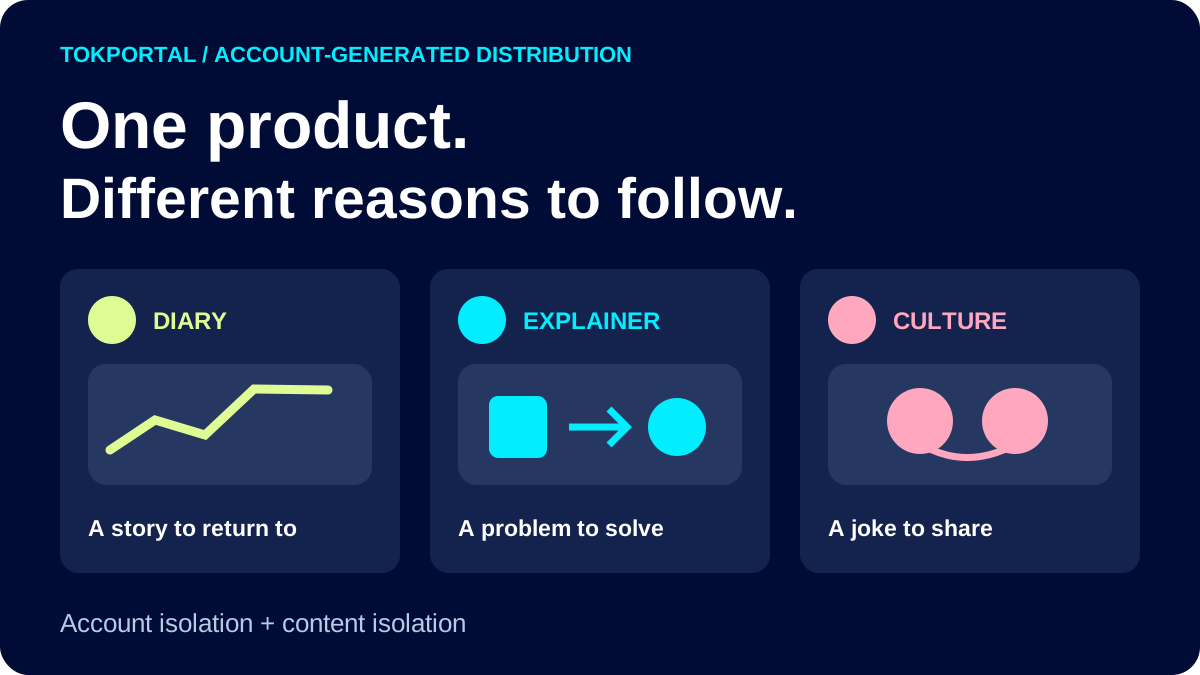
An account brief should answer a viewer’s question: what will I get here next week? A founder’s training diary, a movement explainer and a gym comedy account can all support the same fitness product. Their audiences may overlap. Their promises, voices and content decisions should still be distinguishable.
The training diary
Beginners building a habit
A realistic account of getting through the first month.
Narrative slideshows
The three things I stopped tracking this week.
Form, explained
Lifters fixing one movement
One technical problem, demonstrated clearly.
Annotated demonstrations
What to change when your squat heels lift.
Gym culture
People who love gym jokes
Recognizable situations worth sending to a friend.
Memes and reactions
When the rest timer becomes a scrolling session.
Illustrative account briefs. These are planning examples, not real profiles or campaign results.
These are hypothetical briefs, not invented customers. Notice that the product has not changed. The editorial job has. A diary needs progression, a technical account needs demonstrations, and a comedy account needs a situation that is funny even when nobody clicks the bio.
Write the profile, then write the first three posts
Here is a worked brief for a fictional fitness app. The app helps people plan workouts. That product is the shared commercial context, but it does not need to become the subject of every publication. The account must earn attention before the product link can use it.
The training diary follows the experience of getting started. A possible bio is “Small workouts. Honest progress. Making week two easier than week one.” Its first three posts could cover packing a gym bag the night before, shortening an overambitious routine and returning after missing a session. If a real person presents the diary, use their actual experience. If the character is fictional, make the format legible as fiction rather than inventing a customer transformation.
Form, explained answers a narrow practical question. Its bio might promise “One movement problem, one clear demonstration.” The first three posts show a setup adjustment, compare two movement cues and explain what a viewer should look for in a demonstration. The account needs demonstrable subject knowledge; an AI-generated script does not substitute for checking a fitness claim.
Gym culture earns a follow through recognisable situations. Its first posts could be a reaction to the friend who rewrites the workout on arrival, a slideshow about packing everything except shoes and a short sketch about a rest timer. The comedy should still work when the product name is removed. Otherwise it is just an advertisement wearing a meme costume.
Shared ownership does not require shared identity
You can keep one product link, a consistent disclosure policy and a central asset library. Isolation does not require pretending that the accounts have unrelated owners. What changes is the editorial experience: the profile image, bio, voice, recurring subjects and rules for accepting a post.
Give each account an exclusion list. The diary rejects jokes that break its story. The explainer rejects vague motivational claims without a demonstration. The culture account rejects a feature announcement unless there is a worthwhile joke or situation. Exclusions are useful because a vague brief can justify almost any upload.
A practical review is to hide the usernames and read three proposed posts. If the editor cannot assign them to the right account, the roles need work. Check the complete exports as well as the script. An account map can look wonderfully differentiated while the videos all end up using the same stock clip and voice.
A new hook is not always a new execution
Try the distinction
You have one idea: make workouts easier to finish.
A different opening can be useful for a creative test. But if the same footage, argument and payoff fill the remaining post, do not count that as a distinct piece of content for every account.
The diary shows a failed week and one recovery rule. The explainer demonstrates a shorter workout. The comedy account makes a joke about overcomplicated routines. The product connection is shared; the viewing experience is different.
Illustrative editorial scenarios, not measured campaign results.
Keep a repeatable format when it helps people recognize the account. A consistent layout, pacing or visual identity is compatible with original content. The question is whether the next post brings a new example, demonstration, story or useful argument. A template is a container; it still needs something worth putting inside it.
A real example: local content is more than translation
UltraSuperNew describes adapting Duolingo’s Japanese TikTok presence through local experimentation. The pictured museum turned translation mistakes into a cultural activation. The useful AGD lesson is to build an account around material its audience recognises, instead of translating the same feed. Read the original case and inspect its other examples.
This is our interpretation of a public case. Duolingo is not presented as a TokPortal customer or as an adopter of the AGD term. The lesson to borrow is editorial specificity, not a promised growth multiple.
Turn one subject into three genuinely different executions
Take the subject “finishing a workout when you are short on time.” A weak network changes the opening sentence of one video three times. A stronger network gives the subject three different jobs.
For the diary, write a five-slide story: the ambitious plan, the moment the day changed, the smaller session that remained possible, what the person actually did and the lesson for next time. For the explainer, film a clear decision: which part of the planned session stays, what is postponed and why. For the culture account, show the familiar mismatch between a huge workout plan and a ten-minute gap in the calendar.
The differences are visible in the source material, narrative and payoff. They are not limited to the caption. Keep a recurring visual system where it helps recognition, but require a new example for each episode. If all three drafts depend on the same unsupported claim, rewriting the format has not solved the real problem.
The handoff from creative team to account operations
Before scheduling, attach five things to each asset: its account, its editorial role, the final export, the caption and the intended next action. Keep the source files and usage permissions with the creative record. This prevents an operator from having to guess which nearly identical account should receive an upload.
In TokPortal, the dashboard, API or MCP can coordinate the campaign while local operators carry out the account work and native publishing. Your editorial team still owns the creative choices. A managed publishing workflow does not decide whether the video deserves to exist.
Plan the actual amount of original material. Three accounts with one daily slot over thirty days offer ninety slots. If you have eighteen distinct finished posts, you have eighteen posts to schedule, not ninety. Use the AGD distribution planner to expose that gap before buying more capacity. Improve the content supply or reduce the planned network until the two fit.
Review the network before the next batch
Account and content isolation worksheet
ACCOUNT ROLE
Audience problem:
Reason to follow:
Voice and point of view:
Recurring formats:
What this account will not publish:

NEXT THREE POSTS
1. New example or story:
2. New demonstration or argument:
3. New payoff for the viewer:

COMPARE WITH THE OTHER ACCOUNTS
What is shared intentionally?
What is meaningfully different?
Would these posts still make sense if the account names were hidden?
Who owns the media and required permissions?
Read the three proposed posts without their usernames. If you cannot tell which account each belongs to, sharpen the briefs. Then watch the actual exports. If the difference disappears after the first two seconds, improve the executions. This is a practical editorial review, not a detector score or a promise about a platform’s enforcement.
Should different languages use separate TikTok accounts?
Separate languages are a reason to investigate separate account roles, not an automatic instruction to multiply profiles. Ask whether the language change also changes the examples, cultural references, questions, production team or expected next action. The Duolingo profiles above make that investigation concrete: inspect the content and write down what the local account actually contributes.
If two proposed accounts would publish the same material to the same audience with interchangeable captions, the editorial argument is weak. If one can answer local questions and create original local situations, the brief is stronger. Keep a single account when the audience promise is coherent and you cannot sustain another useful body of work. Add an account when you can explain its role and produce the work that role requires.
Account design and reach diagnosis answer different questions. This AGD worksheet helps define what each account contributes. The relative-performance guide then shows how to compare the observations without turning one result into an algorithm rule.
What isolation does not mean
Isolation is an editorial practice, not a technique for disguising ownership or evading restrictions. TikTok describes recommendation as a personalized ranking process using interaction, content and user information. It does not supply an “original enough” percentage for a rewritten video. Read TikTok’s current explanation, and judge your network on the value of the actual posts.
Once the roles and content are clear, use the distribution planner to compare creative supply with available posting slots. A network that needs sixty distinct assets should not be budgeted as though six files will do the work.
What to change after the first review
When one account is working and another is not, resist copying the winning account wholesale. Ask what job the stronger post did: answer a concrete question, dramatise a situation, make a good joke or tell a satisfying story. Then look for a different piece of material that performs the same job within the weaker account’s identity.
Zaria Parvez’s account of building Duolingo’s social presence emphasises experimentation and the work of carrying a brand voice. Our practical takeaway is to preserve the judgement behind an account, not just its visual shell. Keep a record of accepted and rejected posts so that the next editor can learn the difference.
If two accounts keep converging on the same audience promise and the same posts, redefine one role before adding a third. Account isolation and content isolation work together: the first gives the network range; the second gives that range something worthwhile to distribute.

Written by
Vincent Tellenne
Co-founder & CEO
Vincent is a co-founder and CEO of TokPortal. He works on the infrastructure and operating model behind scaled organic social media distribution.
Learn more about this topic with AI
Related Resources
Related Tools
Put your AGD strategy to work
You make the content.
TokPortal runs the account operations.
Create and operate TikTok and Instagram accounts in your target market. Local operators handle the account work and native publishing. You control the brief, content and campaign from the dashboard, API or MCP.
- 01Choose your market
- 02Define each account
- 03Schedule your content
Review market availability and pricing before ordering. No reach forecast is built into your plan.