
On this page
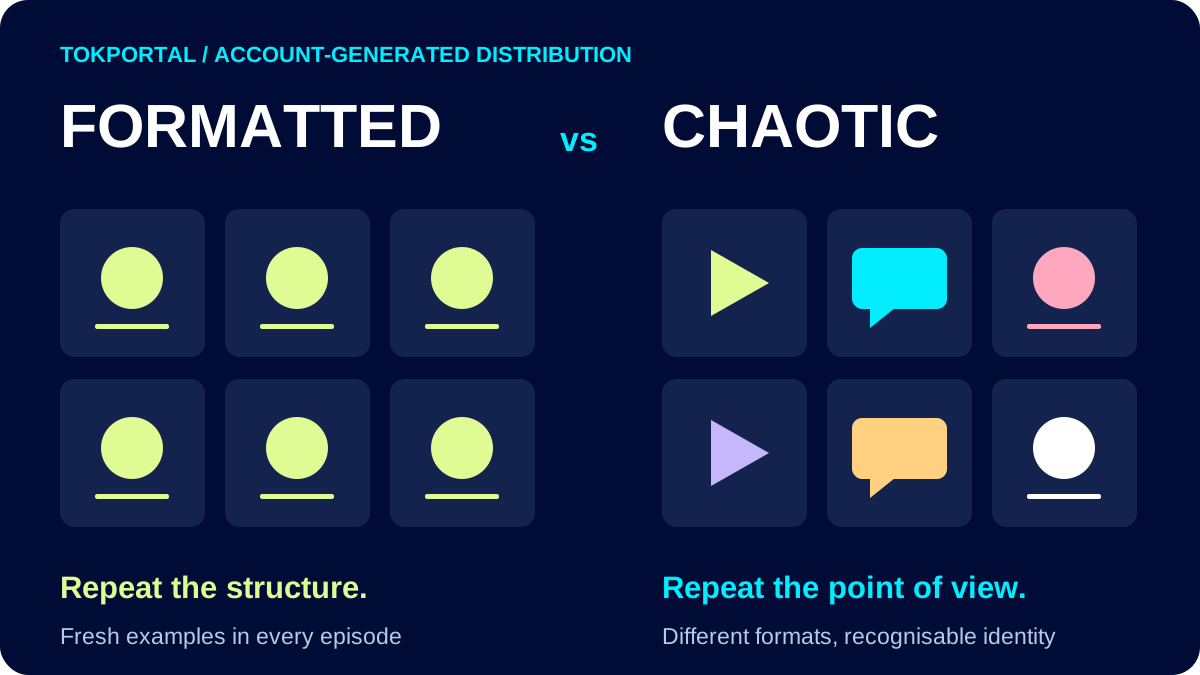
In Account-Generated Distribution (AGD), a formatted account repeats a recognizable kind of content. A chaotic account can move between memes, reactions, best-of clips, slideshows and videos. Both can have a clear identity. The difference is what provides the continuity: the format, or the account’s taste and personality.
A network does not need to pick one model for every account. A product can support a tightly structured explainer series alongside a much looser culture account. The decision is practical: what can your team keep making well, and why would a viewer want another post from this particular account?
Sources & real examples
Public accounts, original posts and primary references. Each example is linked where it is discussed.
- UltraSuperNew: Duo’s Sumo Showdown ↗
- Zaria Parvez: the work behind Duolingo’s voice ↗
- TikTok: recommendation signals ↗
View all 8 sources and review notes
- UltraSuperNew: Duo’s Sumo Showdown ↗
Original campaign imagery and agency explanation of the Japanese social-first work.
- Zaria Parvez: the work behind Duolingo’s voice ↗
A first-person perspective on experimentation and sustaining a distinctive social presence.
- TikTok: recommendation signals ↗
Context for measuring a feed. TikTok does not classify accounts as “formatted” or “chaotic”.
- Zach King: verified Shorts feed ↗
Profile and individual posts inspected; snapshots show continuity and exceptions.
- Zach King: Star Wars Lego Build Goes Wrong ↗
Original Short and a captured frame for close editorial analysis.
- Duolingo Japan: public TikTok feed ↗
A real mixed-format example; no claim of AGD adoption or customer affiliation.
- Duolingo Japan: original apology skit ↗
Concrete video to compare with the wider feed.
- A creator’s question about mixing niches ↗
Public discussion used to identify a real editorial decision, not an algorithm rule.
The two operating models
Feature
Formatted account
Chaotic account
What stays consistent
What can change
Production advantage
Common failure
Review question
These names are part of TokPortal’s AGD vocabulary. They describe how a team organizes editorial work, not account types recognized by TikTok or Instagram. Both models still require account isolation and genuinely distinct content.
Zach King: a recognizable promise across different scenes
Look at the actual Shorts feed. The props and situations vary: a Lego build, a bathtub adventure, a sports-related scene and behind-the-scenes material. Our editorial reading is that a recurring promise can survive substantial changes in subject and setting. The viewer can return for visual invention and surprise without needing every video to follow a literal template.
This also makes the account a useful counterexample to an overly rigid classification. A feed can have a recognizable center and still publish an exception. “Formatted” and “chaotic” are planning tools, not labels that should flatten an entire creator’s body of work. Review the recurring promise, the individual formats and the role of the exceptions separately.
In the Lego Short, the captured frame shows a model spacecraft airborne above the table while the people in the scene look toward it. The premise is legible visually: an ordinary object behaves in an extraordinary way. A brief inspired by that mechanism would specify the everyday setup, the impossible event and the visual payoff. It would still need an original scene and original production.
For AGD, the operational lesson is to write down what stays recognizable and what must be reinvented. “Make seven different videos” gives an editor no useful continuity. “Reuse this exact clip with seven captions” gives the audience no new execution. A stronger brief names the recurring experience, then demands new material for each episode. The stable element can be a question, a demonstration structure, a character relationship or a kind of reveal.
Use the feed review to estimate creative work honestly. A consistent promise does not mean cheap production. Props, performance, editing and the final payoff can all change. Before you add account capacity, ask the creative team to show the next three complete ideas, including what the audience receives at the end. A list of hooks is not the same thing as three finished concepts.
Formatted does not mean filling in the same template
Imagine a fictional budgeting app with an account called “One receipt, one lesson.” Each episode takes a different everyday purchase and explains one decision behind it. The opening image, pace and closing question can repeat. The receipt, calculation and useful observation must change.
One episode could compare the per-use cost of a purchase. Another could examine a subscription renewal the user forgot. A third could explain the tradeoff between buying one item now and waiting. These are different editorial objects held together by a recognisable structure. A series that swaps “coffee” for “lunch” in an otherwise identical script is much thinner.
Write a format recipe with four parts: what raw material you need, how the episode opens, what happens in the middle and what the viewer gets at the end. Then write down what makes an episode rejectable. “No real example,” “the same lesson as yesterday” and “a product feature with no viewing payoff” are more useful rejection reasons than “doesn’t feel viral.”
Chaotic does not mean posting the folder’s leftovers
Now give the same fictional app a second account: “The group chat after payday.” Its editorial promise is recognisable money situations, not financial advice. On Monday it might publish a meme. On Tuesday it might react to a relatable story. On Wednesday it might use a slideshow to build a joke. The continuity comes from the audience and sense of humour.
A chaotic account needs an editor who can say no. A clip can be popular and still belong to a different audience. A joke can mention money and still be wrong for the character. Give the editor examples of material the account would enthusiastically share, reluctantly tolerate and reject. Those distinctions help more than a long list of generic brand adjectives.
Keep the product connection occasional and natural. A budgeting app may appear when it solves the situation being discussed. It does not need to interrupt every joke. Required commercial disclosures still apply; an organic style is a creative choice, not a reason to hide a relationship.
Choose around what you can keep making
Try the distinction
Which account would you actually be able to sustain?
A formatted account fits when you can repeatedly find a fresh example and explain it well. Build the format around the work: a before, a diagnosis, a demonstration and a takeaway. Reusing the structure is useful; reusing the substance is the failure.
A chaotic account fits when the curator’s taste is the connection. The production team needs permission to reject material that technically fits the category but feels wrong for the account. A recognizable attitude keeps format variety from becoming random output.
Illustrative editorial scenarios, not measured campaign results.
Think about the actual handoff. A formatted account can often be briefed with a small set of examples and a checklist. A chaotic account usually needs more editorial judgment: the person approving the post must understand what belongs. If that judgment lives in one founder’s head, include their review time in the operating plan.
Duolingo Japan: different formats with a shared character
Now compare the visible Duolingo Japan feed. The owl appears across different kinds of execution. The apology skit gives you a concrete post to inspect: a person, the mascot and a language-related situation. Other visible thumbnails use dancing, graphics and different staging. The character supplies continuity while the format changes.
Our AGD interpretation is that a mixed-format account needs a clear editorial center. A mascot is one way to provide it. A consistent point of view, a recurring social situation or a distinctive curator can also do that work. Without such a center, “chaotic” becomes an excuse to publish whatever is available. With one, the editor has a reason to accept one idea and reject another.
The production implications differ from a recurring demonstration series. Someone must judge whether a trend fits the voice, whether the joke is understandable and whether the account has permission to use the material. A queue of available clips cannot make those judgments. Assign editorial responsibility along with publishing responsibility, especially when different people create and operate the accounts.
A mascot can hold different formats together
In UltraSuperNew’s Duolingo Japan case, Duo appears in sumo, food and language-related executions. The mascot links the variety. This is a useful way to inspect a chaotic model: ask what remains recognisable when the subject and format change. The case illustrates creative coherence; it does not establish that mixed formats outperform a series.
Zaria Parvez describes the experimentation and creative responsibility behind Duolingo’s social presence. A distinctive voice depends on editorial judgement. Copying a mascot’s behaviour without understanding your own audience is unlikely to give your account the same coherence.
A seven-post plan for each model
The following plans are original examples for the fictional budgeting app. They are planning material, not posts that have already generated results. Seven posts simply make the comparison concrete; use the amount of material you actually have.
Formatted account: “One receipt, one lesson.” Post one explains a forgotten renewal. Post two compares a frequently used purchase with a rarely used one. Post three unpacks an avoidable delivery fee. Post four follows a repair-versus-replace decision. Post five explains the difference between an introductory price and the later charge. Post six shows a shared bill calculation. Post seven reviews a purchase that was worth its cost. Every episode starts from a different situation and ends with a specific observation.
Chaotic account: “The group chat after payday.” Post one is a meme about feeling rich for an hour. Post two is a reaction to a friend organising another expensive weekend. Post three is a slideshow about a forgotten subscription. Post four is a short sketch about splitting a bill. Post five is a comment reply asking the audience for its most ridiculous purchase. Post six is an original best-of compilation of those permitted submissions. Post seven shows a product feature resolving one of the situations discussed that week.
The account roles overlap around money, but the reasons to follow are different. The formatted account promises a useful recurring breakdown. The chaotic account promises recognition, humour and conversation. Do not copy the same export between them just because one topic appears in both plans.
How to brief the people who make the posts
For the formatted account, hand over a sample episode, a blank structure, the source material for the next episode and a checklist of the facts that need verification. Most of the production decisions should be visible in the example. Ask the next editor to make one complete episode before giving them a large batch.
For the chaotic account, hand over a point of view and a set of decisions. Include three accepted ideas with the reason each belongs, and three rejected ideas with the reason each fails. Specify who can approve a fast response and who checks product claims or permissions. A trend can stop being relevant while a post sits in an unnecessarily complicated approval chain.
For either model, separate creative approval from publication logistics. A local operator should receive the final asset, account, caption and scheduling instruction. In TokPortal, those account operations can be coordinated through the dashboard, API or MCP. The publishing workflow should carry the editorial decision accurately, not improvise it at the last moment.
Try a seven-post brief before multiplying accounts
Seven-post editorial test
ACCOUNT PROMISE
People follow because:
Audience:
Tone in three words:

SEVEN DISTINCT IDEAS
For each: topic / format / new example / viewer payoff
1.
2.
3.
4.
5.
6.
7.

REVIEW
Which idea exists only to fill a slot?
Which two are essentially the same post?
Does changing the format improve the idea or merely add work?
What must an editor know to approve the next seven?
Seven is a short planning exercise, not a required posting schedule or a statistically meaningful test size. If you can only produce three worthwhile ideas, publish those and improve the brief. The exercise exposes whether the production method has enough substance to support the account.
Should I stick to one niche or post different types of content?
A creator asks this exact practical question in a public TikTok discussion: keep one kind of content on the account or try another elsewhere? The question is useful evidence of what people need help deciding. The replies are personal advice, not documentation of TikTok’s ranking system.
Separate three choices before answering. The niche is the subject or audience problem. The format is the way you deliver a post. The account promise is the reason someone returns. You can vary the format while serving the same audience, or repeat a format across unrelated subjects. Those are different changes. AGD gives the team a vocabulary for assigning each experiment to an account with a clear purpose.
Use the real feeds above as a review exercise. Identify what remains recognizable when the execution changes. Then do the same with your proposed seven posts. If you need a long explanation to connect them, either sharpen the account promise or move the outlier to a better-suited account. Do not blame an invisible algorithm rule for a brief that the creative team itself cannot explain.
Use both models in one AGD network
Start with the distinct jobs the network needs. A recurring demonstration account can answer product questions. A culture account can make the audience recognise itself. A diary can create continuity over time. These are editorial choices, not three guaranteed stages in a conversion funnel.
Adding an account creates another ongoing obligation to make worthwhile material. Before expanding, check whether the existing account has a supply problem, a weak promise or simply an unclear approval process. A new username does not fix any of those. The distribution planner lets you compare your actual original content supply with available account slots.
If a recurring series keeps producing stronger ideas, allocate more creative effort to it. If a chaotic account depends on one editor’s taste, make that judgement teachable through recorded examples. The objective is a network you can operate with intent, not an arbitrary ratio of formatted and chaotic accounts.
Keep format experiments separate from performance claims
When you compare results, record the format, idea, account, posting time and elapsed observation window. A meme and a product walkthrough may do different jobs. Views alone can make a useful tutorial look weak beside a broad joke, even if the tutorial sends better-qualified visitors onward.
Use the isolation worksheet to define account roles before adding more capacity. AGD can combine formatted and chaotic accounts in one network. The point is to make their editorial jobs clear enough to operate and improve.
Review the feed, not just the biggest post
Look at several complete posts together. Does a new viewer understand what the account is for? Is there a reason to return after the joke or demonstration ends? Do the account’s bio and recent publications make the same promise?
TikTok’s recommendation documentation describes personalized ranking, not a rule that favours one of these editorial models. Compare posts with similar jobs and observation windows. A broad joke and a detailed product explanation can produce very different views, visits and questions; collapsing them into one score hides the decision you need to make.
Keep the winning structure when it helps. Change the substance when it becomes repetitive. And when a post works, use the AGD viral-hit review to turn the observation into a new original execution rather than a feed full of copies.

Written by
Vincent Tellenne
Co-founder & CEO
Vincent is a co-founder and CEO of TokPortal. He works on the infrastructure and operating model behind scaled organic social media distribution.
Learn more about this topic with AI
Related Resources
Related Tools
Put your AGD strategy to work
You make the content.
TokPortal runs the account operations.
Create and operate TikTok and Instagram accounts in your target market. Local operators handle the account work and native publishing. You control the brief, content and campaign from the dashboard, API or MCP.
- 01Choose your market
- 02Define each account
- 03Schedule your content
Review market availability and pricing before ordering. No reach forecast is built into your plan.