


Sign in with Google
If you’re posting consistently, your creative is strong, and you still can’t crack the U.S. For You Page, you’re usually not dealing with a “content problem”. You’re dealing with a distribution problem.
TikTok’s recommendation system is heavily localized at the start of distribution. In plain terms: if TikTok thinks your account is “based” in Country X, your first test impressions tend to go to Country X (and nearby lookalike audiences). If that first test does not happen in the U.S., you rarely get the U.S. signal momentum you need.
This is why many brands, agencies, and creators feel like they’re shouting into the void when trying to grow in the U.S. from abroad.
Below is the practical breakdown of what’s happening, how to diagnose the root cause fast, and the fixes that actually work in 2026.
TikTok does not decide distribution based on one thing. It stacks signals. But for cross-border growth, three buckets matter most.
Before your hook, editing, or “viral format” even matters, TikTok tries to answer: Where is this account truly coming from?
Common geo signals include:
If these signals point outside the U.S., TikTok will often test your content outside the U.S. first. That’s the invisible ceiling.
Even with a U.S.-eligible account, your video can still read as “non-U.S.” if:
This doesn’t mean you must fake being American. It means your creative needs to be legible and native to the audience you want.
TikTok learns from who watches, rewatches, shares, comments, and follows early.
If your early engagement comes from your current country (because that’s where your followers are), TikTok often reinforces that distribution pattern.
For B2B marketers: think of it like cold start data. If your initial training set is wrong, the model keeps optimizing for the wrong outcome.

You don’t need a full audit to identify the issue. Run this quick check on your last 10 to 20 posts.
If the U.S. is consistently absent (or <1 to 2%) even when the topic is U.S.-relevant, that’s usually a geo-distribution constraint.
If the U.S. appears sometimes but never scales beyond a small percent, your account may be eligible but your creative and early engagement are not pulling.
A single “global” account is the most common structural mistake.
It creates a loop:
For U.S. growth, the cleanest pattern is usually a U.S.-native account that earns U.S.-based engagement over time.
VPNs do not just “change location”. They create inconsistent signals. TikTok is good at detecting that mismatch.
Even when an account is not outright banned, the more common failure mode is suppressed distribution (what people casually call a shadowban).
Open TikTok in the U.S. niche you want (use TikTok Creative Center for trend research) and compare:
If your content feels like it was made for another market, TikTok will often treat it that way.
There are three broad strategies. Which one you choose depends on whether you’re a founder posting 5 videos a week, or an agency shipping 200.
If the goal is real organic U.S. distribution, the most reliable approach is:
This is exactly where most teams get stuck because DIY account creation at scale becomes painful:
TokPortal’s core value here is not “a hack to reach the U.S.” It’s infrastructure.
With TokPortal you can provision geo-verified accounts (including the USA) with real in-country device context, then manage posting through a unified workflow (scheduling across time zones, bulk upload, analytics, and optimization). If you want the fast path, start with the TokPortal Quick Guide.
New accounts that immediately blast 3 salesy videos and then disappear rarely get consistent U.S. distribution.
What works better:
TokPortal includes niche warming designed for this exact issue (a short, structured on-ramp so the account earns cleaner initial placement).
If you’re running user generated content marketing at scale, warming matters even more because UGC looks “native” only if the account context is native too.
Most brands over-localize by rewriting the entire script for every market. That is slow and expensive.
A faster method is to keep the core story and localize the surface layer:
TikTok search has become a real discovery channel, and “search-first captions” are one of the easiest levers to pull for U.S. reach.
Posting time is a multiplier, not a foundation.
If your account is not U.S.-native, scheduling to Eastern Time often just helps you reach more people in your own region who happen to be awake.
Once your setup is correct, time zones matter. In many categories, U.S. windows that often perform are:
If you’re managing multiple accounts, doing this manually is where teams burn out. Scheduling with time zone support becomes table stakes.
Even with the right account, you still need early engagement from the right audience.
Practical ways to get it without spamming:
This is where many teams benefit from training their creators and community managers to handle objections and comment pressure in a way that boosts watch time and conversation.
If you’re building a repeatable workflow for replies, creator coaching, or community handling, an option is to use an AI roleplay training tool like Scenario IQ for sales and service roleplay training to practice responses, objection handling, and high-signal conversation patterns that improve conversion without sounding scripted.
The “fix” depends on your operating model.
Your goal is not 12 accounts. Your goal is one U.S. account that compounds.
If you want to build this with less ops overhead, TokPortal is the clean way to avoid the usual geo friction. Start on the homepage and follow the Quick Guide.
Your problem is operational: too many accounts, too many markets, too many stakeholders.
A scalable U.S. reach system looks like:
This is where TokPortal is positioned as an operating system: account creation, scheduling, analytics, warming, and API access for automation.
If you’re pricing campaigns, you can review TokPortal pricing to understand how teams structure multi-account operations.
If you’re trying to acquire U.S. users organically, you want a repeatable loop:
Do not start by translating your entire brand. Start by shipping U.S.-native versions of your top 5 creatives and iterate weekly.
Hashtags help categorization, but they do not override geo signals. Adding #usa to a non-U.S. account rarely changes distribution in a meaningful way.
It pollutes your audience graph. You might see vanity metrics, but you weaken the learning signal TikTok needs to find real U.S. viewers.
Even if it “works” for a week, it is brittle. In cross-border growth, brittle setups eventually break at the worst time (when a post starts taking off).
Beyond reach, it creates security and workflow risk (team access, handoffs, publishing errors). Separate accounts with centralized management is the mature setup.
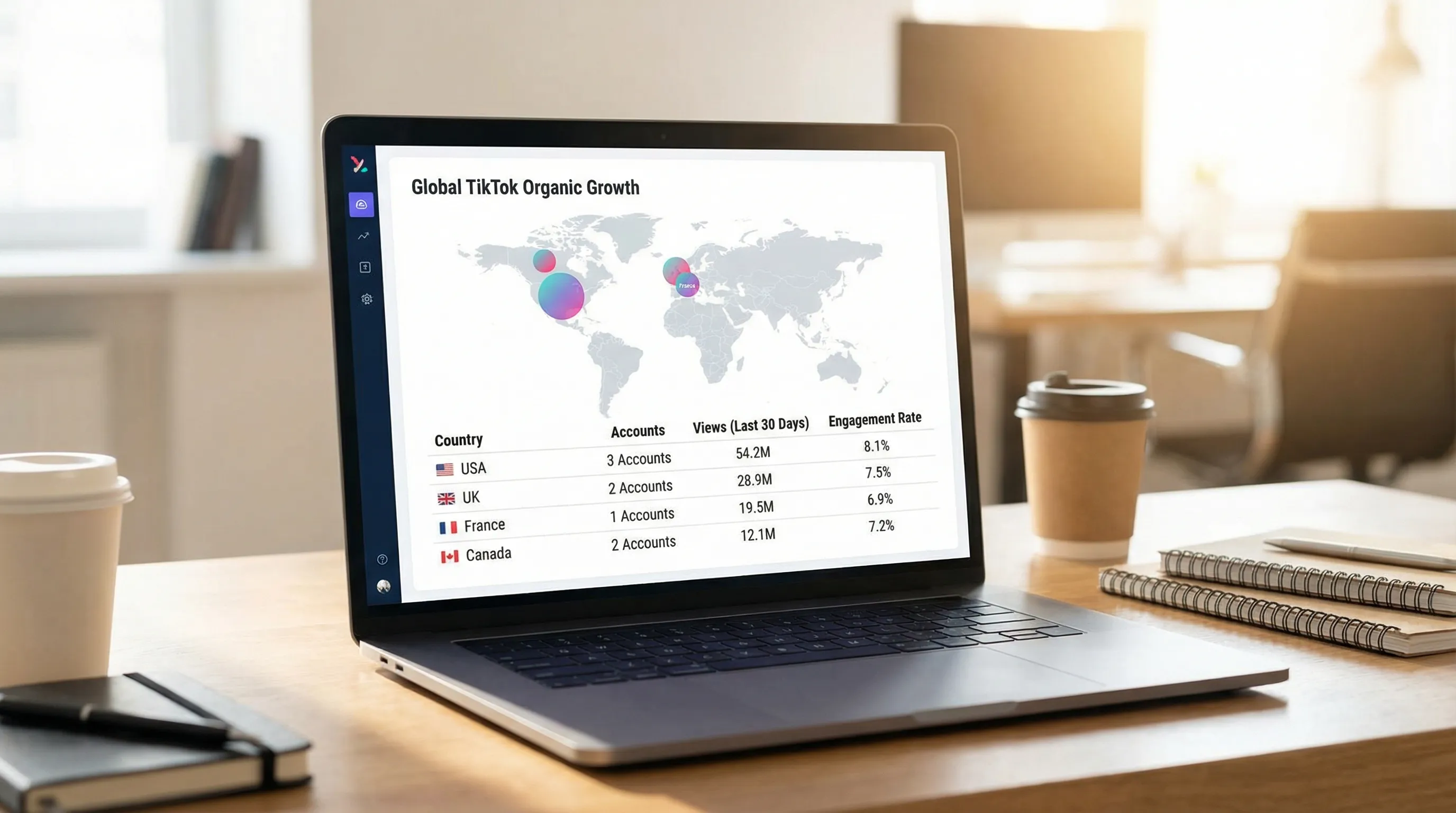
If you want something you can execute this week:
If you want to do this without trial-and-error, create your U.S. account and workflow through TokPortal, then centralize publishing from day one.
The teams that win in the U.S. on TikTok do not “post and hope”. They treat it like entering a new market:
TokPortal exists for exactly this, not just to create accounts in other countries, but to run organic TikTok and Instagram at scale from one system.


 Any question? Contact us.



%401x.svg)