


Sign in with Google
Most “best time to post on TikTok” advice assumes you have one audience in one country.
If you are a brand, agency, app founder, or label trying to grow across multiple markets, the real question is different:
What’s the TikTok time to post for each target country, in that country’s time zone, from an account the algorithm recognizes as local?
Because TikTok’s early distribution is heavily geo-driven, posting at the “right time” for the US does not help much if your account and device signals place you elsewhere. In practice, many teams see their reach plateau for a simple reason: they publish global content with local timing, but not with local distribution.
This guide gives you a time zone plan you can run every week, including a testing sprint and an operating model that scales.
TikTok is not purely chronological, but timing still affects performance because of how videos “launch.” In the first hour or so, TikTok typically tests a post with an initial audience slice and looks for early signals like:
When you publish while your target audience is asleep, you reduce the odds of fast engagement. That slows down the velocity TikTok uses to decide whether to expand distribution.
That said, timing won’t rescue weak creative. Treat posting windows like a multiplier, not the core strategy.
Two data points that matter for planning:
Before you build a schedule, confirm you are not solving the wrong problem.
If you are trying to reach US audiences from a non-US account setup, your content may be tested primarily in your home region first. Even if you post at 8 pm Eastern, TikTok may still show it to a local test bubble.
That is why “TikTok time to post” is inseparable from localization. You need:
If you are scaling beyond one market, this becomes operational. TokPortal exists for this exact workflow: create geo-verified TikTok (and Instagram) accounts in multiple countries, then manage scheduling, posting, and analytics from one dashboard. You can start with the Quick Guide to see what a multi-country setup looks like.
The strongest schedules map to predictable behavior blocks. Across most markets, TikTok usage clusters into a few repeatable windows:
Instead of chasing a single “best time,” plan 2 to 3 posting windows per day per market, then let performance data pick winners.
Use these as starting points for tests, not permanent rules.
United States and Canada (local time per account, usually ET and/or PT)
UK and Western Europe (local time per account: UK, France, Germany, Spain, Italy)
Japan and Australia (local time per account)
A few notes for advanced teams:
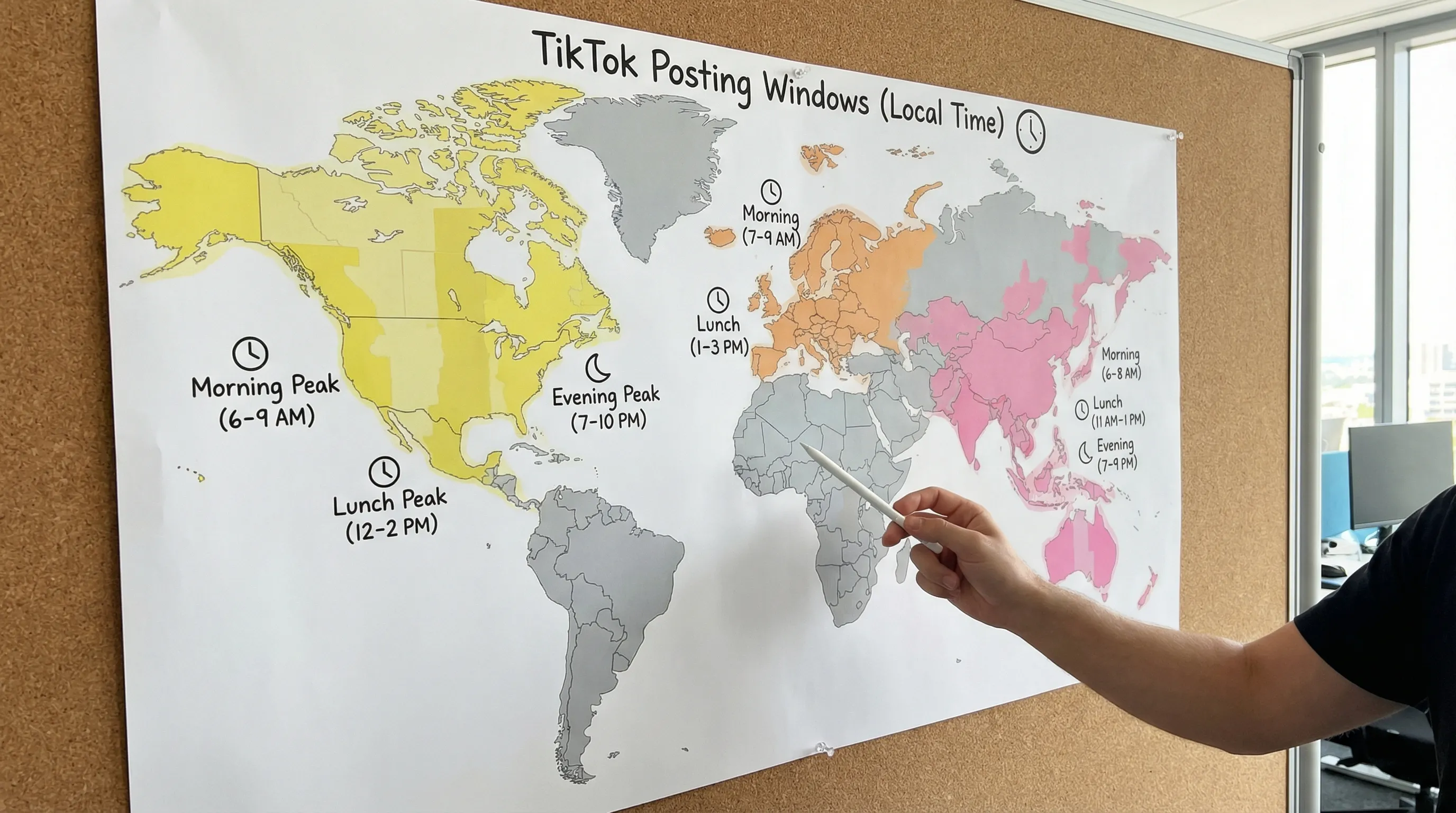
If you post in three countries, you can “eyeball” it.
If you post in eight countries with 5 to 10 accounts, you need a plan that prevents two common failures:
A practical planning model is:
Pick two windows you will hit consistently for two weeks:
Then add a “flex slot” only when you have extra volume or a fast-moving trend.
This approach makes it much easier to keep quality high while still collecting enough data to learn.
Not all content behaves the same. Timing sensitivity varies:
This is also where TikTok’s evolution into a search platform matters. TikTok search has been reported as growing rapidly year over year, and many teams now plan for both “launch velocity” (timing) and “evergreen discovery” (keywords, on-screen text, captions).
You do not need a 90-day analytics project to find your best TikTok time to post. You need a controlled sprint.
Here is a simple format that works for most growth teams.
For each market/account, test two variables only:
Keep everything else stable:
If you change format every day, you learn nothing about timing.
Do not optimize on views alone. Track:
Then pick one “north star” per account (for many DTC brands it’s profile visits per 1,000 views, for SaaS it’s link clicks or sign-ups, for labels it might be saves and sound usage).
A timing window “wins” if:
If both windows tie, choose the one your team can execute consistently. Operational consistency beats theoretical optimization.
If you target the US, Canada, the UK, and Europe, DST will quietly break your schedule twice a year.
Your posting plan should explicitly define:
This matters because a one-hour drift can move you from “after work peak” to “commute,” which changes the audience mood and engagement behavior.
TokPortal’s scheduling is designed for multi-time-zone operations, so you can plan by market and avoid the constant manual conversions that happen when you run everything from spreadsheets.
If your goal is global reach (not just market-by-market testing), you can publish in a rolling pattern that creates momentum across regions.
A practical cadence many agencies use:
This is not about one post going global. It is about building multiple local engines that each hit peak attention in their own time zone.
This strategy also reduces creative fatigue: you can repurpose a core concept while adjusting the first 2 seconds, on-screen text, and CTA for each market.
For brands that want to operationalize this at scale (especially when multiple departments touch content, approvals, and reporting), it can help to invest in workflow automation and systems integration so your content pipeline does not collapse under volume. Some mid-market teams work with partners focused on this kind of operational layer, for example AI automation and system integration services that reduce manual reporting and coordination overhead.
Most teams do not fail because they chose 7:00 pm instead of 8:00 pm. They fail because of structural issues.
If the account is not natively associated with the target country, timing tweaks won’t fix distribution. Solve geo first, then optimize timing.
If you post twice one week and eight times the next, you cannot compare windows. Plan a minimum cadence you can sustain.
When you test five windows, you spread your sample size thin and end up with noisy conclusions. Start with two.
In the US, East Coast and West Coast behave differently. If you sell nationally, you may want separate accounts or at least separate posting windows per coast.
TikTok rewards retention. If your evening posts get more raw views but weaker completion, your growth may stall over time.
Use this as an operating rhythm.
Define for each country:
Batching reduces the chance you miss windows because you are still editing.
The first hour is where timing matters most. Build a lightweight routine:
Weekends often favor:
If you only have capacity for one daily post, weekends are usually best placed in late morning or early evening.
A time zone plan only works if you can execute it across multiple accounts without burning your team.
TokPortal is built for the exact constraints that appear once you go global:
If you want to see how teams structure this end-to-end, start at the TokPortal homepage and then review the pricing based on how many markets you plan to operate.
When you are ready to run your first multi-market schedule, create your workspace here: Sign up.
The “TikTok time to post” is not one magic hour. It is a repeatable system:
Do that, and timing stops being a superstition and becomes a lever you can reliably pull.


 Any question? Contact us.



%401x.svg)