


Sign in with Google
Voice cloning has leapt from sci-fi to smartphone in just a few years. With a 30-second voice sample and the right AI, creators can now generate studio-quality audio in any language that sounds uncannily like their own voice—or someone else’s. For TikTok localization, that super-power is game-changing: no more subtitles that get ignored, no more mismatched stock voices. Yet with great synthetic vocals comes great responsibility. Missteps can spark copyright strikes, community backlash, or even legal fines.
Below is a practical playbook that balances impact and integrity: what voice cloning actually is, where the ethical red lines lie, and the best tools and workflows to produce multilingual TikToks that respect audiences and the law.
Voice cloning (sometimes called neural voice synthesis) uses deep-learning models to replicate the acoustic fingerprint of a human speaker. Modern systems capture timbre, cadence, prosody, and micro-pauses, then let you generate arbitrary text—often in dozens of languages—while preserving the source voice’s identity.
How it works, simplified:
- Collect a clean voice sample (as short as 30–60 seconds for top-tier models).
- Fine-tune a pretrained speech synthesis model on that sample.
- Input a text prompt in the target language. The model converts it to phonemes and predicts waveforms that match the original speaker’s vocal profile.
- Optional: Run a dubbing or alignment step to sync the synthetic audio with your original lip movements.
The result: a believable foreign-language track that still “sounds like you.”
1. Authenticity at scale – Fans hear your voice, not a generic narrator.
2. Higher watch time – Viewers stay engaged when the audio matches on-screen lip cues.
3. Algorithmic lift – TikTok favors local-language content; cloned voice tracks unlock that reach without filming fresh takes.
4. Cost savings – One shoot day can yield assets for 10+ markets instead of reshoots with native speakers.
Before opening the cloning app, lock in an ethics checklist. Generative voice tech is under increasing scrutiny (see the 2024 EU AI Act and multiple U.S. state “voice likeness” bills). These five pillars keep you—and your brand—on the safe side:
1. Consent
- Record and store explicit, written consent from any person whose voice will be cloned—even employees or freelancers. Minors require guardian approval.
- Consent must cover specific use cases (e.g., "organic social media posts in Spanish and French") and duration.
2. Disclosure
- Tell audiences when synthetic voice is used. A simple caption—"Voice generated via AI"—is becoming the norm and pre-empts accusations of deepfake deception.
- Branded content regulations in the EU and several Asian jurisdictions now mandate such disclosures.
3. Copyright & Licensing
- You can’t clone a celebrity or movie character without negotiating publicity or likeness rights. "Fair use" rarely applies to commercial TikToks.
- Music rights still matter: if you reproduce sung lyrics with a cloned voice, you need the same composition/master licenses as any cover song.
4. Cultural & Context Sensitivity
- Avoid literal translations that create awkward or offensive phrasing. Always have a native reviewer check scripts.
- Be mindful of dialects and regional accents; a Mexico-city Spanish track may sound off in Argentina.
5. Data Security & Privacy
- Store voice samples and model checkpoints in secure, access-controlled systems.
- Align with GDPR or local privacy laws on biometric data retention. Many countries treat voiceprints as personally identifiable information (PII).
Ignoring any of the above can lead to takedowns, lawsuits, or reputational damage that dwarfs the localization benefits.

- EU AI Act (effective 2026): Synthetic content must be clearly labeled; biometric data usage requires user consent and strict security measures.
- U.S. State Laws: Tennessee’s ELVIS Act (2025) and pending bills in California and New York prohibit unauthorized commercial voice likeness usage and enable civil damages.
- China’s Deep Synthesis Regulation (2024): Platforms must add watermarks to AI-generated voice and face content.
- Brazil’s LGPD Amendment (proposed): May classify voiceprints as sensitive personal data, triggering stricter consent rules.
Stay updated; legislation is evolving almost monthly.
Below are five widely used products in 2025 that balance quality, language coverage, and compliance features. Prices evolve, so double-check current tiers.
1. ElevenLabs Multilingual
- 29 languages and counting, emotion sliders, 30-second cloning, GDPR-compliant EU servers.
- Strength: Seamless prosody transfer between languages.
- Watch-out: Entry plan watermarks synthetic audio unless you credit the platform.
2. OpenAI Voice Engine (private beta)
- Same Whisper-backbone alignment used in ChatGPT voice.
- Strength: Ultra-fast inference and automatic lip-sync timing.
- Watch-out: Strict regulatory usage gates; requires application approval.
3. Resemble AI
- Real-time voice conversion plug-in, CSV bulk generation for scripts, SOC 2 Type II compliance.
- Strength: API for automating hundreds of local language variants.
- Watch-out: Emotion control less granular than ElevenLabs.
4. Rask AI “Clone & Dub” Suite
- Simple UI aimed at short-form creators; auto-generates aligned captions.
- Strength: One-click export to CapCut and TikTok Creative Center.
- Watch-out: Max video length 15 minutes; heavy server load at peak.
5. Papercup Studio
- Human-in-the-loop quality check; great for brand safety and legal sign-off.
- Strength: Best for enterprise compliance needs.
- Watch-out: Turnaround time (24–48 hrs) slows agile TikTok schedules.
Use the framework below to integrate voice cloning into a TikTok localization pipeline that scales while staying compliant.
1. Script & Shoot in Source Language
- Film high-energy takes; leave short pauses between sentences—they help later alignment.
2. Collect Clean Voice Reference
- Record a 60-second noise-free sample reading diverse phonemes. Save raw WAV.
- Store in your encrypted cloud drive assigned to "biometric assets."✅
3. Clone & Generate Multilingual Tracks
- Upload sample to your chosen platform.
- Batch-input translated scripts. Enable emotion consistency or adjust to local tone (e.g., more formal in Japan).
4. Quality & Compliance Review
- Native-speaker QA listens for mistranslations, accent mishaps, or cultural faux pas.
- Add "AI voice generated" disclosure to captions or on-screen text.
5. Edit & Lip-Sync
- Drag the output into CapCut or Premiere. Use auto-sync or manual nudge until mouth movements match within ~3 frames.
6. Multi-Market Publishing with TokPortal
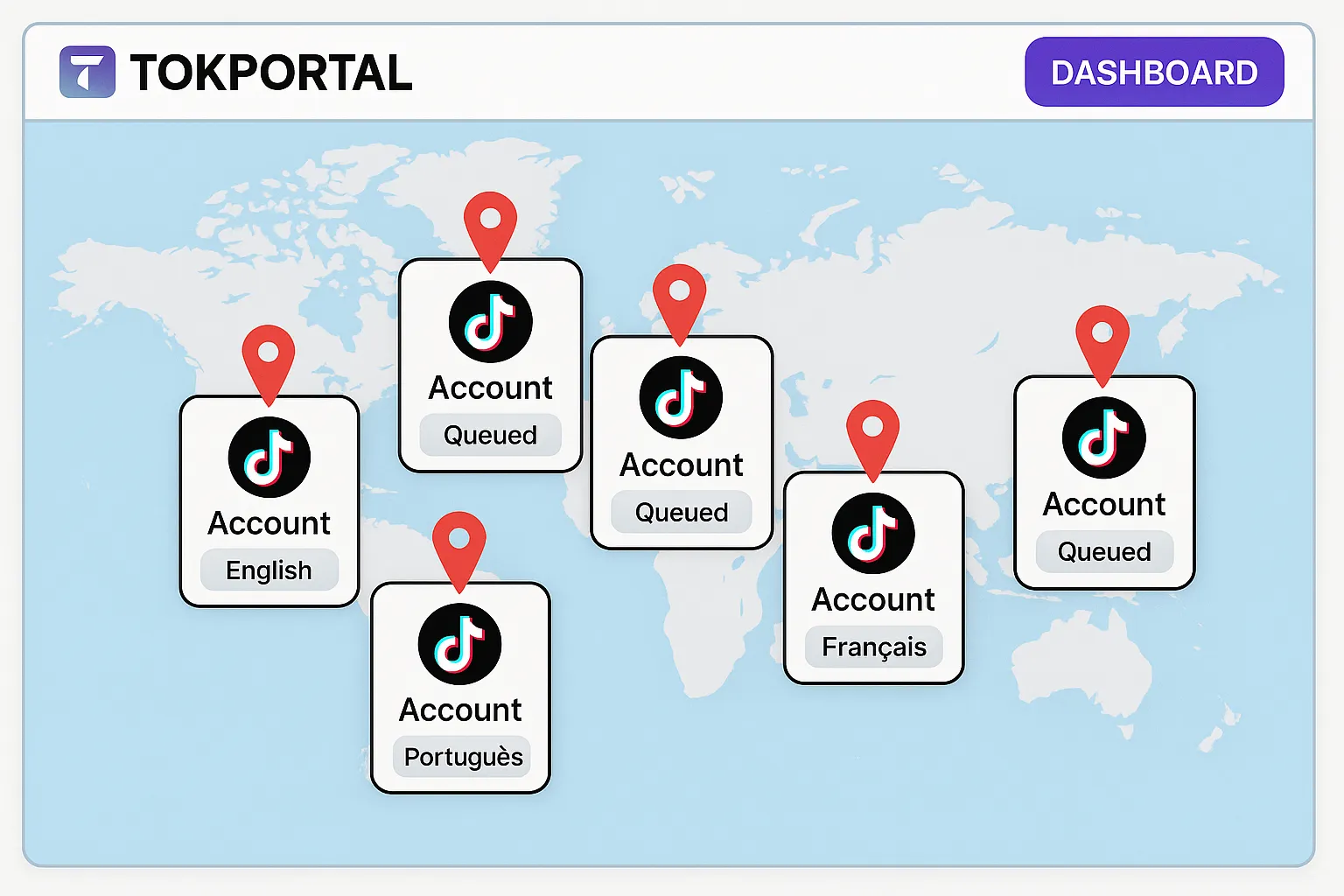
- Upload each localized file to the corresponding in-country TikTok account inside the TokPortal dashboard.
- Schedule for local peak hours, attach market-specific hashtags, and monitor analytics centrally.
7. Archive & Audit Trail
- Keep a compliance log including: consent forms, tool used, script versions, reviewer names, and publication dates.
- TokPortal’s file-attachment feature lets you store those docs alongside each scheduled post for easy audits.
- Accidental Deepfakes: Never clone an influencer without contract language that explicitly covers AI voice rights. If a brand pays a creator for one video, that doesn’t automatically grant clone rights.
- “One-Size” Translations: Humor, idioms, and call-to-actions rarely translate one-to-one. Tailor each script beyond literal translation.
- Lip-Sync Drift: Even 100 ms of delay looks uncanny. Always spot-check at 200 % playback speed before exporting.
- Caption Clash: When you add on-screen text in the original language but audio is localized, viewers get confused. Localize visual text as well or remove it.
- Tool Watermarks: Some freemium tiers embed audible watermarks. These can tank your completion rate; pay for the pro plan if necessary.
- Goal: Expand from Germany-only to six EU markets in Q2 2025.
- Tactic: Filmed 15 core workout tips, cloned her voice into French, Spanish, Italian, Dutch, Polish, and English using ElevenLabs & TokPortal distribution.
- Result: +3.1 million incremental non-German views, 27 % average watch-through rate, €0.003 cost-per-view (fully loaded), zero takedown notices.
- Key takeaway: Transparent “Voice generated in partnership with AI” caption increased comment sentiment—fans viewed it as tech-savvy rather than deceptive.
Does TikTok’s algorithm penalize AI-generated voices? No evidence so far. Performance hinges on engagement metrics (watch time, rewatches). Always disclose to avoid policy violations.
How much reference audio do I need? Modern models can work with 30–60 seconds, but 5–10 minutes yields better emotional range.
What if my voice sounds “robotic” in another language? Tweak phoneme temperature or pitch controls, or provide longer training data. Native proof-listening catches most oddities.
Can TokPortal handle bulk uploads of cloned-voice videos? Yes. Drag-and-drop multiple language variants, assign each to its local account, schedule by time zone, and track analytics in one dashboard.
Voice cloning lets you speak to fans everywhere without losing authenticity, but distribution still makes or breaks results. TokPortal gives you real, SIM-verified local TikTok accounts, secure management, and a scheduler built for multi-language rollouts—no VPN hackery, no shadow bans.
Create your first localized account today and see how seamless multilingual TikTok marketing can be. Visit TokPortal and request a free demo.

 Any question? Contact us.



%401x.svg)