


Sign in with Google
People try a TikTok VPN for the same reason they try any shortcut: they want U.S., U.K., or EU reach without rebuilding their whole setup.
And the internet is full of confident advice that sounds logical:
In practice, this is one of the most expensive “cheap” growth tactics on TikTok.
Not because a VPN company is literally stealing from you, but because the promise is structurally misleading: TikTok does not determine location (or trust) from IP alone. When you spoof one signal and everything else stays foreign, your account often gets suppressed. No ban message. Just flatlined distribution.
This article explains why.
A VPN changes one thing: where your traffic appears to come from.
TikTok’s recommendation and integrity systems are built for a much harder problem: figuring out where a real person is, and whether an account behaves like a real local user.
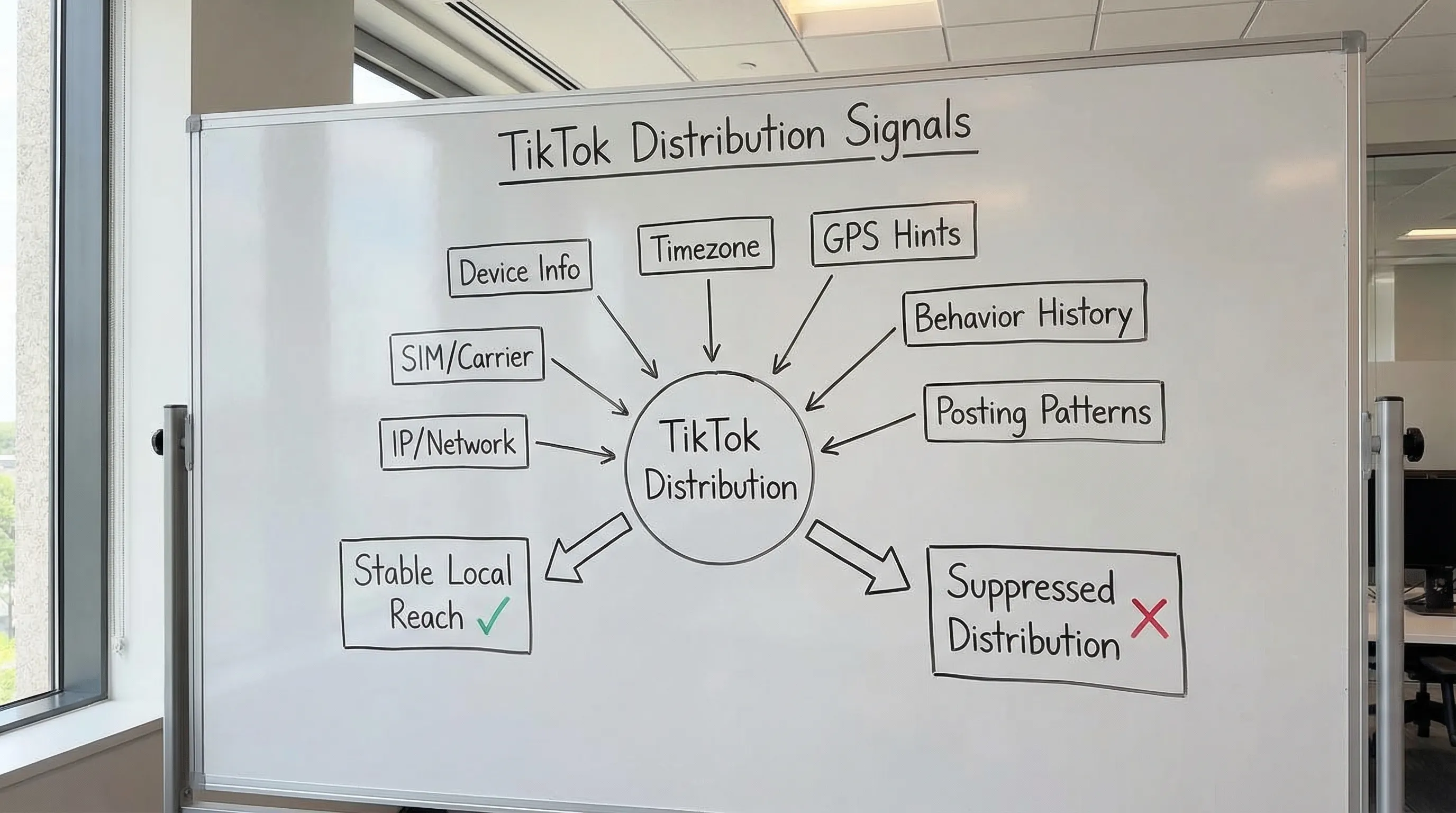
So TikTok evaluates many signals at once, then looks for consistency.
If you’re physically in Belgium and you flip your IP to Los Angeles, that is not “clever targeting” to TikTok. It is a mismatch.
This is also why VPN-based tactics may look like they work for a few days, then collapse right when you start posting daily, scaling accounts, or repeating the same pattern.
TikTok publicly discloses that it collects technical and network identifiers and may infer location from device and network data in its privacy documentation. You can review the details in TikTok’s Privacy Policy.
From a growth operator’s point of view, the key takeaway is that TikTok can triangulate geo and authenticity from many layers, including:
A VPN only changes the IP layer. Everything else keeps telling TikTok, “this account is not actually local.”
That inconsistency is exactly what triggers the most common failure mode:
Distribution suppression (what creators call a shadowban).
TikTok heavily weights device-level trust because it is harder to fake at scale.
Here’s the classic scenario:
Even if your IP says “New York,” your device and behavioral history look European.
TikTok doesn’t need to “catch you using a VPN” to reduce reach. It just needs to decide: “I’m not confident what audience this belongs to, and I’m not confident this is a stable, authentic user.”
When that confidence drops, TikTok protects the For You feed by limiting distribution.
Many teams graduate from VPNs to “higher quality” proxy setups:
These can reduce obvious datacenter flags, but they still don’t solve the core issue:
So you end up paying more for a slightly different version of the same inconsistency.
When TikTok is confident about an account, it can test content in a relevant initial audience bubble and expand if signals are strong.
When TikTok is not confident about geo and trust, you often see:
This feels random, but it usually isn’t. It is the platform running tighter integrity checks and smaller test distributions because the account’s context looks unstable.
A common assumption is:
“I used a VPN, got shadowbanned, I’ll stop, and everything will go back to normal.”
In reality, platforms maintain internal trust scoring (account-level and device-level). If an account repeatedly shows location inconsistencies or suspicious access patterns, you can lower its baseline trust.
That’s why you’ll see reports like:
From TikTok’s perspective, the account already demonstrated unstable signals. Even if you behave perfectly afterward, the system may keep you in a more conservative distribution bucket.
If you want to browse trends in another country, using a VPN is often less risky.
Posting is where the risk spikes.
Uploading content triggers additional systems:
In other words, TikTok can tolerate some ambiguity for a viewer session, but it becomes much stricter when an account publishes content into the ecosystem.
If TikTok cannot confidently determine where the account belongs, it limits distribution to protect feed quality.
You will always find creators claiming success with a TikTok VPN.
That can happen in the short term, especially when:
But it rarely scales.
As soon as you:
TikTok has more data to evaluate consistency. And the mismatch becomes easier to detect.
This is why VPN-based strategies often fail at the exact moment teams try to get serious.
TikTok doesn’t give a dashboard that says “we suppressed you due to conflicting location signals.” So you diagnose it indirectly.
Look for patterns like:
Important: creative can also be the problem. But when suppression correlates strongly with VPN/proxy behavior, the geo mismatch is usually the root cause.
There is no guaranteed “unshadowban button,” but you can stop making the signals worse.
Pick one stable setup and keep it stable:
Frequent switching (IP hopping, device swapping, bouncing between proxies) looks worse than a single consistent profile.
If you want to research U.S. trends, do it on a separate device or account, and don’t mix that with the account you publish from.
If your business depends on reaching a foreign market organically, the “repair” path is often slower than the “correct rebuild” path.
That means: new account, real local signals, stable usage.
It sounds annoying, but it is exactly what TikTok’s systems are optimized to reward.
If you want stable U.S. reach, the best practice is not “more advanced spoofing.”
It’s alignment.
A native, local setup typically includes:
This gives TikTok maximum confidence about:
The outcome is what growth teams actually want:
Yes, real local setups introduce constraints:
But that constraint exists because TikTok is explicitly designed to reward authenticity and consistency.
So teams must choose:
Most “mysterious shadowban” stories are just the first choice colliding with how TikTok actually works.
If you are a solo creator, you can sometimes get away with messy ops for longer.
If you’re an agency, a UGC studio, a DTC brand, a game studio, or a SaaS growth team, VPN tactics break faster because you need:
That is exactly where VPN workflows become a trap: they might get you a few “proof” posts, then punish you when you operationalize.
If your goal is “post TikToks anywhere and reach real local audiences,” you need two things:
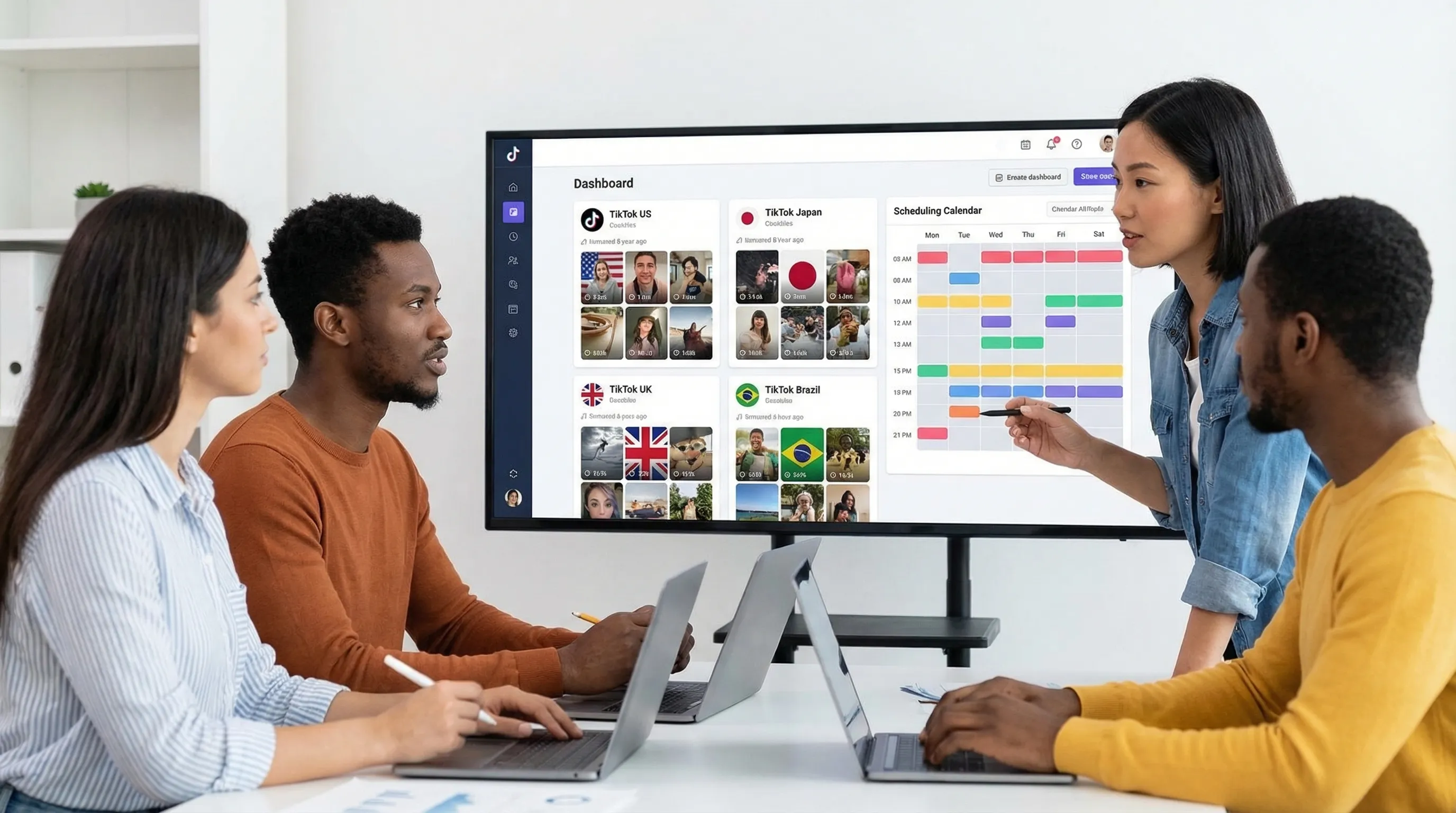
TokPortal is built for that second reality, not the shortcut narrative.
TokPortal provides:
If you want to understand the platform first, start at the TokPortal homepage and the Quick Guide.
If you’re already planning a multi-country rollout and need to model cost and scale, check Pricing.
Ask one question:
Do you need predictable reach in a specific country, repeatedly, at scale?
TikTok growth across borders is not won by “best spoofing.” It is won by consistent local signals plus consistent publishing operations.
If you want more frameworks on scaling organic short-form globally, browse the TokPortal blog. And if you’re ready to set up real local distribution, you can sign up here.

 Any question? Contact us.



%401x.svg)