

Sign in with Google
If your U.S. reach on TikTok has felt “different” lately, it might not be your hooks or your posting times.
In January 2026, TikTok confirmed a new U.S.-based entity is now in control of the app and published updated U.S. terms and a new privacy policy. Almost immediately, creators and marketers started framing it as “new rules” for the U.S. TikTok For You Page.
Some of that is internet hype. But one change is real and strategically important: the updated policy explicitly allows TikTok to collect precise location (GPS-level) data if users enable location services. That is a meaningful shift in how TikTok can personalize the feed and how brands should think about U.S. distribution, localization, and trust.
Below is what changed, what’s confirmed (and what isn’t), and how to adapt your organic strategy if the U.S. is a priority market.
TikTok has always been a location-sensitive platform. The For You Page is built on the idea of matching content to viewers most likely to watch, rewatch, share, and follow.
TikTok publicly describes recommendation inputs as a mix of:
Location has historically been part of that “settings and signals” layer, even if it was often approximate.
What changed in early 2026 is that TikTok’s updated U.S. privacy policy gives it a clearer path to use precise location if a user opts in at the OS level. That makes hyperlocal personalization more feasible, and it creates second-order effects for creators and brands trying to break into the U.S. feed from abroad.
On Jan. 22, TikTok confirmed the app was now controlled by a U.S.-based entity formed to comply with a federal divestment requirement, and it published updated terms and a new privacy policy. This is the moment most users saw the “agree to continue” pop-up.
The new ownership structure reported includes Oracle, Silver Lake, and MGX (combined 45%), plus other investors, while ByteDance retains 19.9% (just under the 20% cap).
The policy changes that triggered backlash were primarily about:
These concerns spread quickly on social media, with some users saying they deleted TikTok over privacy fears.
For a plain-language overview of the policy shift and the quote from EPIC highlighting how granular precise location can be, see the reporting from CBS News.
Under TikTok’s latest policy language, the app may collect precise location data “depending on your settings.” The key condition is whether a user has granted TikTok location access in their device settings.
Privacy researchers flagged this because older policy language had explicitly stated that current versions of the app did not collect precise GPS info from U.S. users. EPIC’s deputy director called the change stark, noting that precise location can reveal your address, or even your floor in an apartment building.
TikTok’s position (as reported) is also important: the company said users will be prompted when the feature is rolled out and will be able to opt in or opt out. A TikTok official said a dedicated in-app toggle was not present yet because the tracking functionality had not been added at the time.
Even without GPS, TikTok can infer approximate location from signals like IP address or SIM region, as most major platforms can.
But precise location is a different category of signal. If it becomes widely enabled, TikTok can more confidently:
This is why marketers feel like there are “new rules.” The feed may not have “changed” in a single day, but the inputs available to personalize the feed are expanding.
The updated policy also describes categories of personal data TikTok may collect, including sensitive attributes such as racial or ethnic origin, religious beliefs, health-related data, sexual orientation, citizenship, and more.
Many of these categories were disclosed in prior versions too, but the newer language describes processing of sensitive data as being done “in accordance with applicable law.” Critics view this as broader than prior phrasing that emphasized limited use for operating the service or legal compliance.
Part of the confusion is that U.S. privacy frameworks are patchwork, and policy language often tracks legal definitions (for example, terminology aligned with the California Consumer Privacy Act (CCPA)).
That does not automatically mean TikTok is suddenly collecting everything it lists from every user. But it does mean TikTok is positioning its disclosures and permissions more defensibly under U.S. law.
If TikTok has stronger location signals for U.S. users, two outcomes become more likely:
Expect more city-level and state-level relevance in the U.S. feed. This can be great for brands that operate locally or do retail distribution, but it punishes “generic” content that doesn’t anchor itself.
Practical examples that tend to benefit when location becomes more important:
TikTok already uses multi-layered signals to understand where an account is really based. If the U.S. user side gets more precise, the mismatch between:
becomes harder to overcome consistently.
In practical terms, you may still get occasional U.S. spikes, but repeatable U.S. distribution tends to require a setup that reads as U.S.-native.
This is where teams waste months: they treat the U.S. like “a language,” not like a distinct distribution environment.
Here’s how to adapt without guessing.
When privacy backlash is trending, brands and creators get punished for anything that feels deceptive.
Simple adjustments that reduce friction:
This is not about being political. It is about removing “I don’t trust this” from the viewer’s first impression.
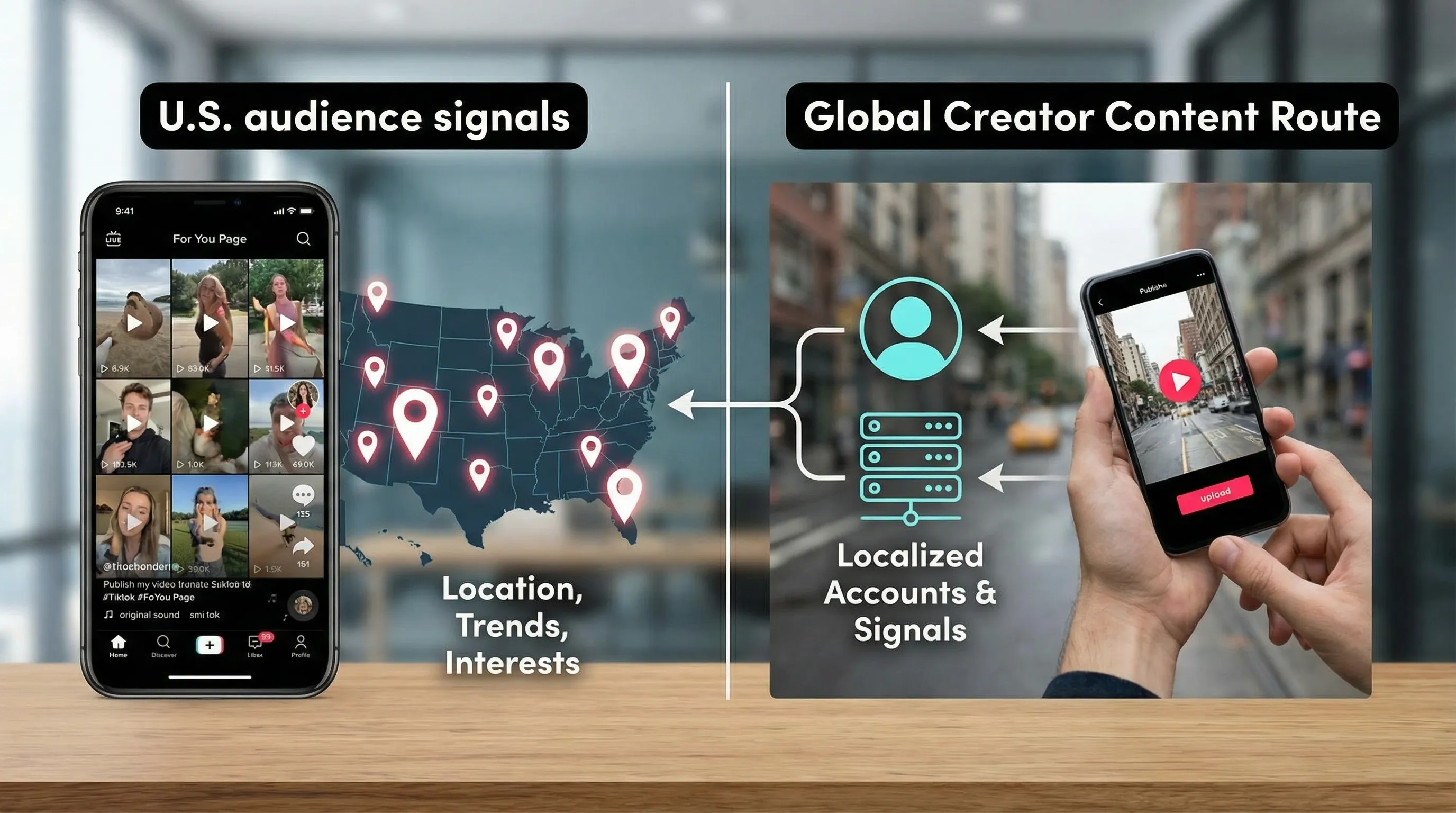
Most teams localize captions and sounds, then wonder why the U.S. distribution is inconsistent.
Add explicit location “handles” into the content itself:
You are giving the system and the viewer the same thing: a reason to believe the content belongs in their feed.
A lot of cross-border creators still try:
These methods frequently create inconsistent reach, verification failures, or ban risk (and they do not scale operationally).
If the U.S. TikTok For You Page is getting more location-sensitive, spoofing becomes even less reliable.
If your business depends on U.S. reach, you need infrastructure that makes your accounts read as U.S.-native at the platform level.
TokPortal is built for exactly that operating problem: scaling organic TikTok (and Instagram) across countries without VPN risk and without a manual nightmare.
What TokPortal can do (as relevant to U.S. reach):
If you want the shortest path from “we need U.S. distribution” to “we’re posting like a U.S. operator,” start with the TokPortal Quick Guide and then create an account.
When people say “the algorithm changed,” they often mean their inputs changed and they can’t isolate which one.
A simple protocol for the next 2 to 3 weeks:
The goal is not to win every test. The goal is to learn what consistently creates an initial U.S. test bubble, because that is where the TikTok For You Page begins compounding distribution.
If you’re managing multiple accounts or markets, you’ll feel the difference immediately with a centralized workflow. That’s the core “staying power” of TokPortal beyond account creation. You can explore the platform basics from the homepage and see packaging on the pricing page.
If you’re a startup founder, mobile app marketer, or DTC operator, TikTok is not just “top of funnel.” It’s increasingly a search and discovery layer.
At the same time, consumer sentiment around data collection is fragile. Pew Research has repeatedly found strong concern about corporate data use, even as many users accept privacy policies without reading them (Pew Research Center).
So the new “rules” are a double constraint:
The teams that win in 2026 will treat U.S. organic TikTok like a real market entry, with native distribution, native operations, and clean analytics.
The U.S. TikTok For You Page did not flip a switch overnight. But the January 2026 privacy policy shift makes one thing clear: location is becoming an even more explicit part of the U.S. TikTok experience.
If you want dependable U.S. reach, you need:
That’s the gap TokPortal is designed to close: not just “accounts in other countries,” but the operating system for organic TikTok and Instagram at scale.
When you’re ready to build repeatable U.S. distribution, start with the TokPortal Quick Guide or go straight to sign up. For more playbooks, browse the TokPortal blog.


 Any question? Contact us.



%401x.svg)