


Sign in with Google
Music is half the magic on TikTok, but the moment a logo or product appears in your clip, that catchy hook can turn into a legal landmine—especially in the United States. Since early 2024, U.S. labels have stepped up enforcement on unauthorized brand usage, while TikTok itself has tightened rules distinguishing “personal” and “commercial” tracks. If you manage a business account or post branded content from abroad to reach a U.S. audience, understanding the platform’s two main audio buckets—the Commercial Music Library (CML) and user-generated trending sounds—is no longer optional. It is a compliance requirement.
Below is a plain-English breakdown of how music licensing works on U.S. TikTok, what brands can safely use today, and practical workflows to keep your reach—and your legal budget—intact.
TikTok’s global music catalog is made possible through blanket agreements with publishers and record labels. Those deals usually grant synch rights for end users but not for commercial entities. That means:
- Regular users can slap a Drake track on their cat video.
- Brands, agencies, and anyone with monetary intent (product placement, affiliate links, paid partnerships) must follow stricter terms—or obtain their own licenses.
Failing to do so in the U.S. can lead to:
- Immediate audio muting or removal under TikTok’s automated content ID system.
- Copyright takedown notices and strikes that jeopardize your account.
- Statutory damages of up to 150,000 USD per infringed work if rightsholders sue under the DMCA.
The safest path is to start every campaign by asking: Is this track part of TikTok’s Commercial Music Library, or do I hold a separate license that explicitly covers TikTok? If the answer is no, you risk infringement.
TikTok’s CML is a curated database of roughly one million pre-cleared stems, instrumentals, and lesser-known vocal tracks that brands can use worldwide without additional fees. Think of it as TikTok’s in-house stock-music catalog.
Key facts for U.S. marketers as of August 2025:
- Eligibility: Automatically available to Business Accounts. Personal accounts cannot access it.
- Cost: Free for organic posts and Spark Ads that amplify your own video. Stand-alone ad units may still require licensing via TikTok Ads Manager.
- Duration cap: Up to 60 seconds per video.
- Territory: Rights cleared for the United States plus 200+ markets, but always double-check the track details because some songs exclude specific countries.
- Genre mix: Heavy on indie pop, electronic, hip-hop instrumentals, and emerging artists; no Billboard Top 40.
- Search filters: Mood, genre, tempo, keywords.
How to access it
1. Switch your profile to Business Account.
2. Tap “Add sound” while editing, then select “Commercial sounds.”
3. Bookmark favorites or create a custom playlist for your team.
Pros:
- Instantly safe for branded use.
- No time lost negotiating licenses.
- TikTok’s algorithm does not penalize CML tracks; completion rate and shares matter more.
Cons:
- Smaller sound pools mean fewer viral moments.
- Some influencers consider CML “uncool,” which may impact creator partnerships.
A 2025 study by Conviva found that U.S. posts using CML audio averaged 12 percent lower view-through rates than comparable posts with trending chart music. The gap narrows to 4 percent when the creative concept is tailored to the song’s beat. In other words, good storytelling still beats raw star power.
Trending sounds are typically user-generated audio snippets—sometimes clips from major songs, sometimes mashups or memes—that surge on the For You Page. They offer cultural relevance and built-in momentum, but their licensing status is often murky.
Recent U.S. enforcement trends:
- Universal Music Group and Warner Music Group both issued bulk DMCA takedowns in late-2024 targeting brand accounts that reused label music without a license.
- TikTok’s AI detection now flags business accounts that add protected tracks during editing. The audio picker will display a red exclamation warning if a song is unavailable for commercial use.
- Posts may publish silently (no audio) or get muted after the fact, killing retention.
Yes, but only if one of these is true:
1. The audio is in the CML (rare but possible for tracks TikTok later reclassifies).
2. You hold a direct license or micro-license for TikTok usage. Platforms like Lickd or Songtradr sell such rights for as low as 20 USD per track.
3. The sound is original content you created or commissioned from a composer under a work-for-hire contract.
If none of the above apply, stick to CML or risk a takedown.
In February 2025, TikTok concluded new multi-year agreements with Sony and BMG but remains in arbitration with several independent publishers. The deals restored parts of their catalogs to the platform yet exclude brand usage unless routed through TikTok’s Ads Commercial Music (ACM) program.
Practical takeaway: Even if a Top 40 track is available in the consumer library again, it is not automatically cleared for your brand reel. You still need explicit approval via ACM or a direct license.
1. Define your creative angle first. Script around mood and pacing, not a specific chart hit.
2. Search CML using mood keywords (e.g., “energetic pop,” “lo-fi chill”). Preview on desktop for faster filtering.
3. Shortlist three tracks that fit your hook. Run them by stakeholders early to avoid last-minute swaps.
4. Test engagement with a non-branded pilot post if possible. Analyze average watch time.
5. Localize variations for other markets. Some CML tracks block Germany or Japan, so always read the territory note. TokPortal flags such restrictions during upload.
6. Schedule with confidence via TokPortal to publish from a genuine U.S. account, ensuring the algorithm sees your content as native.
- Inquire through TikTok’s Commercial Music Rights Clearing form (lead time 10–15 business days).
- Or secure a micro-license on third-party sites, then upload your own sound in TikTok’s editor. Label the audio clearly (e.g., “Licensed ‑ Artist Name ‑ Track Title”). Keep the invoice for audit purposes.
- Double-check that the license includes social ad amplification if you plan to Spark-boost the post.
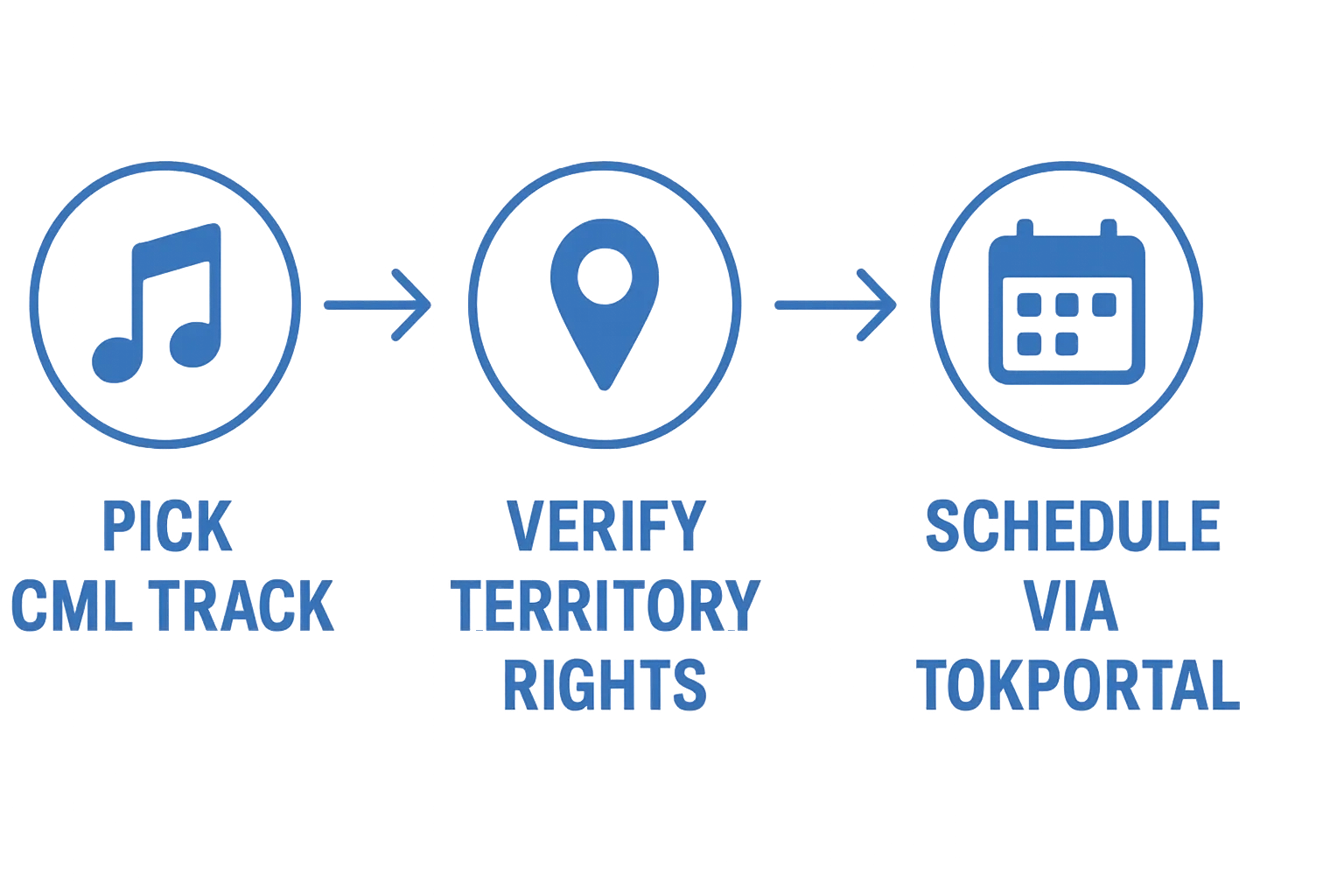
If your brand operates multiple TikTok accounts, music rights quickly become a spider web. A CML track cleared for the U.S. may be blocked in India; a micro-license may be restricted to North America only. TokPortal’s dashboard helps by:
- Displaying country-specific clearance notes right next to each scheduled video.
- Allowing you to swap audio per market without reuploading footage.
- Maintaining a license log so legal teams can trace every post.
This workflow ensures you comply with U.S. requirements while maximizing organic short-form marketing in other regions—no VPN hacks needed.
- [ ] Use a Business Account when posting branded content.
- [ ] Choose tracks from TikTok’s Commercial Music Library or obtain a written license.
- [ ] Confirm the license covers the United States and TikTok usage.
- [ ] Save proof of purchase or clearance.
- [ ] Monitor auto-muting or copyright flags after publishing.
- [ ] Localize audio per country when repurposing content via TokPortal.
Can I use 15 seconds of a hit song under fair use? No. Fair use rarely applies to commercial marketing. Any unlicensed use risks a DMCA claim.
What happens if my video gets muted? Your reach plummets. Delete, replace the audio with a CML track, and repost. Repeated offenses can trigger account review.
Is the Commercial Music Library available to creators outside the U.S.? Yes, but some tracks have geographic carve-outs. Always read the notes before scheduling global posts.
Do I need different licenses for Spark Ads? If you boost your own organic post, the CML license typically carries over. Third-party ads require separate clearance through TikTok Ads Manager.
How does TokPortal help with music compliance? The platform flags territory restrictions, stores license files, and streamlines multi-market scheduling so you avoid accidental infringements.
Navigating music rights should not slow your growth. TokPortal lets you create genuine U.S. TikTok accounts, schedule posts with pre-cleared audio, and track compliance across every market—all from one secure dashboard. Ready to boost your organic reach in the United States and beyond? Sign up for a free strategy call today at tokportal.com and start posting with confidence.

 Any question? Contact us.



%401x.svg)