


Sign in with Google
UGC managers rarely lose campaigns because the creative is “bad.” They lose because the posting ops are sloppy: wrong account geo, missing usage rights, inconsistent naming, broken handoffs, timezone mistakes, or a caption that triggers review.
When you are shipping UGC at scale, a checklist is not bureaucracy, it is throughput. TikTok is now widely viewed as both a social platform and a search surface, and consistency matters. Posting 5+ times per week is commonly associated with stronger distribution, but only if each post is published cleanly and on the right local account.
This guide is a practical UGC posting checklist for managers, covering the full path from “file received” to “live on TikTok,” including the operational steps that prevent avoidable reach loss.
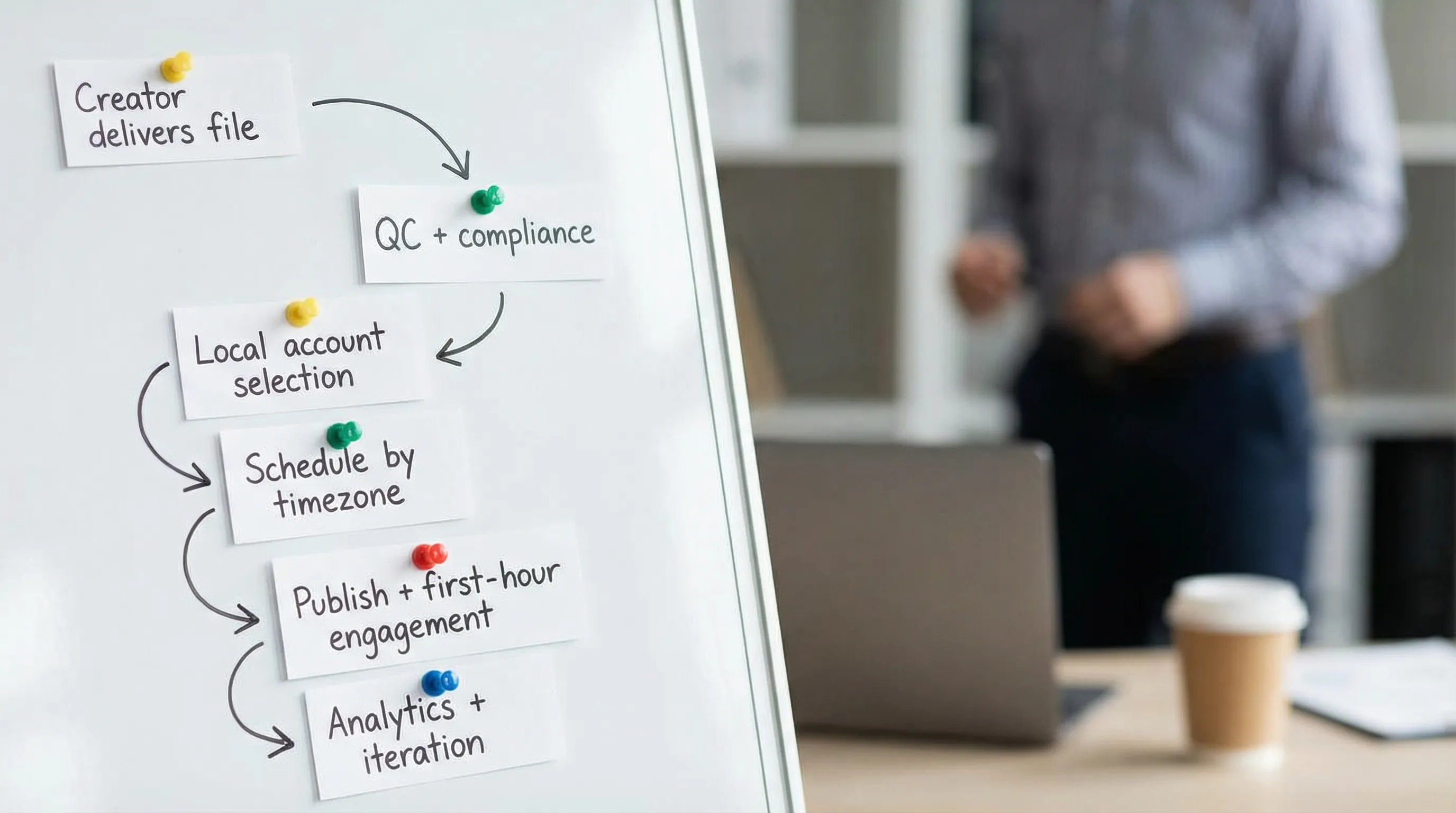
A UGC posting workflow is not just uploading a video. In practice, it is a chain of decisions that affect distribution, compliance, and your ability to learn.
Most posting failures happen in three places:
Asset intake: missing variants, missing rights, wrong exports, no consistent file naming.
Distribution setup: posting from the wrong geo, inconsistent account segmentation, scheduling at the wrong local time.
Measurement: no country-level tracking, no hypothesis for why a post worked, no structured iteration.
If you manage multiple creators, brands, or countries, your goal is simple: reduce the number of “unique decisions” required per post.
Start with intake discipline. If intake is messy, publishing will be messy.
Use one intake standard for every creator and every agency partner, even if the content styles differ.
Ask for these at delivery time, not after you discover a problem.
If you cannot find a file in 10 seconds, you will eventually post the wrong one.
A workable naming pattern is:
Brand_Creator_ConceptAngle_Country_Language_Version_Date
Example: Acme_Jules_Testimonial_US_EN_V2_2026-02-13
This makes bulk scheduling and later analysis dramatically easier.
UGC is not just content. It is an agreement, and TikTok is increasingly strict about branded content signals.
You do not need to turn this into legal theater, but you do need a repeatable minimum standard.
At minimum, confirm in writing:
If you work across markets, also confirm whether there are territory restrictions for music or footage.
For U.S. campaigns, review the FTC Endorsement Guides and keep disclosure consistent. For platform-specific requirements, TikTok’s branded content policies can change, so always verify against current in-app guidance.
Before you schedule:
This takes minutes and can prevent takedowns or forced edits.
Localization is not only translation. It is matching the content to the audience context, including geo signals, posting times, and cultural expectations.
TokPortal’s audience is usually dealing with a hard reality: TikTok distribution is heavily location-influenced, and posting from the wrong environment often underperforms. In many growth tests, teams see major reach loss when the account geo does not match the target market.
So decide upfront:
You can localize without re-editing the entire video:
If you need deeper localization, consider dubbing or re-voicing, but do it with creator consent.
The fastest way to waste good UGC is posting it from an account that TikTok classifies as “foreign” to the audience you want.
Managers often try to brute-force this with VPNs. The issue is that TikTok uses multiple signals beyond IP, and VPN workflows introduce risk: shadowed distribution, verification loops, and account bans.
If your job is to reliably ship content into specific countries, the clean approach is using real local accounts.
With TokPortal, teams can provision geo-verified TikTok and Instagram accounts in 9+ countries (USA, UK, France, Canada, Japan, Australia, Italy, Germany, Spain), typically delivered in about 30 minutes, then manage them from a unified dashboard. That matters when you are distributing UGC across multiple markets every week.
If you are new to the platform, start with the Quick Guide to understand the setup flow.
This is the checklist that prevents “we posted it and realized…” moments.
Watch the video once with sound, once muted.
If you are posting similar UGC across multiple country accounts, make sure each upload has at least one differentiator:
You are not trying to “trick” the algorithm. You are preventing your network from feeling like a copy-paste machine.
This is where managers either create clarity or create noise.
A strong UGC caption usually does one of these:
Keep it readable. TikTok captions can be long, but most people skim.
Use a small set of consistent tags:
If you are operating internationally, avoid using U.S.-centric tags on a UK account unless the content is explicitly U.S.-relevant.
At small volume, you can “just post when it feels right.” At UGC scale, you need a system.
Define two windows per market (a primary and a backup). Then stick to it for at least 2 weeks so your comparisons are meaningful.
If you manage multiple markets, scheduling manually becomes a daily tax. TokPortal’s scheduler supports timezones and bulk uploads, which is designed for the operational reality of posting across countries, not just for a single brand account.
If you are pricing out scale, see TokPortal pricing and map it to your expected account count and weekly output.
Keep these simple:
Publishing is not the finish line. For UGC, the first hour is where you can improve outcomes without touching the video.
Within 5 minutes:
This is basic, but many teams skip it when they are posting across multiple accounts.
UGC is only “scalable” if your learnings are reusable.
At minimum, track:
TokPortal includes analytics per account and country, which is what you need when you are comparing the same creative across markets or testing different UGC angles in parallel.
Do not just report numbers. Decide what to do next:
Consistency compounds on organic platforms. Ads stop when spend stops, but organic libraries keep working when you keep publishing.
If you manage agencies, creators, editors, and brand stakeholders, your real job is handoffs.
A simple SOP structure:
Define one owner per stage:
Make “done” binary.
For example:
This is how you avoid the common failure mode: everyone assumes someone else handled it.

Many teams discover TokPortal because they cannot reach a target country from abroad. That is the hook.
But day-to-day, the value is operational: a single system for running organic content at scale.
TokPortal is built for teams that need to:
If you want to see how this fits your current workflow, start at the TokPortal homepage, then follow the Quick Guide. When you are ready to operationalize, you can sign up here.
UGC is already competitive. The creative bar is rising, and more teams are shipping more volume.
A posting checklist is the manager advantage because it protects what you have already paid for: the concept, the creator time, the edit, and the testing plan.
If your team is posting into multiple countries, the fastest win is not “more content.” It is fewer preventable mistakes per post, plus the infrastructure to publish and learn across markets.
For more workflows and playbooks, browse the TokPortal blog.


 Any question? Contact us.



%401x.svg)