
UGC for TokPortal Managers: Find, Vet, and Organize Clips

March 4, 2026

UGC is the fuel for high-volume organic TikTok and Instagram growth, but most teams hit the same wall: clips arrive in random formats, with unclear usage rights, inconsistent quality, and no system for mapping assets to countries, accounts, and posting slots.

If you manage TokPortal accounts (for a brand, agency, UGC studio, or app growth team), your advantage is distribution at scale. Your bottleneck is operations: sourcing enough creators, vetting fast without lowering standards, and organizing clips so they can be scheduled across markets without confusion.

This guide gives you a practical UGC pipeline you can run weekly: where to find creators, how to qualify them, what to demand contractually, and how to structure a content library that is actually usable when you are posting across multiple countries.

What “good UGC” looks like when you manage multi-country accounts

UGC that performs on one account is not automatically “scalable UGC.” For managers running multiple geo accounts, the bar is different:

  • Modular: the hook, body, and CTA can be swapped without reshooting.
  • Localizable: text overlays, captions, and references can be adapted for US, UK, FR, DE, etc.
  • Native-feeling: no overly polished ad vibe, natural speech, real environment.
  • Operationally clean: correct specs, filenames, and documentation (usage rights, whitelisting rules, music risk).

A simple rule: if a clip cannot be understood, adapted, and scheduled by someone who did not speak to the creator, it is not scalable UGC.

Find UGC creators (fast) without drowning in DMs

Sourcing is easier when you split it into two lanes: always-on inbound and targeted outbound.

Always-on inbound (build a creator funnel you can reuse)

Inbound is how you reduce your cost per usable clip over time.

  • Post a recurring “Creators wanted” video on your brand account(s) with clear niches and examples.
  • Create a short application form that collects: country, age range, language, examples, turnaround time, and rates.
  • Put the form in bio and pin the post.

If you operate multiple regions, run the same recruitment post on each local account so applicants match the audience you want to reach.

Targeted outbound (when you need a specific face, niche, or country)

Outbound works best when your message is specific.

Places to source:

  • TikTok search and hashtag crawling (look for “day in the life,” “review,” “must-have,” “TikTok made me buy it” formats in your niche).
  • TikTok Creative Center for trend intel and categories (use it for creative direction, not just ads): TikTok Creative Center
  • Instagram Reels creators with low production, high trust content (often easier to repurpose)
  • UGC communities and creator marketplaces (useful for volume, but vet harder)

Your outbound message should include:

  • The exact style you want (link to 1 to 3 examples)
  • Deliverables (how many hooks, aspect ratio, raw files)
  • Timeline
  • Usage rights expectations

Vet creators like a performance team, not a casting director

You are not hiring “talent.” You are buying repeatable performance.

The 60-second creator scorecard

Use a scorecard so your team evaluates consistently.

1) Hook ability

  • Do they earn attention in the first 1 to 2 seconds?
  • Do they use a clear tension line (problem, curiosity, outcome)?

2) On-camera credibility

  • Do they look like a real user of the product category?
  • Do they speak naturally, not like they are reading ad copy?

3) Editing and pacing

  • Do they cut dead air?
  • Do they use pattern interrupts (angle changes, text swaps, b-roll)?

4) Brand safety and compliance maturity

  • Have they posted sponsored content before?
  • Do they disclose appropriately?

For US-facing content, the reference point is the FTC endorsement guidance: FTC Endorsement Guides

5) Localization fit

  • Accent and slang match the target market (if required)
  • Will the same creator work across multiple markets, or do you need local faces?

What to ask before you pay

A short pre-flight checklist prevents 80% of problems later:

  • Can you deliver raw files (no watermark), plus the final edit?
  • Can you record 2 to 3 hook variations per concept?
  • Can you provide clean audio (no copyrighted music baked in) if needed?
  • Are you comfortable with paid usage terms and brand whitelisting rules (if applicable)?
  • What is your turnaround time and revision policy?

Lock down usage rights (so your best clips do not become liabilities)

Most teams lose time (and sometimes accounts) because usage rights are treated as an afterthought.

At minimum, your UGC agreement should define:

  • Usage scope: organic social, paid social, website, email, app store, etc.
  • Duration: 3 months, 6 months, 12 months, perpetual (price changes accordingly)
  • Territory: specific countries vs worldwide
  • Exclusivity: category exclusivity usually costs extra
  • Deliverables: number of concepts, hook variations, aspect ratio, raw files
  • Disclosure requirements: how to label sponsored content

If you run multi-country accounts, territory and duration are the two fields you should be able to answer instantly for any clip.

Organize clips so they can be posted across countries without confusion

Most “UGC libraries” fail for one reason: they are built like storage, not like an operating system.

Use a naming convention that encodes posting reality

A filename should tell you what it is without opening it.

A practical convention:

  • Brand_Product_Angle_Creator_Country_Lang_Length_Version_Date

Example:

  • AcmeApp_OnboardingHack_ScreenRec_Alex_US_EN_23s_V2_2026-02-11

This matters when you are bulk uploading and scheduling across multiple accounts and time zones.
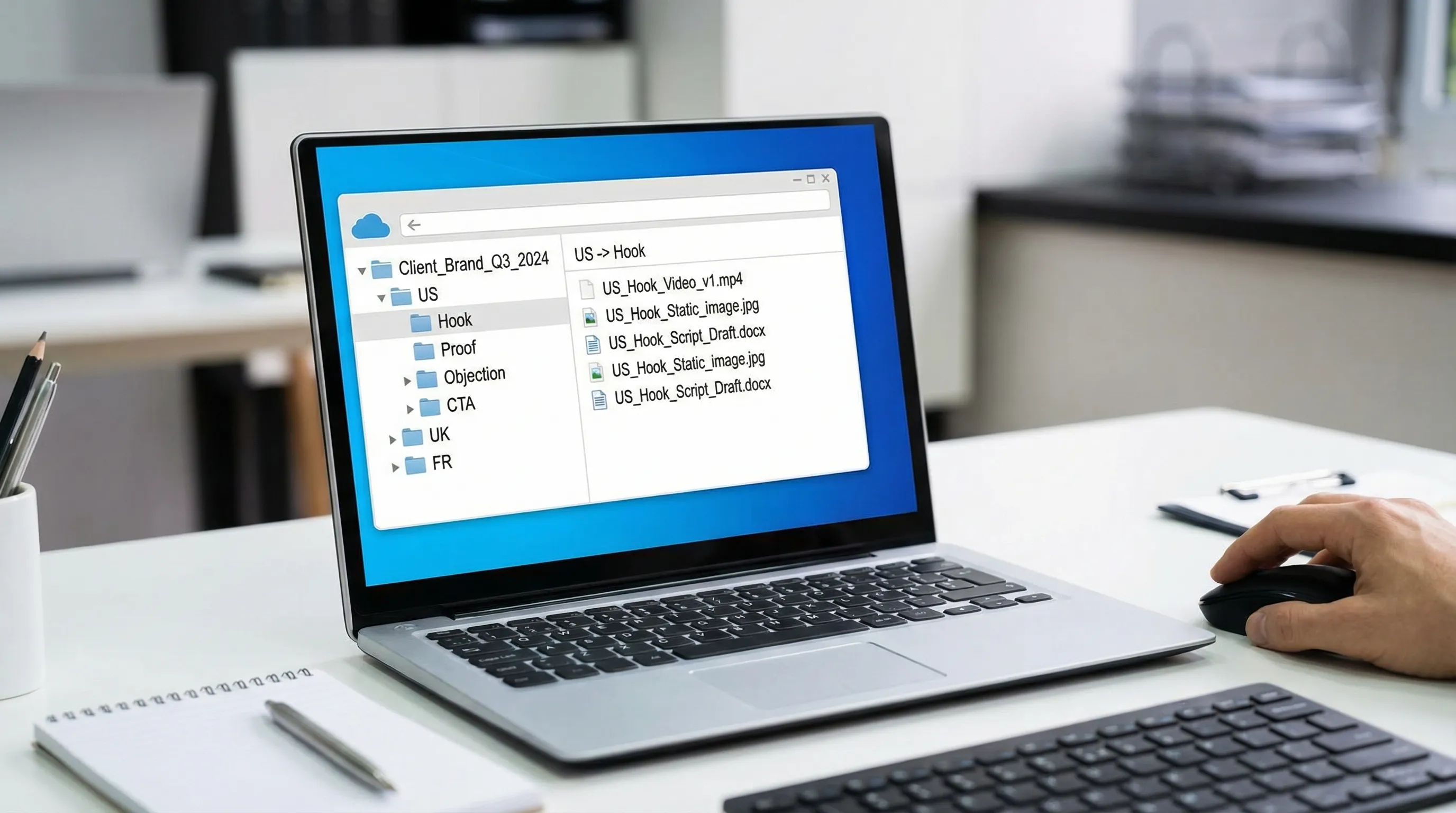
A clean content library folder structure for UGC: top-level folders by brand and quarter, subfolders by country (US, UK, FR), then by funnel stage (Hook, Proof, Objection, CTA), with consistent filenames visible in a file list.

Tag clips by “angle” and “job to be done,” not by creator name

Creators come and go. Angles compound.

Use 6 to 10 angle tags that match your business model, such as:

  • Problem agitation
  • Before/after
  • Social proof
  • Comparison
  • Objection handling
  • Tutorial
  • Unboxing
  • Founder story

Then add a second layer: the job the viewer hires you for (save time, look better, earn more, reduce risk, etc.).

This makes it far easier to reuse winning structures across markets.

Store “localization layers” separately

To scale across countries, separate what changes from what stays.

  • Core layer: the main video
  • Text layer: editable captions, on-screen text, product UI callouts
  • Audio layer: voiceover, dubbed versions, clean audio
  • CTA layer: localized CTA lines, links, discount terms (if any)

This is the difference between “we need to reshoot for Germany” and “we just need a DE text and CTA swap.”

Build a simple clip QA checklist (so scheduling is safe)

Before a clip is marked “ready,” confirm:

  • Vertical 9:16, safe margins respected
  • No watermarks
  • Clear audio
  • No unlicensed copyrighted music baked into the file (unless you are intentionally using platform audio)
  • Claims are supportable (avoid medical, financial, or performance promises you cannot substantiate)
  • Usage rights fields completed (duration, territory, paid allowed or not)

Operational workflow: from UGC intake to multi-country scheduling

Here is a weekly cadence that works for managers who need volume without chaos.

Intake day (collect, normalize, document)

  • Receive all deliverables into one intake folder
  • Rename files to your convention
  • Attach rights terms and creator details in a single record (spreadsheet, Airtable, Notion, or your internal system)
  • Run QA and flag any fixes immediately

Packaging day (make each concept scalable)

  • Cut 2 to 4 hook variants from each concept
  • Export market-ready versions (or prep text layers for localization)
  • Assign angle tags and funnel stage

Distribution day (schedule per country and learn faster)

This is where TokPortal managers win, because you can publish as locals in multiple regions and compare results cleanly.

With TokPortal, you can:

  • Manage multiple TikTok and Instagram accounts from one place
  • Schedule posts with timezone support
  • Bulk upload assets for high-volume weeks
  • Track performance per account and country

If you are new to the platform, the fastest starting point is the TokPortal Quick Guide. If you are planning account volume, check pricing.

How to structure UGC testing across countries (without burning clips)

A common mistake is posting the same “best” clip everywhere on day one. Instead, treat geos like a testing lab.

Stagger tests to preserve learning

  • Launch a concept in 1 to 2 primary markets first (often US and UK)
  • If it hits your baseline metrics, localize and expand to the next 2 to 3 markets
  • Only then roll it to all accounts

This prevents a weak concept from consuming your entire weekly schedule.

Define “greenlight metrics” that are simple

You do not need a complex dashboard to make good decisions. Pick a small set of leading indicators:

  • 3-second view rate (hook strength)
  • Average watch time or completion (content-product fit)
  • Shares and saves (distribution signal)
  • Comments quality (objections, intent, confusion)

Once you have a winner, scale variants, not just reposts.

Common UGC pitfalls TokPortal managers should avoid

“We bought UGC, why is it not performing?”

Because UGC is not a format, it is a system. The same creator can produce a great clip and a weak clip. What scales is:

  • A repeatable creative brief
  • Hooks that match the market
  • A testing cadence that produces iterations

Over-localizing too early

You do not need separate shoots for every country at the start. Often the highest ROI path is:

  • One core shoot
  • Localized text and CTA
  • Local account distribution

Then upgrade to local faces for the markets that show traction.

Losing track of rights and territory

If you cannot answer “Can we run this in Canada for 6 months?” in 10 seconds, your library is not operational.

Where TokPortal fits in the UGC machine (beyond account creation)

TokPortal is not just a way to create accounts in other countries. For UGC-heavy teams, it becomes the operating layer that connects:

  • UGC production (creators, briefs, edits)
  • Multi-account distribution (local accounts per market)
  • Scheduling across time zones
  • Analytics by account and country

If you are managing global organic at scale, that operational consistency is usually the difference between “posting content” and running a growth system.
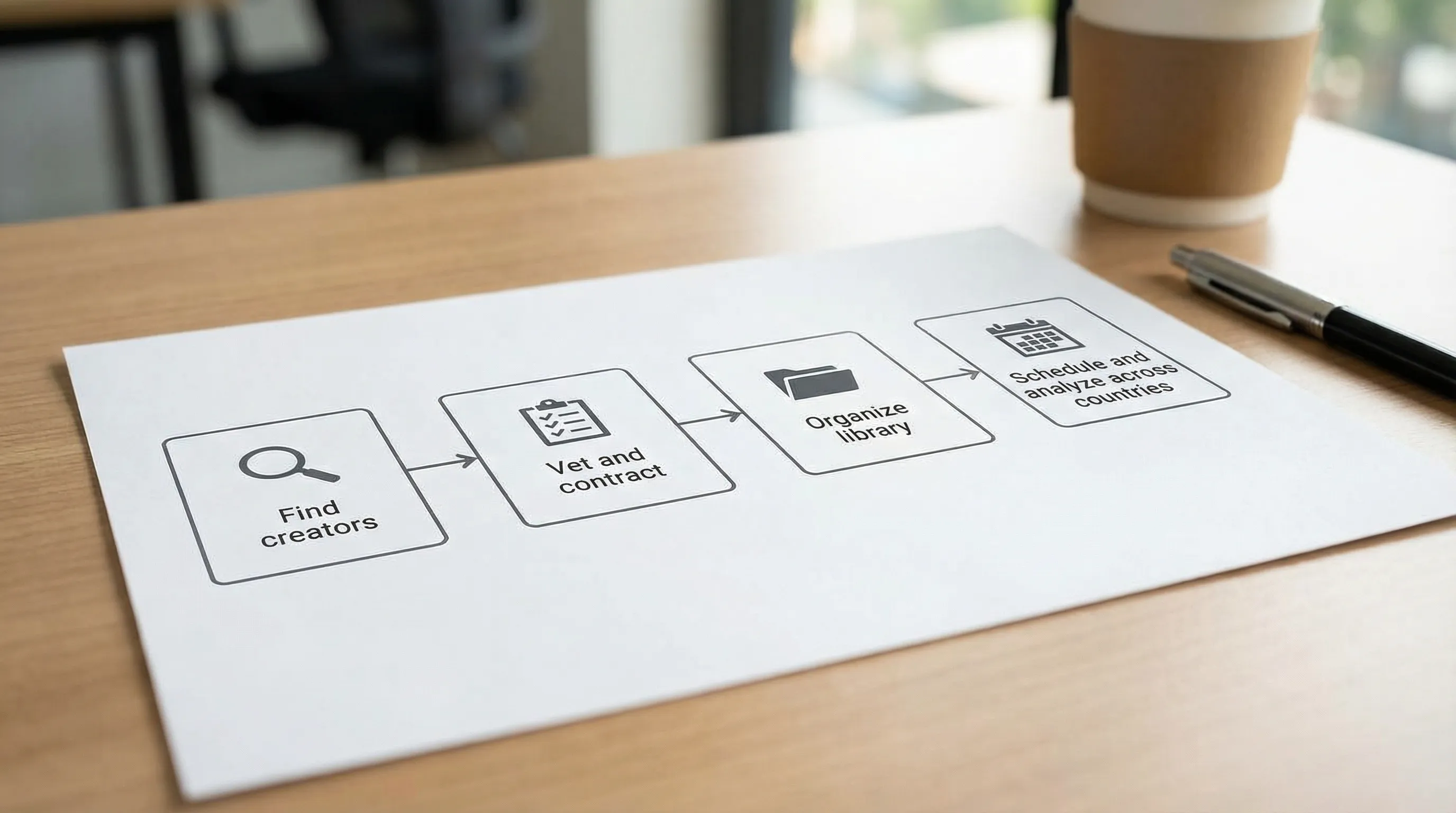
A simple workflow diagram with four labeled boxes connected left to right: Find creators, Vet and contract, Organize library, Schedule and analyze across countries. Each box includes small icons like a magnifying glass, checklist, folder, and calendar chart.

Frequently Asked Questions

What is the fastest way to find UGC creators for a specific country? Start with TikTok search in that country’s niche (hooks and hashtags), then run a local “creators wanted” post on that region’s account to build inbound applicants.

How many hook variations should I request per UGC concept? For performance-driven teams, 2 to 3 hooks per concept is a strong baseline. Hooks are usually the highest leverage variable and the cheapest to iterate.

Do I need different creators for every market? Not always. Many brands scale with one core creator and localized text/CTA first, then add local faces only in the markets that prove traction.

What should I store with every UGC clip to stay compliant? At minimum: usage duration, territory, allowed placements (organic vs paid), disclosure requirements, and whether raw files were delivered.

How do I prevent my team from reposting the wrong version to the wrong account? Use filenames that encode country and language, separate localization layers, and require a “ready to post” QA checklist before anything enters the scheduling queue.

Turn your UGC library into a global posting machine

If you already have creators (or you are ready to recruit them), the next step is building a distribution system that can post organically in multiple countries without VPN risk, timezone chaos, or account sprawl.

For more playbooks on global organic growth, browse the TokPortal blog.
Step Through the 🌀 Portal to Global Reach

Create Local TikTok Account(s)
and Start Posting Videos

Upload TikToks
Real device - No VPN - Reusable account - Email support 7/7
Any question? Contact us.
x
View Countries