
Tik Tok Creators: What Brands Should Look for in 2026

March 27, 2026

In 2026, hiring Tik Tok creators is less about “who has the biggest following” and more about who can reliably produce native, high-retention short-form that converts in a specific market. The creator economy has matured, audiences are faster to detect ads, and TikTok has become a discovery engine where format, trust, and localization drive results.

If you are a brand, agency, label, or growth team, this guide breaks down what to look for now, how to evaluate creators without getting fooled by vanity metrics, and how to scale what works across countries without turning your operation into chaos.

What changed for brands (and creators) going into 2026

A few shifts are forcing brands to upgrade their creator selection process:

Organic reach is still real, but distribution is more “local by default”

TikTok’s recommendations heavily favor content that behaves like it was made for a specific audience: language, cultural references, posting patterns, and especially account and viewer geography. A creator can be “globally popular,” yet their content may still under-deliver in the exact country where you need growth.

Content looks cheaper to make, but harder to trust

AI-assisted editing, AI dubbing, templates, and UGC factories have increased output. The downside is a flood of content that feels generic. Brands win when creators feel specific, not when they feel mass-produced.

Buyers expect proof, not promises

More teams are benchmarking creators like performance channels. They want clarity on:

  • What the creator can ship, how fast, and in what formats
  • What usage rights the brand gets
  • How success will be measured (and what “good” looks like)

Decide what you are buying: influence, content, or distribution

Before you evaluate creators, be clear on the job you are hiring them for. In 2026, most creator partnerships fall into one (or more) of these buckets:

1) Creator-led demand (influence)

You are paying for the creator’s trust and audience relationship. The metric is not views, it is action: installs, sign-ups, sales, saves, clicks, or branded search lift.

2) UGC production (content)

You are paying for repeatable creative that you can publish on your brand accounts (and potentially in multiple geos). The creator’s follower count matters less than their on-camera delivery, pacing, and ability to produce winning hooks.

3) Market entry (local credibility)

You are hiring creators specifically because they are native to a country or culture you need to penetrate. Their value is authenticity and cultural fluency.

4) Creative R&D (testing)

You want creators who can generate many variants, rapidly. Their value is speed, iteration discipline, and “learning velocity.”

Once you know the job, you can judge creators fairly.

A practical 2026 scorecard for evaluating Tik Tok creators

You do not need a complicated model, you need a consistent one. Use the criteria below to qualify creators fast, then do deeper diligence only on the finalists.
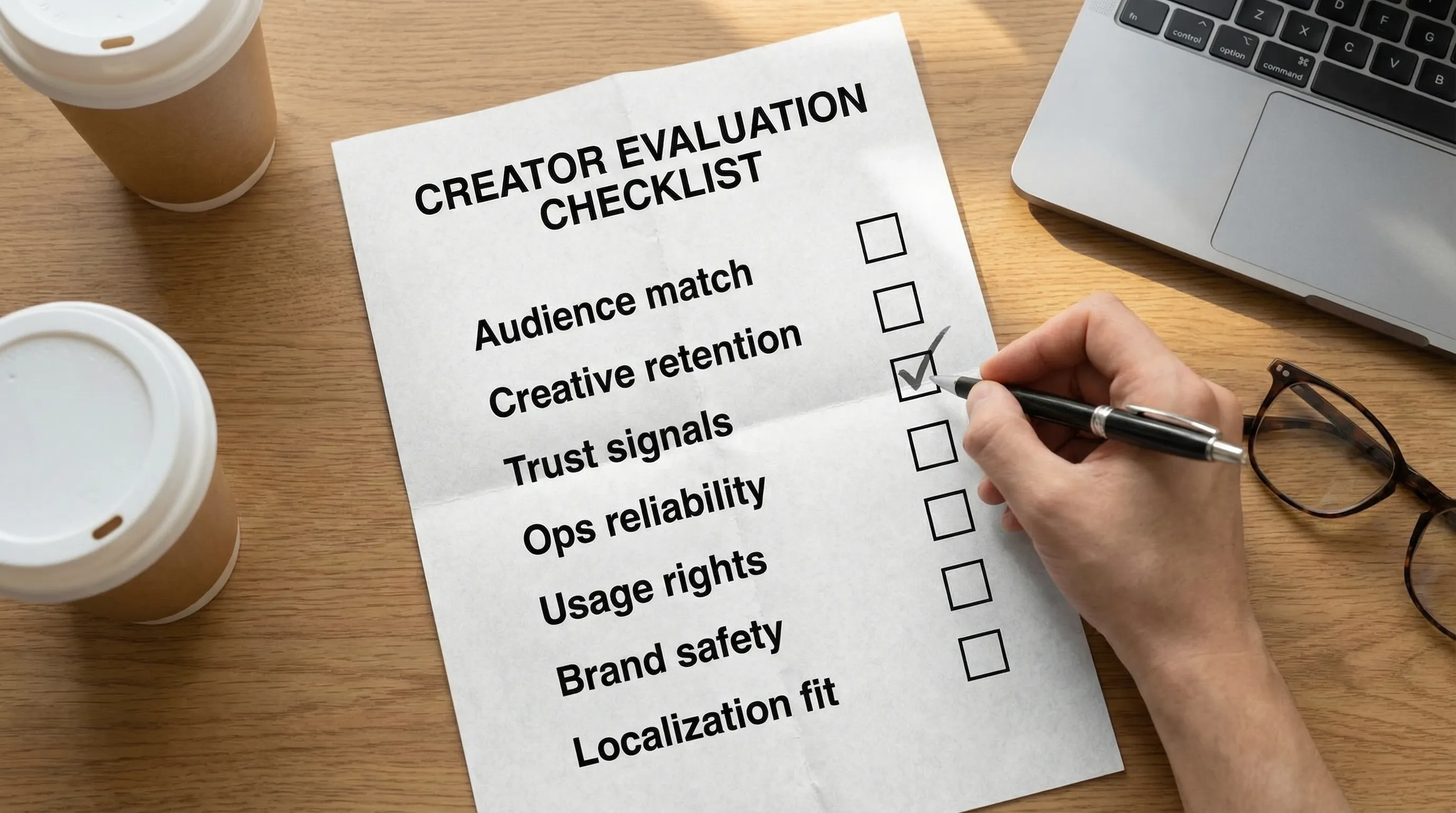
A creator evaluation checklist graphic with simple sections: Audience match, Creative retention, Trust signals, Ops reliability, Usage rights, Brand safety, Localization fit.

1) Audience reality check (especially geography)

The first question is not “how many followers,” it is “where are the viewers who actually see this content?”

Ask for:

  • Recent video analytics screenshots showing top countries and top cities
  • Typical posting times and which time zone they optimize for
  • Any history of audience shifts (for example, a creator who went viral in Brazil but sells in the US)

What to watch for:

  • A creator whose follower base is in one country while your product is sold in another
  • Viral spikes that do not repeat, suggesting the audience is not stable

If your campaign is multi-country, a single creator rarely solves distribution alone. You will typically pair creators with a system that can publish natively in each market.

2) Creative retention, the best predictor of repeatable performance

On TikTok, retention is the tax you pay to earn reach. In 2026, brands should prioritize creators who consistently deliver:

  • A compelling first 1 to 2 seconds (pattern interrupt, bold claim, or highly specific scenario)
  • Tight edits that remove dead time
  • A clear story arc (setup, tension, payoff)

How to evaluate quickly:

  • Watch 10 recent posts. If you feel your attention drifting, the content will not scale.
  • Check whether the creator has repeatable “series” formats. Series creators are easier to brief and scale.

A simple internal rule that works well: if the content does not hold you, it will not hold cold audiences.

3) Trust signals inside the comments (not just engagement rate)

Creators can buy likes. It is much harder to fake the texture of real trust.

Scan comments for:

  • People asking genuine questions (“does this work on iPhone 15?”)
  • People tagging friends (“this is literally you”)
  • Creator replies that add substance (not just emojis or “link in bio”)

Red flags:

  • Comment sections dominated by generic praise with no specificity
  • Lots of “where do I buy” with no follow-through in later comments
  • A pattern of angry accusations about sponsorship disclosure

For disclosure norms, reference the FTC Endorsement Guides when you build your creator agreement and posting guidelines.

4) Proof of conversion behavior (even without perfect attribution)

Not every creator will have clean performance data. Still, you can screen for creators who consistently drive action, not passive views.

Ask for:

  • Past brand examples where comments show clear intent
  • Click data if they used trackable links
  • Any lift indicators: increased DMs, email sign-ups, store visits, app installs

What to look for in videos:

  • Clear CTAs that fit the platform (save this, send to a friend, try this tonight)
  • Product demo moments that are visual and quick
  • Objection-handling baked into the script (price, trust, complexity)

5) Brand fit, but not in the “polished ad” sense

In 2026, “overproduced” can underperform because it triggers ad fatigue. The best creators understand native persuasion.

Good brand fit usually looks like:

  • The creator can deliver your value proposition in their natural voice
  • They can integrate the product without breaking the pace of the video
  • Their audience is already primed for the problem you solve

A strong creator will push back on your brief. That is often a positive signal, it means they protect what works with their audience.

6) Operational reliability (the hidden ROI driver)

Most creator programs fail operationally, not creatively. If you are scaling, reliability matters as much as talent.

Screen for:

  • Turnaround time (first draft and revisions)
  • Ability to produce variations (different hooks, different CTAs, different lengths)
  • File delivery (raw clips, project files if relevant, captions burned and unburned)

A practical approach is to start with a paid test batch (for example, 3 to 6 videos) and evaluate both performance and collaboration quality.

7) Usage rights, whitelisting, and content ownership clarity

Avoid awkward surprises later by agreeing upfront on:

  • Where the brand can use the content (TikTok, Reels, Shorts, landing pages)
  • Duration of usage rights
  • Exclusivity rules (category, competitor conflict window)
  • Whether the creator will allow boosting or whitelisting if you run ads

If you expand internationally, also verify music licensing constraints. TikTok’s music availability differs by region, and business accounts face additional limitations.

8) Brand safety and “future you” risk

Brands now think like risk managers because creator controversies travel fast.

Do basic diligence:

  • Scroll back 6 to 12 months of posts
  • Look for extremist political content, hateful speech, harassment patterns, or repeated community guideline strikes
  • Evaluate how they speak about sponsors and money

Also assess AI-related risk:

  • If a creator uses AI voice or cloning, ensure consent and clear disclosures where needed
  • If they heavily use stock or recycled content, you may struggle to claim authenticity

9) Localization ability (the multiplier for international growth)

If you sell across borders, “English + subtitles” is not a localization strategy. Strong local creators do at least one of these extremely well:

  • Translate the joke, not just the words
  • Use local buying cues (currency, shipping norms, cultural references)
  • Understand local sensitivity and taboo topics
  • Match local pacing and audio trends

If you want to scale across multiple countries, the best setup is often:

  • A core creative concept that stays constant
  • Local creators (or localized versions) that make it feel native per market
  • Publishing from accounts that are actually local to that audience

TokPortal’s own positioning is built on this reality: TikTok distribution is local, so scaling internationally requires local infrastructure, not hacks.

A 30-day creator hiring playbook that actually de-risks spend

You can run this process whether you are a DTC brand, a SaaS growth team, a label pushing a track, or an agency managing multiple clients.

Week 1: Build a “creator brief” that creators can win with

A good brief is not a script. It is constraints + truth.

Include:

  • The one thing your product does better than alternatives
  • The top 3 objections you want addressed
  • The target market and the audience persona
  • Examples of formats you like (not just competitors, also creators)
  • Compliance requirements (disclosures, claims you cannot make)

Week 2: Run a controlled creative test

Pick 3 to 5 creators and request:

  • 2 to 3 hook variations per concept
  • At least two lengths (for example 12 to 18 seconds, and 25 to 40 seconds)
  • One direct response version and one story-first version

Do not over-optimize for production quality. Optimize for retention and clarity.

Week 3: Double down on winners, kill losers fast

Your job is to identify repeatability.

  • If a creator hits once, ask for iteration in the same format
  • If they miss twice with clear briefs, move on
  • If comments show confusion, rewrite the claim and simplify the demo

Week 4: Scale distribution across geos (without multiplying workload)

This is where most teams break.

If you are expanding into multiple countries, you need a system for:

  • Scheduling across time zones
  • Managing multiple accounts safely
  • Tracking performance by country and account
  • Reposting localized variants without creating a mess

TokPortal was built for exactly this scaling layer: creating geo-verified accounts in multiple countries, scheduling with timezone support, and tracking results across markets from one place. If you want the overview, start with the Quick Guide.

Where TokPortal fits (and where it does not)

TokPortal is not “a list of creators.” It is the infrastructure that makes creator-led organic scale possible when you are posting across markets.

It is especially useful when:

  • You are running multi-country campaigns and need local accounts
  • You are managing many accounts and need one workflow for scheduling and analytics
  • You want to test content-market fit across geos before you increase ad spend

If you only need a one-off sponsorship in a single country, TokPortal may be overkill. But if you are building a repeatable organic engine, it becomes the operating system.

You can learn more on the homepage or review pricing when you are ready to scale.
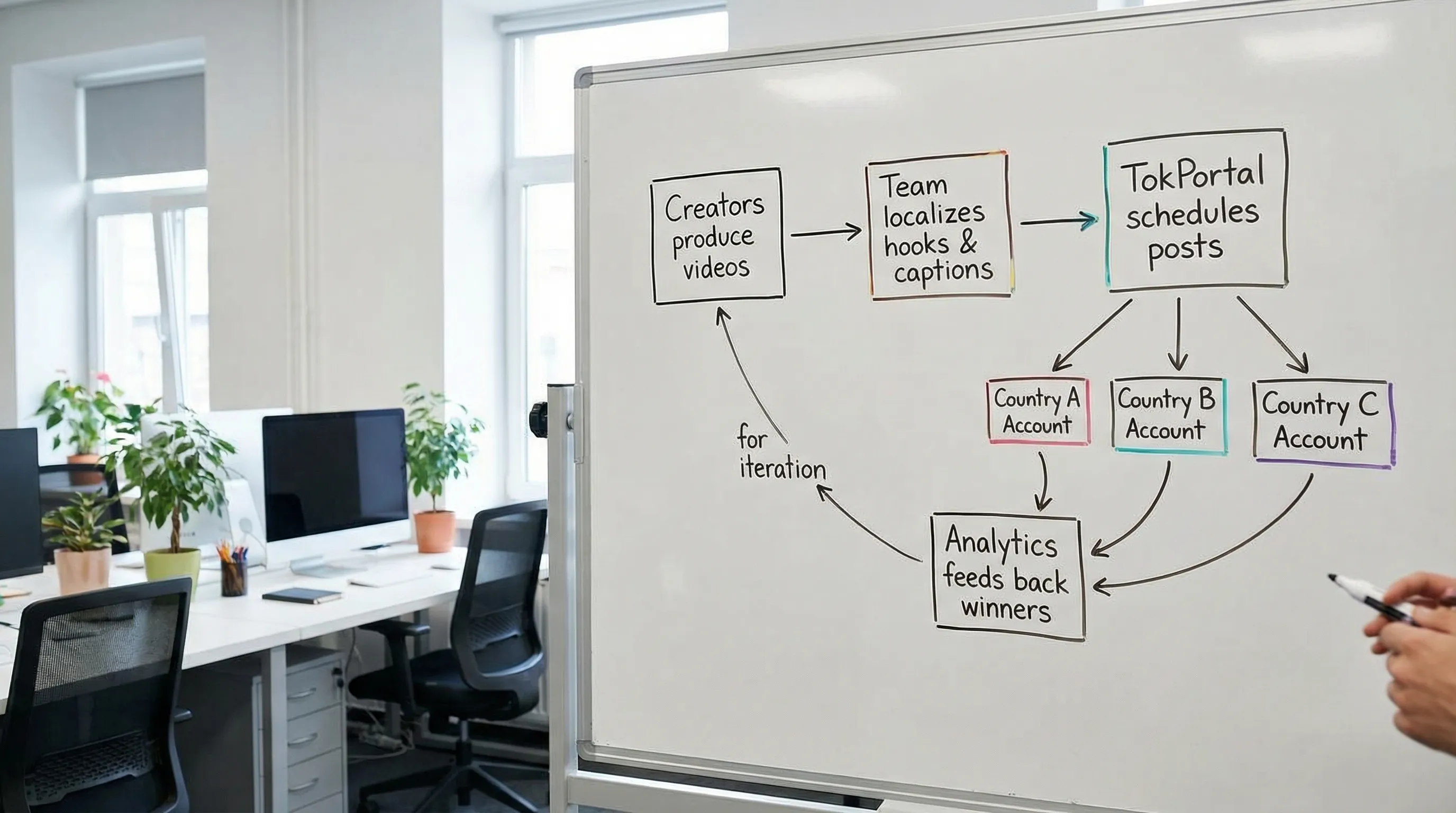
A simple workflow diagram showing: Creators produce videos, team localizes hooks and captions, TokPortal schedules posts to multiple country accounts, analytics feeds back winners for iteration.

The 2026 bottom line: pick creators you can scale, not just creators who can spike

The best Tik Tok creators for brands in 2026 share three traits:

  • They can earn attention repeatedly (retention-first creative)
  • They convert trust into action (comment quality, objections handled, clear demos)
  • They are operationally scalable (fast iteration, clear rights, localization-ready)

If your growth strategy depends on multiple geographies, treat creator partnerships and distribution as one system. Creators generate the creative edge, your infrastructure determines whether that edge compounds.

When you are ready to operationalize multi-market organic at scale, create your workspace in TokPortal and start testing: Sign up here. For more playbooks, browse the TokPortal blog.

Step Through the 🌀 Portal to Global Reach

Create Local TikTok Account(s)
and Start Posting Videos

Upload TikToks
Real device - No VPN - Reusable account - Email support 7/7
Any question? Contact us.
x
View Countries