


Sign in with Google
Most TikTok posts fail for one simple reason: the creator never closes the loop between what the audience did and what the next post should change. For TokPortal managers, that loop is the job. You are not just “posting videos”, you are collecting TikTok feedback from real local audiences and turning it into cleaner hooks, sharper localization, and higher-performing uploads.
This guide breaks down how effective managers collect feedback (quantitative and qualitative), how they translate it into actionable edits, and how to run a repeatable improvement cycle across multiple accounts and countries.
On TikTok, feedback is not only comments like “this is great” or “cringe.” The platform gives feedback through distribution and viewer behavior.
As a manager, your goal is to read three layers at once:
The best managers treat every post like a small experiment: publish, observe signals quickly, decide what to keep, then iterate.
Feedback collection is easier when you standardize sources and check them in a consistent order.
TikTok’s analytics are your first stop because they reduce guesswork. Focus on signals that indicate whether the creative earned attention, then whether it earned intent.
Useful official reference: TikTok Creator Portal (best practices, content education) and TikTok Creative Center (trend visibility by market).
What you are looking for is not “did it get views,” but “why did distribution expand or collapse.”
Comments are unstructured, but they are extremely actionable when you cluster them:
A manager’s advantage is patience and pattern recognition. Ten comments can be more valuable than 10,000 views if they tell you what to fix.
Shares and saves are often stronger indicators than likes because they signal utility or identity.
When shares and saves are low, you often need a clearer payoff (template, checklist, before/after, “do this, not that”).
Even if you are not responsible for the offer, profile actions are a strong indicator that the content is attracting the right audience.
Look for:
A post that gets fewer views but drives more follows is frequently a better format to build a series around.
A post can fail simply because it is “off-beat” for the local For You Page.
Use market context to answer:
This is where TikTok Creative Center helps: it provides a quick read on what’s popular in a specific region.
When you manage many posts across accounts, consistency matters. TokPortal is built to simplify global TikTok operations with secure account management, scheduling and uploading, and dashboard-based management across multiple local accounts.
For managers, this turns feedback into something you can actually act on: you can publish consistently, compare outcomes, and repeat what works without turning the workflow into chaos.
If you are new: start here to understand what TokPortal does at a high level: TokPortal.
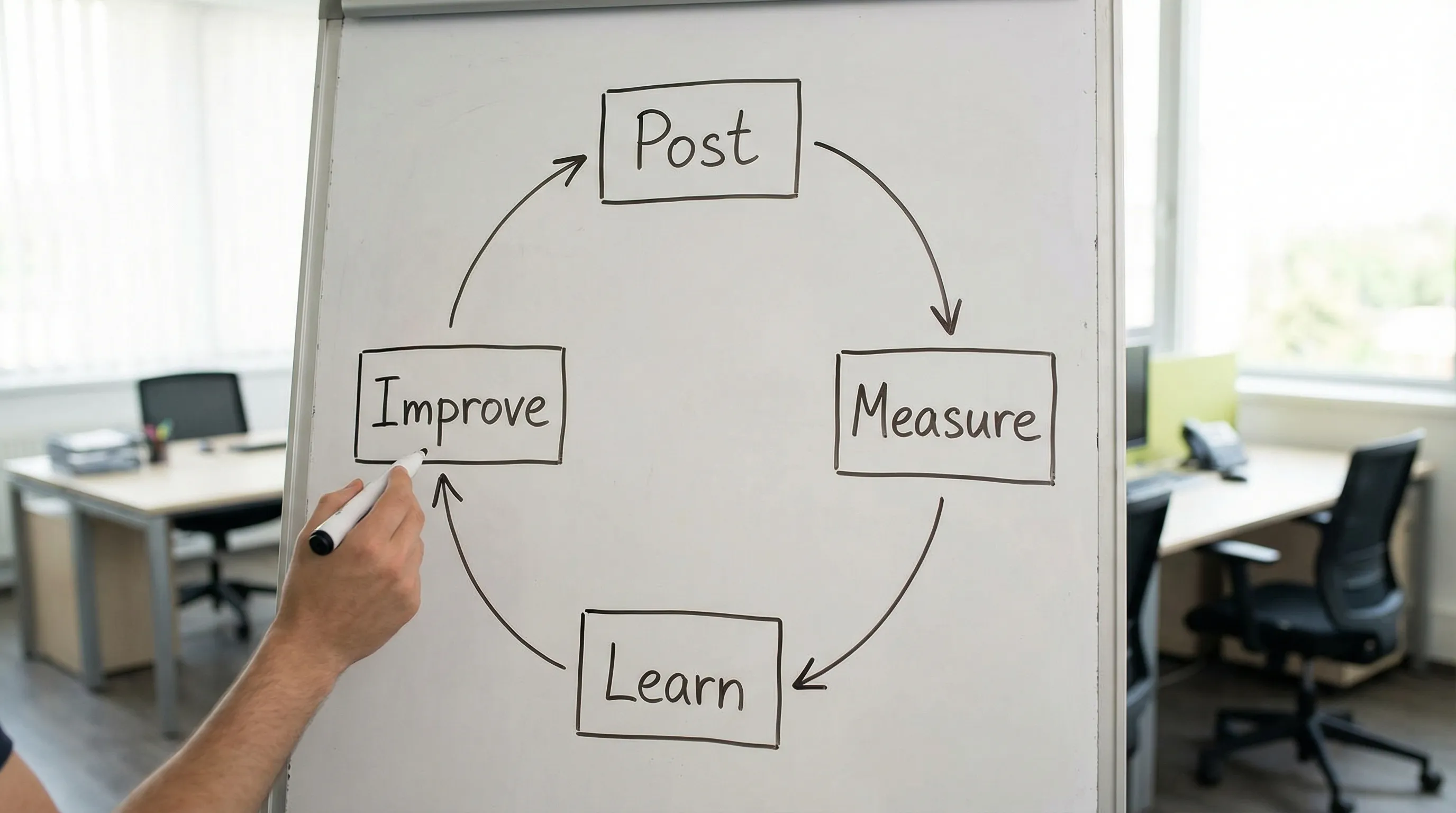
A strong manager runs a tight loop. You do not wait weeks to “analyze.” You capture signals early and decide what to change next.
Many posts show their trajectory early.
Your goal is to write down what happened while it is fresh, not to rely on memory later.
Avoid vague notes like “did bad” or “people didn’t like it.” Tag the issue:
One post should not generate 12 changes. Pick one or two high-leverage edits for the next upload, such as:
Reposting “the same idea” is not enough. You want the next post to test your hypothesis.
Example hypothesis:
TikTok exposes many data points. Managers get results faster by prioritizing a small set.
Retention is usually the primary bottleneck.
What to do when retention is weak: shorten the setup, move the payoff earlier, reduce repeated lines, and cut dead air.
After you earn attention, you need a reason for the viewer to do something.
A post can have solid views and still be a format you should drop if it produces low intent.
Read comments for:
When sentiment is negative, do not argue in comments. Instead, fix the next post with more proof, clearer framing, or cleaner claims.
Feedback only matters if it changes the next upload. These are the levers managers use most.
If comments show confusion or analytics show early drop-off, you likely need a better hook.
Common hook fixes:
If viewers drop at second 2 to 4, your intro is too long.
Quick pacing upgrades:
A post can be “in English” and still feel foreign in the US, UK, or EU markets.
What managers commonly adjust based on feedback:
Many viewers watch without sound. If you see “what did they say?” comments, your on-screen text is not doing its job.
Improve captions by making the first line:
If follows are low, your CTA is probably weak or missing. CTAs do not need to be salesy.
Examples of manager-friendly CTAs:
Consistency beats intensity. A repeatable routine creates compounding learning.
TokPortal’s scheduling and dashboard workflow is designed for this kind of operational cadence across multiple accounts, so you can spend more time improving creative and less time juggling logins.

Good feedback is specific, testable, and tied to a moment in the video.
Avoid: “Make it more engaging.”
Use:
A lightweight template that works well:
This is the difference between “feedback” and “iteration.”
This often means the post is entertaining but not positioned as a repeatable niche.
Fix: add a clearer series frame (“Part 1”, “Day 3 of…”, “US vs UK example #2”), and use a niche-consistent CTA.
Viewers watched, but they did not feel compelled to pass it on.
Fix: increase social utility. Add a list, a strong opinion, a “send this to…” line, or a simple takeaway people want credit for discovering.
This can be good news. It means interest is there, but clarity is missing.
Fix: turn the top question into the hook of the next post, and answer it in the first 3 seconds.
If locals comment that something feels “not from here,” treat it as premium feedback, not negativity.
Fix: adjust phrasing, references, and on-screen text, and use local examples. If you manage multiple markets, keep a short “do not use” list of phrases that repeatedly trigger pushback.
TokPortal exists because native distribution on TikTok is deeply location-sensitive. Managers are the people who make global posting operationally possible while keeping content organic, consistent, and market-aware.
If you enjoy:
then manager work is a strong fit.
TokPortal supports this operational role with features like local account creation, secure account management, scheduling and uploads, and dashboard-based organization across accounts. To learn more about the platform and where you could fit in as a manager, start at TokPortal.


 Any question? Contact us.



%401x.svg)