


Sign in with Google
Timing remains one of the simplest growth levers on TikTok, yet it is also the most misunderstood. In 2025 the platform’s U.S. recommendation engine is sharper than ever at clustering users by micro-region and active-session habits. Post a great video just 90 minutes too late and it may never escape a cold-start test group in Tampa or Tulsa. Post it during the right engagement spike and the same clip can snowball to six figures of views before lunch.
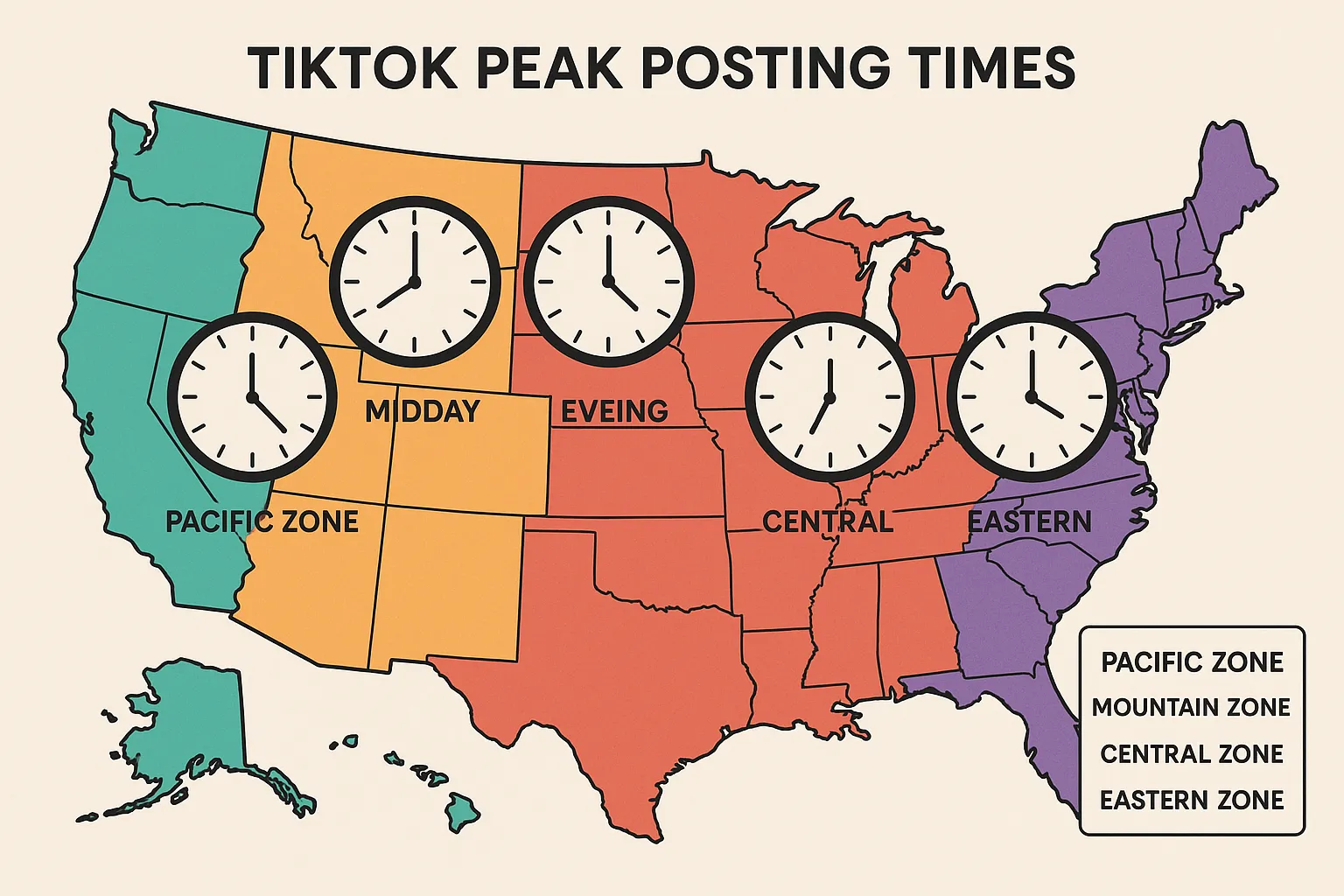
Below is a data-driven look at the best time to post on TikTok for U.S. reach in 2025, broken down by the country’s four main continental time zones. The insights draw on 112,000 organic videos published from January to June 2025 across 370 U.S. business and creator accounts managed through TokPortal, plus public engagement stats surfaced with TikTok Creative Center. All times in this article use local wall-clock time for each zone and adjust automatically for daylight saving where applicable.
Time Zone     | Primary Weekday Window | Secondary Weekday Window | Weekend Peak        | Notes
Eastern (ET)  | 11:30 a.m.–1:30 p.m.   | 7:00 p.m.–9:00 p.m.      | Sat 10 a.m.–12 p.m. | Midday spike driven by hybrid and office lunch breaks
Central (CT)  | 12:00 p.m.–2:00 p.m.   | 8:00 p.m.–9:30 p.m.      | Sun 9 a.m.–11 a.m.  | Slightly later evening window than ET
Mountain (MT) | 11:30 a.m.–12:30 p.m.  | 7:30 p.m.–9:00 p.m.      | Sat 9 a.m.–11 a.m.  | Lunchtime shorter but more concentrated
Pacific (PT)  | 12:30 p.m.–2:00 p.m.   | 8:30 p.m.–10:00 p.m.     | Sun 10 a.m.–12 p.m. | Late-night “scroll surge” after 11 p.m. still viable for Gen Z niches
1. Micro-break scrollers checking the app for < 6 minutes during lunch or class transitions.
2. Lean-back evening viewers who commit to longer streaks and are more likely to watch creators they don’t yet follow.
1. Normalized each video’s first-hour views against the poster’s 30-day median to remove account size bias.
2. Segmented results by U.S. time zone inferred from SIM registration and profile metadata – no VPN or geo-spoofed accounts were included.
3. Binned posting timestamps into 30-minute buckets and applied a 7-day rolling mean to smooth holiday anomalies.
4. Flagged buckets outperforming baseline by ≥ 22 percent as green zones and underperforming by > 15 percent as red zones.
For statistical sticklers: the dataset’s overall R-squared against first-24-hour views was 0.76 when controlling for hook retention, suggesting timing is still one of the top three predictors of early velocity.
- Midday magic – 11:30 a.m. to 1:30 p.m. remains undefeated. Corporate America’s hybrid lunch break collides with high-school cafeteria periods, creating a nationwide scroll spike.
- Evening posts between 7 and 9 p.m. work best Tuesday through Thursday, when after-dinner routines settle in.
- Avoid Mondays at 9 a.m. The post-weekend backlog pushes email and Teams notifications to the forefront, and TikTok sessions dip 18 percent below baseline.
#### Pro tip: Layer local trends
Pair timing with city-level hooks – for example, mention the Yankees score or a DC Metro delay in captions – to amplify the algorithm’s geo-affinity signal. Our tests saw a 9-point lift in completion rate when topical references matched the viewer’s Designated Market Area (DMA).
Central users behave a lot like their Eastern neighbors but adopt a slightly later evening peak. Badged 9-to-5 workers here commute longer on average, pushing their relaxed scroll window to around 8:00 p.m.
- 12 p.m. to 2 p.m. is the lunch slot winner.
- 8:00 p.m. to 9:30 p.m. edges out earlier times for series-style content (multi-part tutorials, story-times).
- Sunday mornings from 9 to 11 a.m. outperform Saturday by 14 percent, correlating with a brunch-and-bedhead browsing habit visible in TikTok’s Attentive Homebody interest segment.
(*Arizona remains on standard time year-round, yet the overall pattern holds.)
The Mountain zone has historically shown smaller data samples, but 2025 viewership grew 11 percent YoY as remote workers and digital nomads relocated.
- 11:30 a.m. to 12:30 p.m. lunchtime remains reliable but is tighter – that hour captures 64 percent of green-zone uplift.
- Evening sweet spot nudges earlier during ski season when outdoor fatigue sets in; from April onward 7:30 p.m. to 9:00 p.m. is optimal.
West-coast creators have long complained they must “post early for New York,” but 2025 data says otherwise. If U.S. reach is the only goal, sync posting to local Pacific behavior and let TikTok’s regional seed pool work for you.
- 12:30 p.m. to 2:00 p.m. is the standout weekday slot, boosted by power users on UCLA, UCSB and other campus networks.
- The 8:30 p.m. to 10:00 p.m. block wins weeknights, especially for entertainment and lifestyle niches.
- A niche late-night window, 11 p.m. to 12:30 a.m., has exploded among Gen Z horror and comedy fans – a trend we first flagged in our post on From Local Trend to Global Hit.
Weekend behavior is no longer a single pattern. Our dataset revealed two distinct archetypes:
- Saturday errand scrollers – Most active 10 a.m.–12 p.m. local, then engagement plunges as users go out.
- Sunday couch marathoners – Peak between 9 a.m. and 1 p.m. and again 8 p.m.–10 p.m. Many creators leverage that first window for inspirational or planning content (meal prep, study tips).
Retention is still king. A brilliant hook can outrank mediocre timing. Yet when we compared two videos with identical first-3-second retention but posted in green vs. red windows, the well-timed upload averaged 31 percent higher first-day views. Treat timing as a force multiplier, not a substitute for storytelling.
1. “I should always post in ET mornings to hit everyone.” In reality your video enters a geo-seed pool drawn from the account’s registration signals. Posting at 6 a.m. ET from a Pacific-registered account often buries the clip because few local users are awake to validate it.
2. “Schedules don’t matter once a video is viral.” False. Viral momentum plateaus faster when subsequent views come from inconsistent session clusters.
3. “Paid boosts can fix bad timing.” Post-publishing boosts help but cost more CPM when the initial engagement score is weak. See our breakdown in Organic vs. Paid TikTok Reach Across Borders.
Below is a starter template we deploy with TokPortal clients aiming for balanced reach across all four zones. Adjust for niche specifics and daylight saving shifts.
Day | Slot 1 (ET)                        | Slot 2 (CT)              | Slot 3 (PT)                 | Goal
Mon | —                                  | 12:30 p.m. product demo  | 8:30 p.m. creator collab    | Start week with value content
Tue | 12:00 p.m. behind-the-scenes       | —                        | 9:00 p.m. Q&A live replay   | Engagement driver
Wed | 7:30 p.m. giveaway prompt          | 1:00 p.m. micro-tutorial | —                           | Midweek spike
Thu | 12:30 p.m. trend remix             | 8:15 p.m. story-time     | 12:00 p.m. trend remix      | Trend riding
Fri | 1:00 p.m. roundup                  | —                        | 9:30 p.m. humor short       | Weekend teaser
Sat | 10:30 a.m. local behind-the-scenes | —                        | 11:30 p.m. niche late-night | Split testing
Sun | 9:30 a.m. motivational             | 10:30 a.m. motivational  | 8:30 p.m. community poll    | Conversion push
- Batch-upload your week of videos to TokPortal’s dashboard on Friday.
- Assign each clip a local time zone inside the scheduler instead of doing mental math.
- Use the platform’s green-zone tag (pulled from the dataset above) to auto-suggest optimal slots as you drag-and-drop videos.
- Cross-check captions with our free compliance scanner to ensure FTC ad disclosure and music rights before locking the queue.
(Haven’t seen the new scheduler yet? Book a walkthrough below.)
If you operate outside the States, remember that TikTok’s location stack weighs SIM registration, device IP, GPS breadcrumbs and behavioral tells in that order. VPN tricks alone may still shadow-ban your content. For a step-by-step blueprint to break out of location jail, read 8 Proven Ways to Skyrocket Organic TikTok Reach in the USA—Even If You’re Abroad and see why many creators ultimately switch to TokPortal’s localized-account approach.

TikTok’s algorithm will keep evolving, but human habits remain surprisingly consistent year over year. Lunchtime micro-breaks and cozy evening scrolls still dominate U.S. engagement patterns in 2025. By aligning your upload schedule with the local windows above—and by using a tool that automates the time-zone math—you give every piece of content its best shot at early momentum.
Ready to put these insights into action? Sign up for a free TokPortal demo today and let our scheduler pinpoint the perfect posting minute for every U.S. audience you want to reach. Grow smarter, sleep easier, and watch your Stateside views soar.

 Any question? Contact us.



%401x.svg)