


Sign in with Google
If you are trying to scale TikTok across countries, the hard part is rarely “making content.” It is distribution. The moment you move beyond one account and one timezone, posting becomes a fragile ops problem: logins break, devices get flagged, VPN workarounds stop working, and your team spends more time babysitting uploads than learning what actually performs.
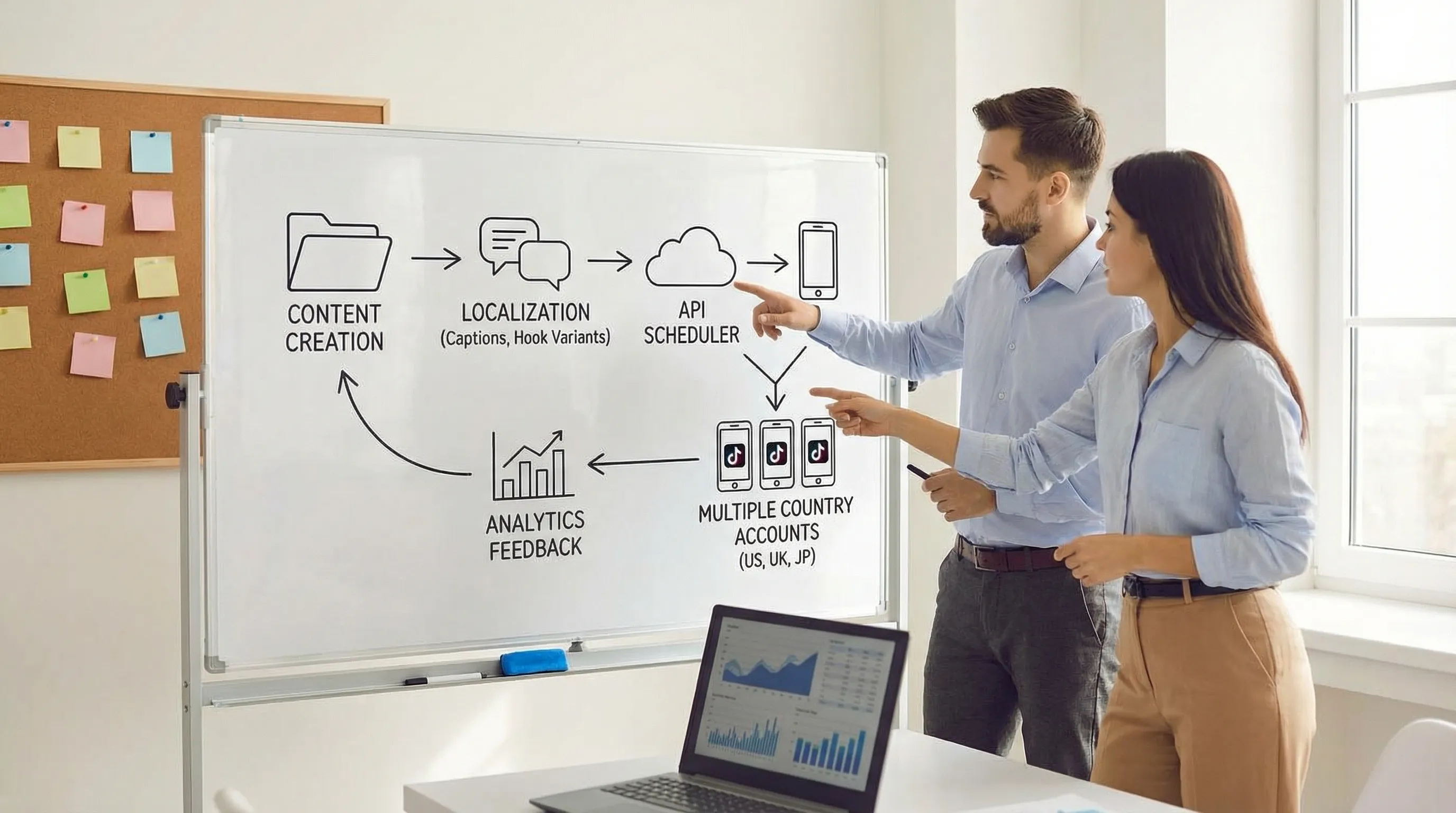
Real-device API uploading is the cleanest way out of that mess. It combines two things TikTok’s systems consistently trust: (1) genuine, in-country device signals, and (2) a repeatable, automated publishing pipeline that can scale.
This article explains what real-device API uploading is, why it works, and how growth teams use it to ship more content, across more markets, with less account risk.
Real-device API uploading is exactly what it sounds like:
This is fundamentally different from:
For teams doing multi-market organic growth, real-device API uploading is less about “a trick” and more about building proper infrastructure.
TikTok’s recommendation system is optimized for viewer experience and platform integrity. To protect that, TikTok evaluates a mix of signals that help it understand whether an account is “native” to a place and whether behavior looks human.
In practice, teams run into three realities:
Even if your content is globally relevant, distribution typically starts in a local test bubble. When your account and device signals do not align with the audience you want, you can end up testing in the wrong pool.
TokPortal’s own guidance echoes a common field observation from international teams: when the account geo does not match the target audience, reach can drop sharply. That is one reason localization is often the entry point into multi-country growth.
VPNs mostly solve one variable (IP), while TikTok can evaluate many others. Depending on setup, that can include device integrity, SIM/telecom signals, timezone consistency, login patterns, and behavioral anomalies.
That is why “it worked last month” workflows suddenly fail. Your process did not become wrong, the platform’s detection simply got better.
When you manage many accounts manually, the workflow itself starts to look suspicious:
Real-device posting reduces those inconsistencies. API-driven publishing reduces the human chaos that creates them.
Most teams can brute-force their way through one or two accounts. The moment you scale, everything compounds:
Consistency matters on TikTok. TokPortal cites a practical benchmark many growth teams see: posting 5+ times per week tends to produce meaningfully better performance than sporadic bursts.
The real issue is not “knowing” you should post more. It is having a workflow that can do it without breaking.
API uploading is often framed as automation, but the real benefit is repeatability. Repeatability is what enables learning.
If you can publish the same creative concept across the US, UK, Canada, Australia, and France within hours (with localized captions, hooks, and timing), you can answer high-value questions quickly:
That is “multi-country social API” value in plain terms: not just posting, but running controlled experiments across geos.
Manual posting is where small mistakes become expensive:
A good API workflow enforces guardrails and makes output consistent.
When you schedule based on each account’s timezone, you stop thinking in “our office time” and start thinking in “viewer time.” That is a subtle shift, but it is one of the fastest ways to stop wasting good videos.
On mature teams, the creative pipeline and publishing pipeline are different skill sets:
API uploading lets you build a stable interface between the two, so distribution does not depend on one person remembering the steps.
An API can help you automate publishing, but it cannot fix a weak device footprint. If your accounts are not genuinely in-country, automation can scale the wrong thing faster.
Real-device infrastructure matters because it aligns three elements:
This is also why many “cheap” scale solutions fail over time. They often optimize for initial setup cost, not long-term account integrity.
To make this concrete, here are patterns that show up repeatedly in agencies, UGC studios, and startup growth teams.
A VPN works until it doesn’t. Then teams change providers, rotate IPs, and keep patching.
The hidden cost is not just bans or shadowbans. It is the time you lose, and the experiments you never run because distribution is unstable.
A single account can work for some brands, but it becomes limiting when:
Even if a phone farm posts “from the right place,” teams often face:
If TikTok is a growth channel for your business, reliability is not a nice-to-have.
TokPortal positions itself as an operating system for scaling organic TikTok and Instagram globally, not just an account-creation service.
At a high level, the platform is built around:
If your goal is multi-market scalability, the important point is the combination: real devices for trust and stability, plus API workflows for volume and speed.
You can start with the TokPortal Quick Guide to understand the basic workflow, then evaluate plans on the pricing page.
This approach is especially strong when you have one or more of the following:
If you are shipping 30, 50, or 200 posts per week across accounts, manual posting is not “hard,” it is structurally broken.
Founders and growth leads often want to validate which market responds before investing in paid. Organic localization plus automated posting is one of the fastest ways to de-risk expansion.
If you manage content for multiple brands or multiple artists, the bottleneck becomes distribution capacity. API publishing turns distribution into a system instead of a scramble.
Paid reach stops when you stop paying. Organic accounts can build audience equity over time, especially when you publish consistently and learn what formats stick.
Where it is not the best fit:
You do not need 20 countries to get value. Start small, prove the loop, then scale.
Pick markets where one of these is true:
Before you localize, standardize. Define:
Then localize the surface layer: phrasing, slang level, captions, and posting windows.
A common failure is doing a heroic week, then disappearing.
If you want TikTok to learn your account and audience, consistency matters. Even a steady cadence (for example, 5+ posts/week) typically beats sporadic bursts with the same total output over a month.
Once you have a working flow, document it, then automate as much as possible:
This is where API uploading becomes a force multiplier.
When you scale across markets, global averages hide the truth.
Track performance by account and country so you can answer:
TokPortal’s analytics are designed for this kind of breakdown across accounts and regions.

Even if you do not choose TokPortal, evaluate solutions on the criteria that actually determine success:
TokPortal claims a long-running operational record with a high success rate and large account volume created, which is exactly the kind of proof you want when your growth depends on stability.
Real-device API uploading is not a gimmick. It is what happens when you treat TikTok distribution like infrastructure.
If your team is serious about multi-country organic growth, the winning pattern is:
If you want to see what this looks like in practice, start at the TokPortal homepage, follow the Quick Guide, and when you are ready to build your pipeline, you can sign up here or review plans on the pricing page.


 Any question? Contact us.



%401x.svg)