


Sign in with Google
Most UGC campaigns fail for a boring reason: the brand treats “UGC” like a creative project, not a performance system.
In 2026, user-generated content is one of the highest-leverage growth assets you can build because it compounds across:
But building a successful UGC strategy should not require guessing what works, or burning budget on content that looks “authentic” but does not convert.
In this guide, I’m going to lay out the exact system we see consistently drive ROI across industries, including what to produce, how to brief creators, how to distribute globally, and how to measure what is actually working.
UGC is any content (videos, photos, reviews, posts) created by people rather than brands.
The part most teams miss: most high-performing “UGC” in 2026 is not random customer content. It is commissioned content engineered to feel like a real post in-feed.
That matters because your strategy changes depending on what you are actually producing. In practice, there are three buckets that get labeled as UGC:
Real people create content, often paid by the brand, to look like a natural recommendation. Think unboxings, demos, testimonials, “day in the life,” or “here’s what I’d do differently.”
This is still the core of UGC for most brands because it gives you:
This is content created with synthetic avatars that do not exist in real life.
It is useful when you need full control and infinite iterations, but it can underperform when your category demands “proof” (skin, food, physical products, or anything with strong scam risk).
This uses real humans who have consented to their likeness being used, with AI generating variations at scale.
It can be a strong option when you need:
Why this distinction matters: “UGC” is not one tactic. It is a portfolio. Your job is to pick the right blend based on speed, control, and trust.
If you want predictable performance, treat UGC like a production and distribution flywheel.
Here’s the loop I recommend for 2026:
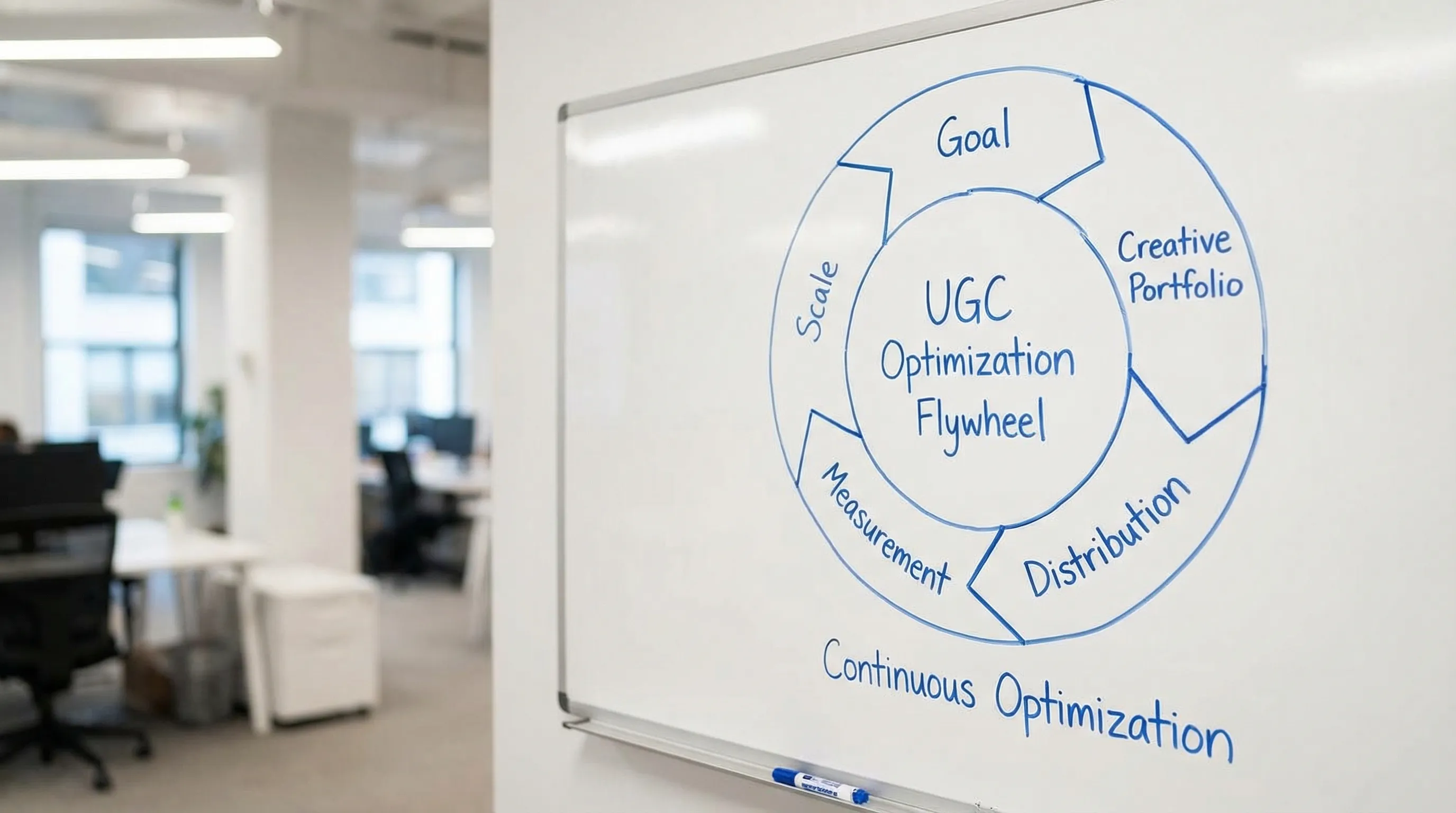
The key is step 3. Most teams under-invest in distribution and over-invest in “perfecting” a small batch of videos.
TokPortal benchmarks show consistent posting is a multiplier, with 34% more views when posting 5+ times per week. UGC does not win because a single video is amazing. It wins because you run enough shots on goal to let the algorithm and the market tell you what resonates.
Some formats repeatedly outperform because they match how people decide in-feed: fast pattern interrupt, quick proof, low-friction next step.
This is the most “organic” UGC style: someone casually includes your product in their routine.
Use it to:
Even if you commission it, your goal is to make it feel like it happened without a brand brief.
The highest ROI testimonials are not generic praise.
They answer one specific objection:
If you sell SaaS, make testimonials outcome-based. If you sell physical products, make them sensory and specific (texture, size, real-world use).
This converts because it reduces uncertainty.
In 2026, the strongest demos are:
For B2B and app growth, tutorial UGC is consistently underrated.
It works because it:
Transformation content works when the “after” is undeniable.
If you can’t show a visible before/after, you can still create transformation by framing:
UGC is not one-size-fits-all. The conversion trigger changes by category.
Your job is to eliminate doubt fast.
Prioritize:
The buyer wants reassurance.
Prioritize:
The buyer wants outcomes and clarity.
Prioritize:
For SaaS teams, UGC pairs well with outbound that captures demand once interest is created. If LinkedIn is part of your motion, tools like personalized LinkedIn conversations at scale can help you follow up and qualify leads without turning outreach into a full-time job.
You do not have to pick one lane. The highest-performing teams use all three intentionally.
Best for long-term brand equity and trust.
Limitations:
Best for controlled iteration.
You get:
This is the default choice for performance teams that need output weekly.
Best when:
The risk is “uncanny” content. The fix is to anchor scripts in real customer language, and keep production constraints similar to real posts (simple setups, natural pacing).
UGC creators and influencers both produce content, but they solve different problems.
Influencers sell access to an audience. UGC creators sell content you can deploy anywhere.
In 2026, most growth teams choose UGC when they want:
And they choose influencers when they want:
Cost reality (typical ranges): UGC creators often sit in the $50 to $500 per video band, while influencer posts can start in the hundreds and climb into thousands+ depending on reach and category.
Most UGC campaigns underperform because the brief is vague.
A high-converting UGC brief is not long. It is specific.
Include:
A practical rule: if your creator can’t repeat the goal back in one sentence, the brief is not ready.

You can have great UGC and still fail if distribution is weak.
Two 2026 realities:
That geo point is why “global UGC” often breaks. Brands try to run one account, one upload workflow, one timezone. The content lands in the wrong test bubble, performs poorly, and the team concludes the creative is bad.
If you are expanding beyond one market, treat each priority country as its own distribution lane:
TokPortal is built for this operational layer. Instead of juggling devices, SIM cards, VPN risk, and multiple logins, you can use TokPortal to:
If you want to see the workflow end-to-end, start with the Quick Guide, then review Pricing when you’re ready to scale.
In 2026, the biggest measurement mistake is judging UGC only on likes.
Likes are not useless, but they are rarely the best leading indicator for revenue.
Here’s the measurement stack I recommend:
If you run paid, remember the baseline economics: TikTok ads commonly sit around $5 to $15 CPM depending on targeting and market conditions. That means your UGC has two jobs:
A useful discipline: do not “scale spend.” Scale winners. Remake the top 10% of videos with new creators, new hooks, and new first lines.
If you want a plan you can actually execute, here’s a clean 30-day sprint structure.
If you are doing this across countries, this is where the ops layer matters. Publishing winners from genuine local accounts is often the difference between “it worked in one geo” and “it scales globally.”
UGC is not an ad. If it looks like an ad, it performs like an ad.
Fix: keep the setting real, the pacing fast, and the script conversational.
Teams pay for a batch, then realize they cannot run it as ads, cannot edit it, or cannot use it internationally.
Fix: put usage rights, duration, and paid permissions in writing every time.
If you test 3 videos, you are not running a campaign. You are buying lottery tickets.
Fix: design for volume. The algorithm needs shots on goal.
Posting “US-targeted” UGC from a non-US account setup often under-delivers.
Fix: distribute from true local accounts, with local posting windows.
UGC is a system. The compounding comes from weekly iteration.
Fix: build a recurring pipeline, then scale what works.
UGC in 2026 is less about finding one magical creator and more about building a repeatable machine:
If your next constraint is global distribution, TokPortal is designed to be the operating system for organic TikTok and Instagram at scale. You can learn the workflow on the TokPortal homepage, and when you’re ready to build your multi-market setup, create your account here: Sign up.


 Any question? Contact us.



%401x.svg)