


Sign in with Google
Running 50+ TikTok accounts sounds like something only a global brand with country managers can pull off. In reality, most teams fail for a simpler reason: they try to scale TikTok like social media, instead of scaling it like an operation.
At 50+ accounts, your bottleneck is rarely creativity. It is infrastructure, workflow, and geo integrity (creating and posting from accounts that TikTok recognizes as truly local). This guide breaks down a practical system to run TikTok multiple accounts across markets without building local teams in every country.
If you have ever managed 3 to 5 accounts, you know the pain points: logins, posting times, approvals, tracking results. At 50+ accounts, those issues become structural:
The solution is not “hire 10 more people.” It is to build a repeatable system where a small central team can publish locally, consistently, and safely.
Before tools or staffing, decide what your “account map” is. Most teams waste months because they create accounts reactively, then cannot standardize content, naming, or measurement.
Country-first (most common for growth teams): one account per country per brand.
This is ideal when your goal is localization and distribution. You learn what formats work in the US vs UK vs France, and you build native audiences.
Vertical-first (best for agencies and multi-client UGC studios): one account per niche per country.
Example: Fitness US, Fitness UK, Fitness CA, then Beauty US, Beauty UK, Beauty CA. This tends to perform well because each account trains a tighter interest graph.
Product-line-first (best for DTC and apps with multiple personas): separate accounts by offer, then localize.
This reduces messaging conflicts and makes CTAs cleaner, but you will manage more accounts.
The hidden cost in TikTok multiple accounts is not posting. It is the slow creep of inconsistency that makes performance hard to compare.
Set a standard for:
If you cannot describe your account system in one sentence, you do not have a system yet.
TikTok distribution is heavily influenced by location signals. If you are trying to reach the US from abroad, your content often gets tested in the wrong audience first, and performance never compacts into the target market.
That is why “just run everything from one global account” underperforms in many categories, and why teams end up hiring local help.
You can replace most of that local execution by ensuring two things:
VPN workflows often break at scale because platforms detect patterns across device, SIM, and behavioral signals. TikTok also publishes guidance and enforcement around platform integrity and spam behaviors, so “cheap hacks” tend to decay over time. (See TikTok resources like the TikTok Creative Center for how the platform encourages native, audience-first content research.)
Think of your TikTok operation like a pipeline with defined inputs and outputs.
Here is the model that works for lean teams:
Centralize what should be centralized:
Localize what must be local:
This is how you avoid needing a local creative director in every market.
Most teams tie editing to posting, then everything slows down.
Instead, use two streams:
When you split these, you can scale posting volume without scaling your editors linearly.
For 50+ accounts, you need a lightweight localization layer that can be applied quickly:
Reserve full rewrites and re-shoots for your top 10 percent of formats.
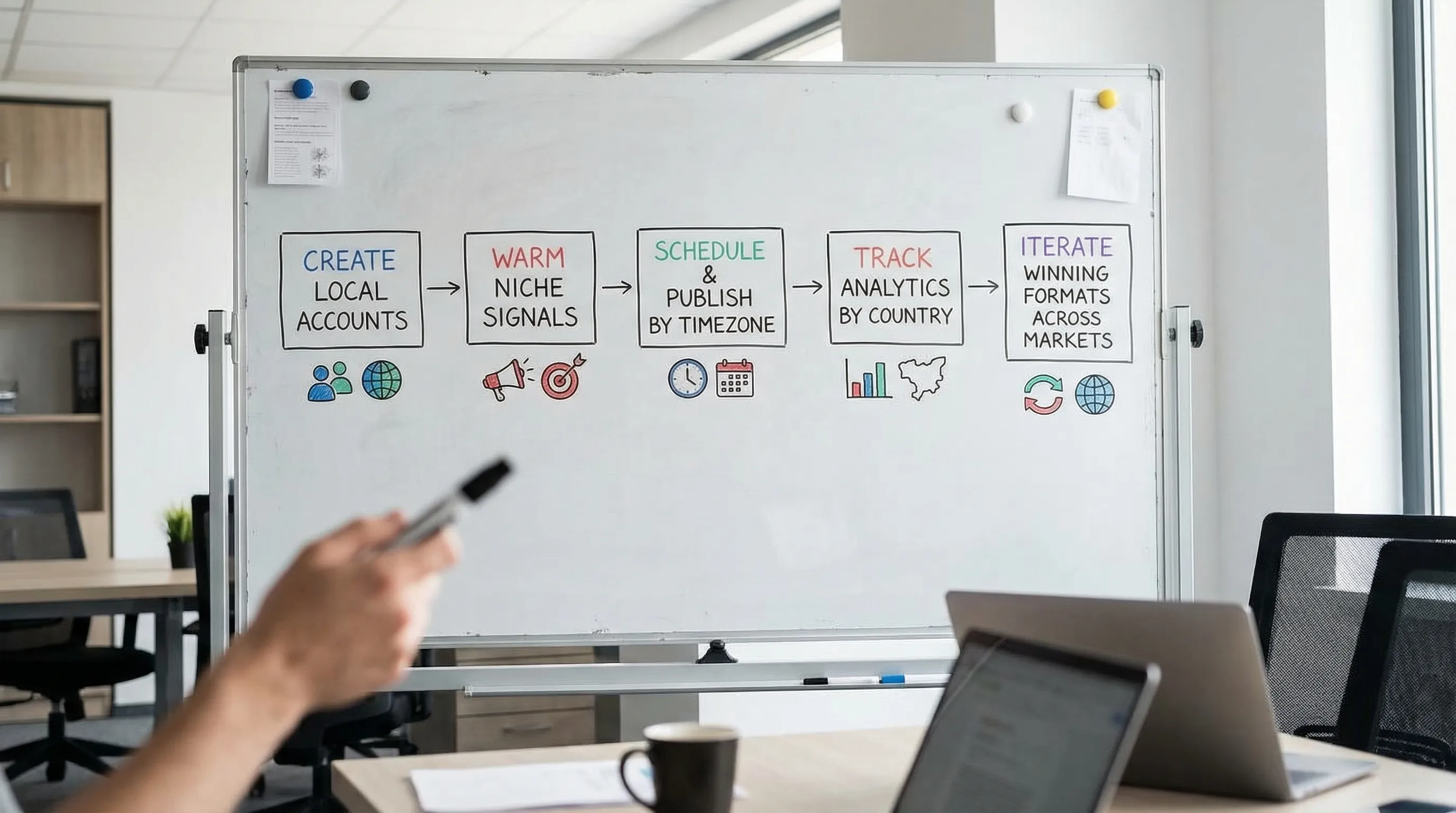
A repeatable cadence beats “working harder.” Here is a practical weekly rhythm used by multi-market teams.
Your goal is to decide what you will test this week, not to brainstorm endlessly.
Use platform-native inputs when possible. TikTok’s Creative Center trends can help you spot regional differences in hashtags and topics.
For each “core idea,” create variations designed for distribution:
At 50+ accounts, you are not chasing one viral video. You are building a machine that finds what works per geo.
This is where most teams break, because manual posting across time zones becomes a full-time job.
Your QA checklist should be boring and consistent:
The goal is to make fast decisions:
If you do this every week, you compound learnings across countries.
You can run 50+ accounts with a small team only if you remove three manual burdens.
If your team is creating accounts manually, you will hit:
TokPortal’s approach is to provision geo-verified accounts in multiple countries and manage them from one place, so your team can scale the account layer without building phone farms, juggling SIMs, or using VPNs that trigger enforcement. (If you are evaluating fit, start at the TokPortal Quick Guide.)
At 50+ accounts, “posting at the right time” becomes impossible manually.
You need:
TokPortal includes video scheduling with timezone support and bulk upload, which is exactly what makes 50+ accounts operationally realistic from a centralized team.
If performance data is scattered, teams start making decisions based on anecdotes.
At scale, you should be able to answer:
TokPortal provides analytics per account/country so you can compare markets and allocate effort based on results, not guesses.
When you launch many accounts quickly, a common failure mode is that the algorithm does not know where to place you. Teams then conclude “this market is dead,” when it is actually an onboarding issue.
TokPortal includes niche warming (described as a 3-day algorithmic optimization process). The practical value is that you start publishing with clearer positioning signals, rather than dumping content into a cold start.
If you are doing this manually, be prepared to spend time on:
When you manage TikTok multiple accounts, security is not a nice-to-have. It is client retention.
Set hard rules for:
A unified system for managing accounts is not just about convenience, it is about preventing the chaos of shared passwords and random devices.
Even with perfect infrastructure, some categories benefit from real local insight:
You do not need full-time country teams for this. A lean alternative:
Central team runs the machine. Local help is “creative QA,” not your operational backbone.
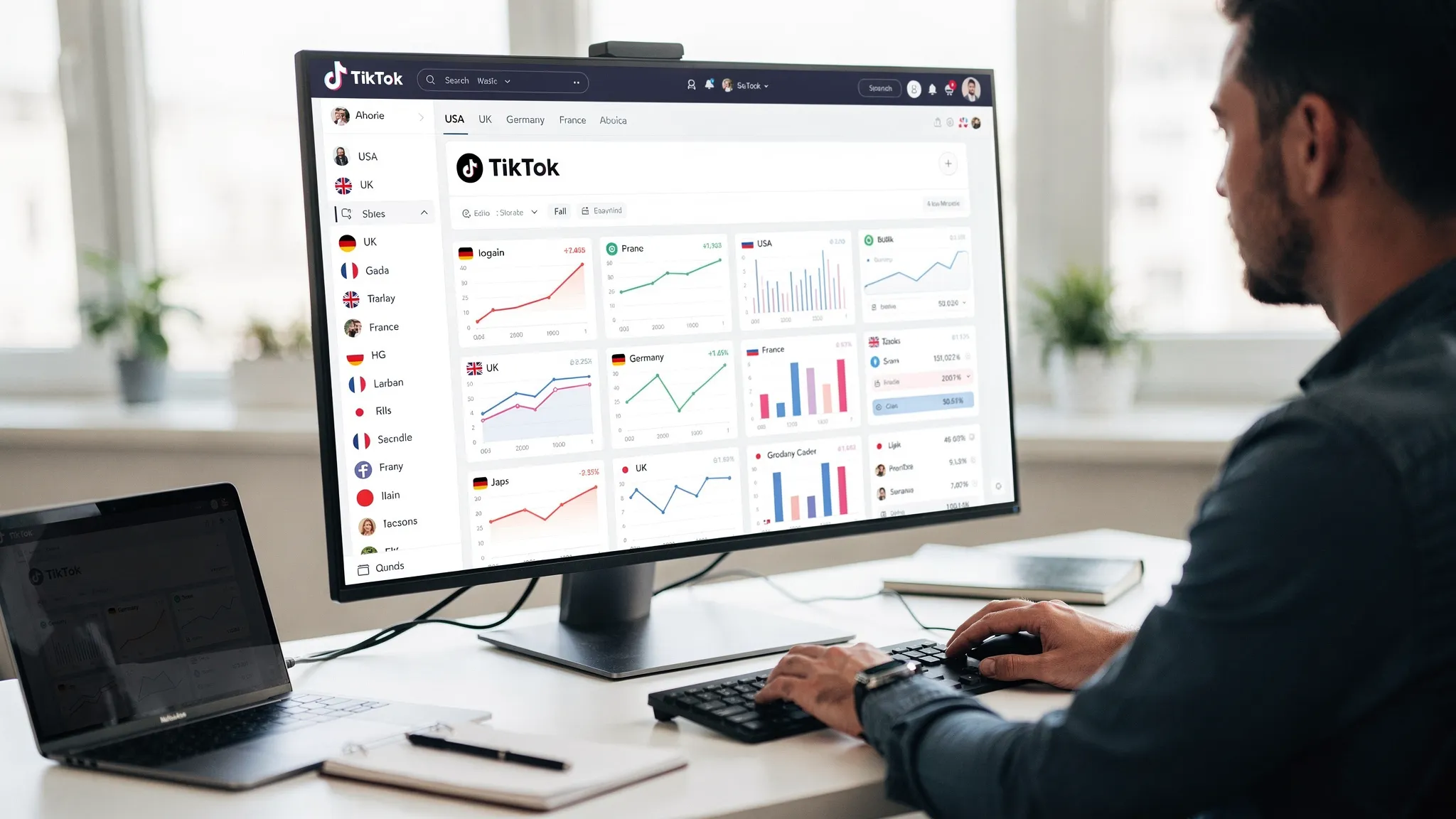
You do not need 12 tools. You need a stable core.
TokPortal is designed for the distribution layer: creating geo-verified accounts, scheduling in local timezones, and tracking performance across countries. If you also need automation, TokPortal offers API access for programmatic posting and workflows.
Is it allowed to have TikTok multiple accounts for one business? Yes, many brands run multiple accounts (by country, product line, or niche). The key is to avoid spam behavior and operate accounts with clear differentiation and audience value.
Why not just post everything on one global TikTok account? One account can work for some brands, but TikTok distribution is strongly influenced by location signals and audience behavior. Country accounts often perform better when you need consistent reach in specific markets.
Do I need a local team to reach US, UK, or EU audiences? Not necessarily. You typically need local geo integrity (accounts that are truly local) and operational capability (timezone scheduling, analytics, and consistent publishing). Local creative input can be added selectively.
What breaks first when scaling to 50+ accounts? Usually scheduling and QA. Without a centralized workflow, teams miss posting windows, mis-publish to the wrong accounts, or lose track of what is live where.
Are VPNs a reliable way to manage accounts in other countries? VPNs can work short-term for some use cases, but they are fragile at scale because platforms detect patterns and inconsistencies across device and network signals. For long-term operations, native account setups are more reliable.
If you want to scale internationally without building local teams in every market, you need infrastructure that makes local posting operational, not heroic.
TokPortal is built for exactly this: geo-verified account creation, a unified dashboard to manage unlimited accounts, timezone scheduling and bulk upload, and analytics by country.


 Any question? Contact us.



%401x.svg)