


Sign in with Google
Running one TikTok account is a creative challenge. Running 10, 50, or 200 accounts across countries, products, and creators becomes an operations problem.
That is why teams that win on organic short-form in 2026 treat TikTok like distribution infrastructure: clear account architecture, a repeatable content pipeline, and a single place to schedule, publish, and measure what works.
This guide breaks down how to manage multiple TikTok accounts at scale from one dashboard, including the workflows agencies, DTC brands, app founders, and labels use to grow globally without turning account management into a full-time firefight.
Yes. TikTok allows users and businesses to run more than one account, as long as you follow platform rules (no impersonation, fraud, spam, or deceptive behavior). TikTok even documents how to add and switch between accounts in the app, which is a strong signal that multi-account usage is expected behavior. See TikTok’s Help Center guidance on adding and switching accounts for the latest platform-specific steps.
The real question is not whether you can, it is whether you can do it reliably at scale without:
A single dashboard is how serious teams turn “multiple accounts” into a system.
Multi-account is not automatically better. It is better when segmentation improves distribution, relevance, or speed of testing.
Multiple accounts typically make sense when:
A single account is often enough when:
If you are expanding internationally, remember that TikTok distribution is heavily influenced by location signals. Publishing into the wrong geo often creates a performance ceiling, even if the creative is strong. That is why many growth teams start with “local accounts per market” as the baseline.
Most teams hit the same bottlenecks once they go past 3 to 5 accounts.
The native app experience is designed for humans, not operations.
Switching accounts manually becomes fragile when you have:
Every manual step becomes a chance to publish the wrong video on the wrong account, miss a posting window, or lose track of what has already shipped.
Teams often start with VPNs, proxies, borrowed phones, and ad-hoc SIM setups. This tends to create inconsistency in account health over time.
TokPortal’s approach is different: real, geo-verified accounts created on real devices in-country, then managed centrally. If your goal is long-term organic compounding, reducing account risk matters as much as improving creative.
Consistency is one of the biggest controllable levers in organic growth, but “consistency” is local.
A brand posting for the US, UK, France, and Japan cannot treat 9:00 AM as one universal moment. A dashboard with timezone-aware scheduling is what turns “we should post at local peak times” into a repeatable behavior.
When performance is split across accounts, countries, and creators, teams waste time answering basic questions:
One dashboard that aggregates performance at the account and country level is the difference between managing content and running an optimization loop.
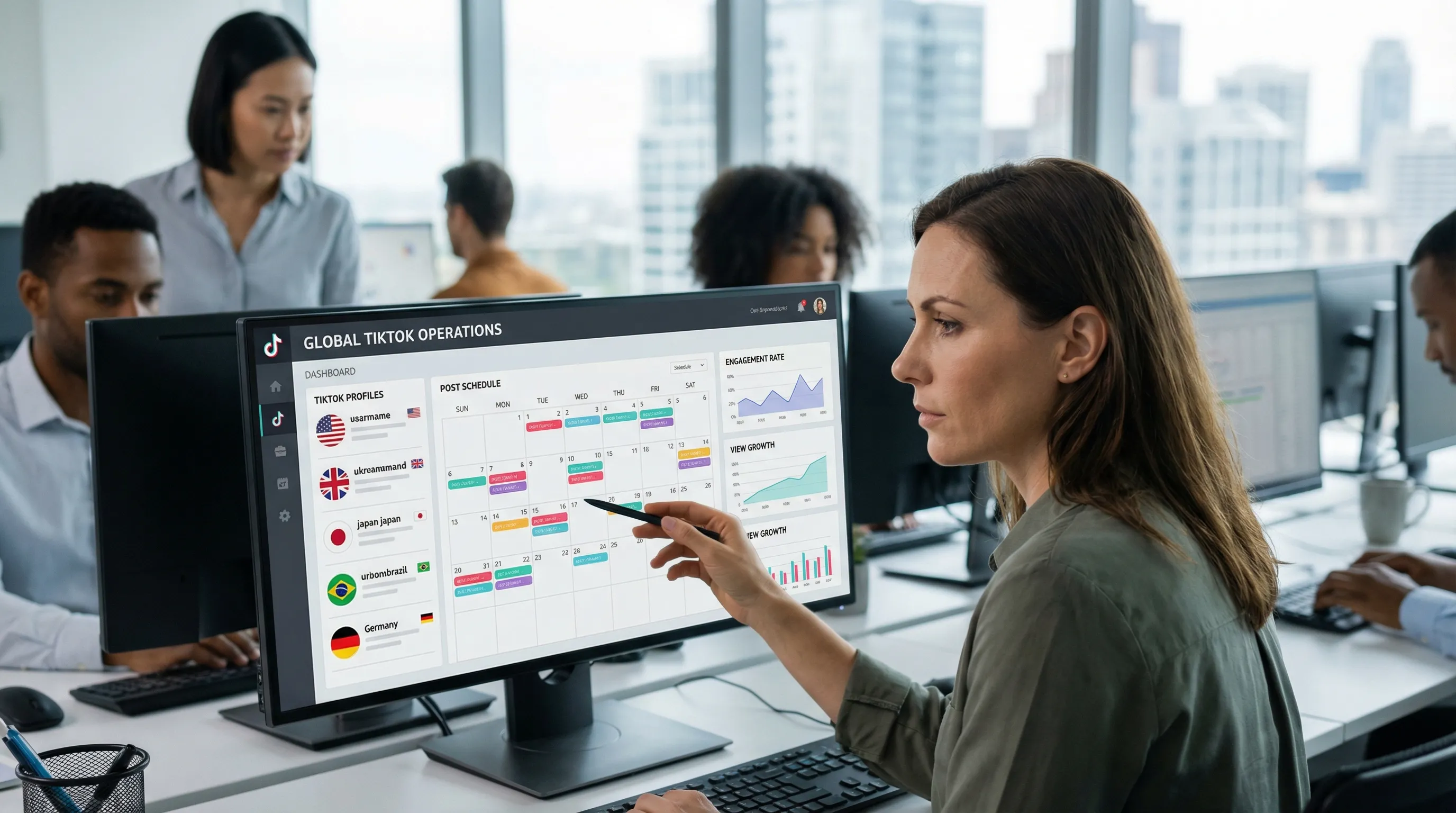
The most effective setup is not “everything centralized” or “everything local.” It is a split:
Centralize the parts that benefit from standardization:
Localize the parts that benefit from cultural proximity:
This is why TokPortal positions itself as more than “accounts in other countries.” It is the operating system that keeps the centralized engine running while you localize what actually needs to be local.
Before you schedule a single post, define how accounts map to business outcomes.
Most scaling teams use one of these patterns:
Pattern A: Country accounts (best for localization and geo testing) One brand, multiple countries (for example, BrandUS, BrandUK, BrandFR).
Pattern B: Product-line accounts (best for diverse audiences) One company, multiple offers (for example, AppTips, AppCreators, AppEnterprise).
Pattern C: Country x product (best for high volume teams) Separate accounts for each market and offer when volume is high enough to justify it.
Standardization prevents chaos later.
Keep a lightweight spec that covers:
This also makes onboarding new team members dramatically faster.
A dashboard helps you publish, but you still need a reliable content pipeline.
A practical supply chain for multi-account TikTok looks like this:
Batching reduces context switching and makes localization easier. Many teams record 10 to 30 raw clips in one session, then slice them into formats.
Your core narrative can stay consistent (problem, proof, payoff). Your local wrapper changes:
If you want a deeper workflow on keeping authenticity while repurposing, TokPortal’s broader library on localization and repurposing is a useful companion starting point from the TokPortal blog.
Not every market needs fully re-shot videos.
Your “ready to publish” asset should include:
When your packaging is consistent, scheduling from one dashboard becomes a mechanical step, not a creative scramble.
When you run multiple markets, the point of scheduling is not just convenience. It is to protect consistency.
Here is a simple approach that works for most teams:
Pick 1 to 2 windows per day per country account and stick to them for at least 2 weeks. You are building a stable testing environment.
A healthy system has a backlog of approved posts per account so you are never forced into “post whatever is ready.” This is where bulk upload and calendar visibility matter.
Publishing the same creative to 8 accounts at the same minute can reduce your ability to learn. Stagger posts so you can attribute performance to market differences, not timing collisions.
TokPortal supports video scheduling with timezone support and bulk upload, which are foundational features if you are publishing at volume across regions.
“Single dashboard” only creates leverage if you implement operating rules.
Small teams can combine roles, but the responsibilities should be explicit:
If you are a label, a DTC brand, or a regulated product category, add an approval gate before scheduling. It is cheaper to slow down one step than to deal with a takedown or brand incident across 20 accounts.
At scale, you are running experiments:
You want a dashboard plus a lightweight experiment log so performance improvements compound and do not disappear when a team member leaves.
When you are posting dozens or hundreds of videos per week, manual workflows break.
TokPortal includes API access for programmatic posting and automation, which matters if you want to connect your content pipeline (editing, localization, storage) directly to scheduling and publishing.
Do not overcomplicate measurement. You want a small set of metrics that indicate creative quality, algorithm pickup, and business impact.
At the account and country level, pay attention to:
TokPortal’s analytics per account and country is designed for this style of decision-making: compare performance across markets without exporting a dozen spreadsheets.
Multi-account management increases the blast radius of mistakes.
At minimum, treat this like a real ops surface:
If your strategy depends on consistent geo performance, using native, geo-verified accounts is the safer foundation than juggling spoofing setups.
If you are trying to scale organic TikTok and Instagram across countries, TokPortal is built to be the infrastructure layer:
If you want to see the platform overview first, start at the TokPortal homepage. If you are already convinced you need infrastructure, check pricing or go straight to sign up.
Can you have multiple TikTok accounts on one phone? Yes, TikTok lets you add and switch between multiple accounts in the app. The limitation is operational, not technical: it becomes hard to manage at scale with multiple team members, time zones, and approval needs.
Will TikTok ban you for having multiple accounts? Having multiple accounts is not, by itself, a bannable offense. Risk usually comes from behavior (spam, repeated policy violations) or suspicious access patterns (for example, inconsistent location signals and logins).
How many TikTok accounts can a business manage realistically? Without a centralized system, most teams start to feel pain at 5 to 10 accounts. With a dashboard, clear roles, and a content pipeline, agencies and growth teams can manage dozens or more.
Do I need separate emails and phone numbers for each TikTok account? In practice, you should plan for separate, recoverable credentials per account so ownership and recovery are clean. Exact requirements can change, so follow TikTok’s latest account setup guidance.
What is the fastest way to run country-specific TikTok accounts? The fastest reliable path is using geo-verified accounts created on real devices in-country, then managing publishing and analytics from one dashboard. This avoids the fragility of VPN-based setups.
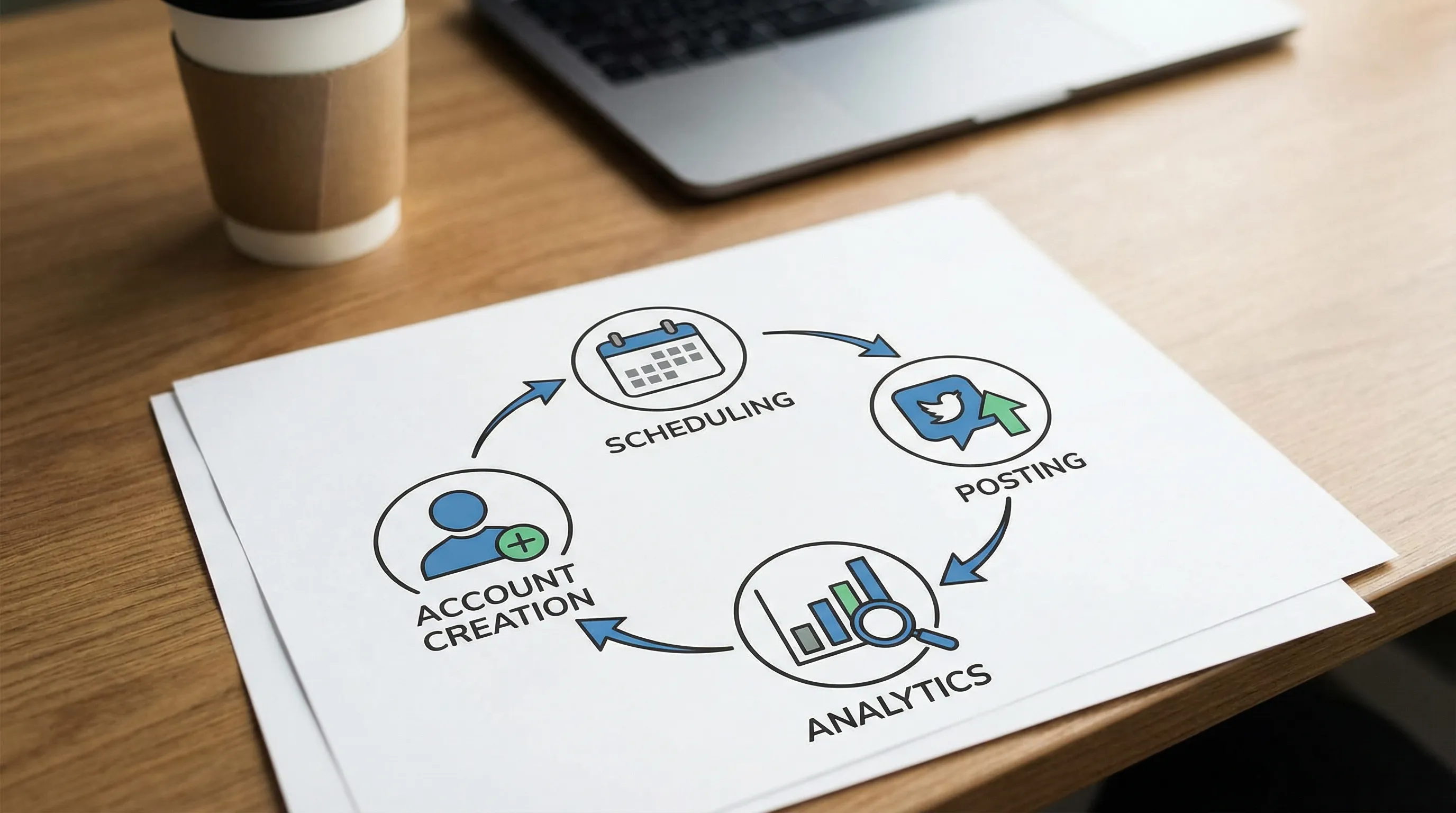
If you are serious about global organic growth, the bottleneck is rarely “ideas.” It is operations: creating the right accounts, posting consistently across time zones, and measuring performance market-by-market.
TokPortal is built for exactly that. Start with the Quick Guide, explore pricing, or create your workspace and begin scaling from one dashboard.


 Any question? Contact us.



%401x.svg)