


Sign in with Google
TikTok can take a brand new account, with zero followers, and still find the right audience fast enough to generate real business outcomes. That is not luck, and it is not “shadowy magic.” It is the result of a recommendation system built to learn quickly from dense behavioral feedback, classify content at upload time, and run constant exploration at scale.
This article breaks down how the TikTok algorithm really works, why it feels stronger than other platforms, and what growth teams can do to consistently earn For You Page distribution (including when you are posting across countries).
TikTok has publicly described the high-level inputs behind the For You feed: user interactions, video information, and device/account settings, while clarifying that they aim to balance personalization with diversity. Their explainer is worth reading because it aligns with what modern recommender systems look like in production.
Separately, ByteDance has published technical work that strongly suggests how their infrastructure can support massive-scale ranking and retrieval.
What we do not know publicly: the exact model architecture for the For You Page, the real weights of each signal, and the full set of rule-based layers that sit on top of model scores (trust, safety, diversity, integrity, policy, regional constraints).
That said, you do not need their source code to understand the mechanics well enough to make better content and better distribution decisions.
The single biggest mental model shift is this:
On TikTok, your follower graph is not the product. Your behavior is the product.
Instagram and YouTube can recommend outside the follower graph, but TikTok’s default UX (swipe, full-screen, autoplay) is purpose-built to:
That is why you can go viral without a following, and also why you can lose momentum if the system cannot confidently classify your niche.
At a high level, TikTok’s algorithm works like most large-scale recommenders: retrieve candidates, rank them, apply constraints, then learn from outcomes.
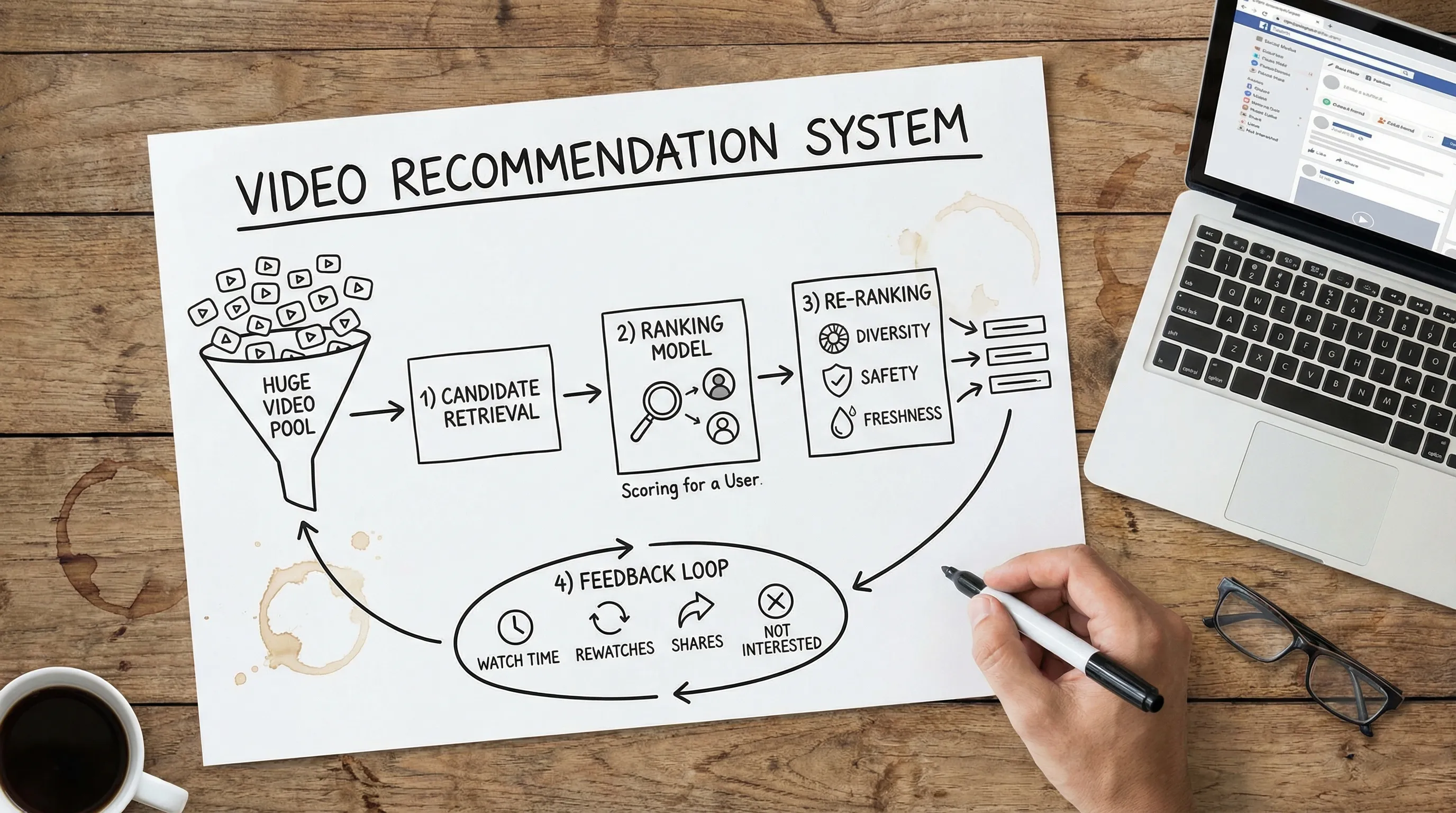
TikTok cannot “score every video” for you in real time. It first retrieves a manageable set of candidates from a massive pool.
Practically, candidate retrieval is driven by embeddings and similarity matching:
This retrieval step is a major reason TikTok feels so good. If retrieval is weak, ranking never gets a chance.
Then a ranking model scores candidates to predict outcomes like:
Modern systems rarely optimize a single metric. They optimize a weighted mix that includes both short-term engagement and longer-term satisfaction proxies.
After the model score, platforms apply constraints. This is where you often see:
This layer is also where “it’s not just the model” becomes true. Two videos with similar model scores may get very different distribution based on constraint logic.
Every swipe is training data. TikTok’s UI creates an unusually high volume of labeled feedback per user session.
That feedback improves:
TikTok publicly lists the categories of signals, but the practical difference is that TikTok’s highest-value signal is extremely measurable: watch behavior.
For short-form video, “did they watch?” is a clean and frequent signal.
A few practical nuances:
A like is cheap. A share is costly. Most recommendation systems treat sharing as a stronger signal of value and relevance.
For brands, “send-to-a-friend” content tends to be:
Comments matter, but not all comments are equal.
From a growth perspective, you want comments that:
TikTok can infer topic and context from:
This is one reason “TikTok SEO” is real. Your content is not just shown, it is understood and indexed.
TikTok has acknowledged that device/account settings can influence recommendations. In practice, geo and language alignment often determine your initial test audience.
This matters a lot for international growth. If you are trying to reach the US, but your account and posting environment are clearly not US-based, TikTok may start you in the wrong test pool, slowing down learning.
A lot of people look for a single “secret architecture.” In reality, TikTok’s edge is a stack of advantages that compound.
In a 10-minute session, a user can watch (and implicitly label) dozens or hundreds of clips.
That produces:
This is a structural advantage versus long-form platforms where each impression is “expensive” and slow.
Great recommenders must balance:
TikTok leans into exploration because:
This is why cold-start can feel unusually strong. The system is willing to test you.
If the system can classify content immediately (via text, audio, visuals), it does not have to wait for thousands of interactions to “figure out what it is.”
That helps new creators because the platform can start testing their content against relevant interest clusters faster.
Large-scale ranking systems win by learning quickly from fresh data. ByteDance’s published work on real-time recommendation infrastructure strongly signals that they invest heavily in speed, embedding systems, and production-grade ML operations.
Even if you never read the paper, the takeaway for marketers is simple: TikTok adapts fast, and your content strategy should assume shorter learning cycles.
TikTok is more willing to recommend from outside your network.
That single product choice unlocks:
The best large-scale systems are not purely neural nets. They are neural ranking plus business rules plus safety plus diversity.
This is also why “it worked last month” is not a guarantee. Constraint layers change constantly, especially around:
Creators often report one of two experiences:
Both can be true.
A practical explanation that fits modern recommender design:
So the play is not “hope for a boost.” The play is “help the system classify you quickly.”
If your goal is to reach specific countries, remember that TikTok’s early distribution is often local, or at least geo-informed.
Two implications for growth teams:
This is exactly where infrastructure matters. If you manage multi-country content programs, the operational bottleneck is not ideas, it’s execution: creating legitimate local accounts, posting at the right local times, and analyzing performance per market.
TokPortal exists for that operational layer. It is designed to help brands and agencies scale organic TikTok and Instagram globally with geo-verified accounts, scheduling, analytics, and automation from one place.
You do not “hack” TikTok. You build a system that produces strong early signals, consistently, in the right audience.
For most brands, production quality is not the lever. Structure is.
Practical retention patterns that keep working:
If you can improve the first 2 seconds, you often improve everything downstream.
Help TikTok classify your clip:
This is not about stuffing hashtags. It is about reducing ambiguity.
Rewatches are a strong signal because they imply value density.
Ways to earn them:
If you publish in disconnected topics, you force the algorithm to relearn.
Instead, run series like:
Series increase repeat consumption and make your account embedding more coherent.
Ask a question that attracts useful replies:
Then answer top comments with new videos. This creates a tight loop of relevance.
If you are a founder, agency, or UGC studio, you will win by testing systematically:
When you do this across geos, you get an extra advantage: you can discover which concepts are universal versus culture-specific.
The hard part is not posting one account. It is running 10, 50, or 200 accounts without:
If you are at that stage, TokPortal is built as an operating system for global organic. It supports geo-verified account creation (delivered in about 30 minutes in supported countries), scheduling with timezone support, niche warming, analytics per account, and API access for automation.

You are looking for consistency in a few leading indicators:
When one of these spikes, do not just celebrate. Clone the pattern (format, pacing, topic framing) and test it across adjacent niches and geos.
How does the TikTok algorithm work for new accounts? TikTok typically runs exploration tests to classify your content and find responsive micro-audiences. If early retention and engagement are strong in a cluster, distribution expands in that cluster.
What matters most in the TikTok algorithm, likes or watch time? Watch behavior (retention, completion, rewatches) is usually the strongest signal because it is frequent and hard to fake. Likes help, but they are a lighter-weight action.
Does location affect TikTok reach? Yes. TikTok has stated that device and account settings can influence recommendations, and in practice geo and language alignment often shape your initial test audience.
Is there a “secret” TikTok algorithm model that competitors can’t copy? The edge is rarely one model. It is the combination of dense short-form feedback, strong content understanding, exploration-heavy design, real-time infrastructure, and rule-based constraint layers.
How can I scale organic TikTok across multiple countries without using VPNs? The reliable method is operating genuine local accounts per market and managing posting, scheduling, and analytics centrally. TokPortal is built for this workflow.
If you are serious about organic growth, the goal is not a single viral hit. It is a repeatable system: consistent testing, clean localization, and operational control across accounts.
TokPortal helps brands, agencies, and growth teams run that system with geo-verified accounts, scheduling across timezones, niche warming, analytics, and automation.


 Any question? Contact us.



%401x.svg)