


Sign in with Google
If you are uploading 5 to 50 TikToks per day across multiple brands, creators, or countries, “manual posting” quickly becomes the bottleneck. Not editing. Not ideation. Posting.
Bulk video uploading to TikTok using an API is how serious growth teams remove that bottleneck, turn posting into a repeatable pipeline, and scale organic distribution like an operation.
TikTok is now a global discovery engine (1.5B+ monthly active users, and product discovery is a primary use case). But the compounding advantage only shows up when you can publish consistently, across accounts, across time zones, without human fatigue.
Bulk uploading is not just “upload 100 files.” In practice, it means:
The API is only one piece. The real unlock is turning TikTok posting into a reliable system.
Yes, but “yes” comes with constraints.
TikTok provides official developer products and APIs, including posting-related endpoints for approved use cases. Access typically depends on account type, app approval, permissions, and TikTok’s current developer program rules.
What to expect:
If you want to start here, use TikTok’s official developer documentation as your source of truth: TikTok for Developers.
Anything that simulates the app with brittle scripts, device spoofing, or questionable proxies tends to break over time and can create account risk. Teams usually try this when they cannot get official permissions, then abandon it when reliability or bans become expensive.
If your brand depends on long-term organic reach, treat high-risk automation like technical debt with interest.
This is where platforms like TokPortal fit when your real problem is not “one account needs posting,” but “we need infrastructure.” TokPortal is positioned as an operating system for organic TikTok and Instagram at scale: account creation in multiple countries, scheduling, bulk upload, analytics, and API access for programmatic posting and automation.
TokPortal also focuses on the operational pain points that APIs alone do not solve, like managing many accounts across markets with consistent workflows.
A scalable API posting system usually looks like this:
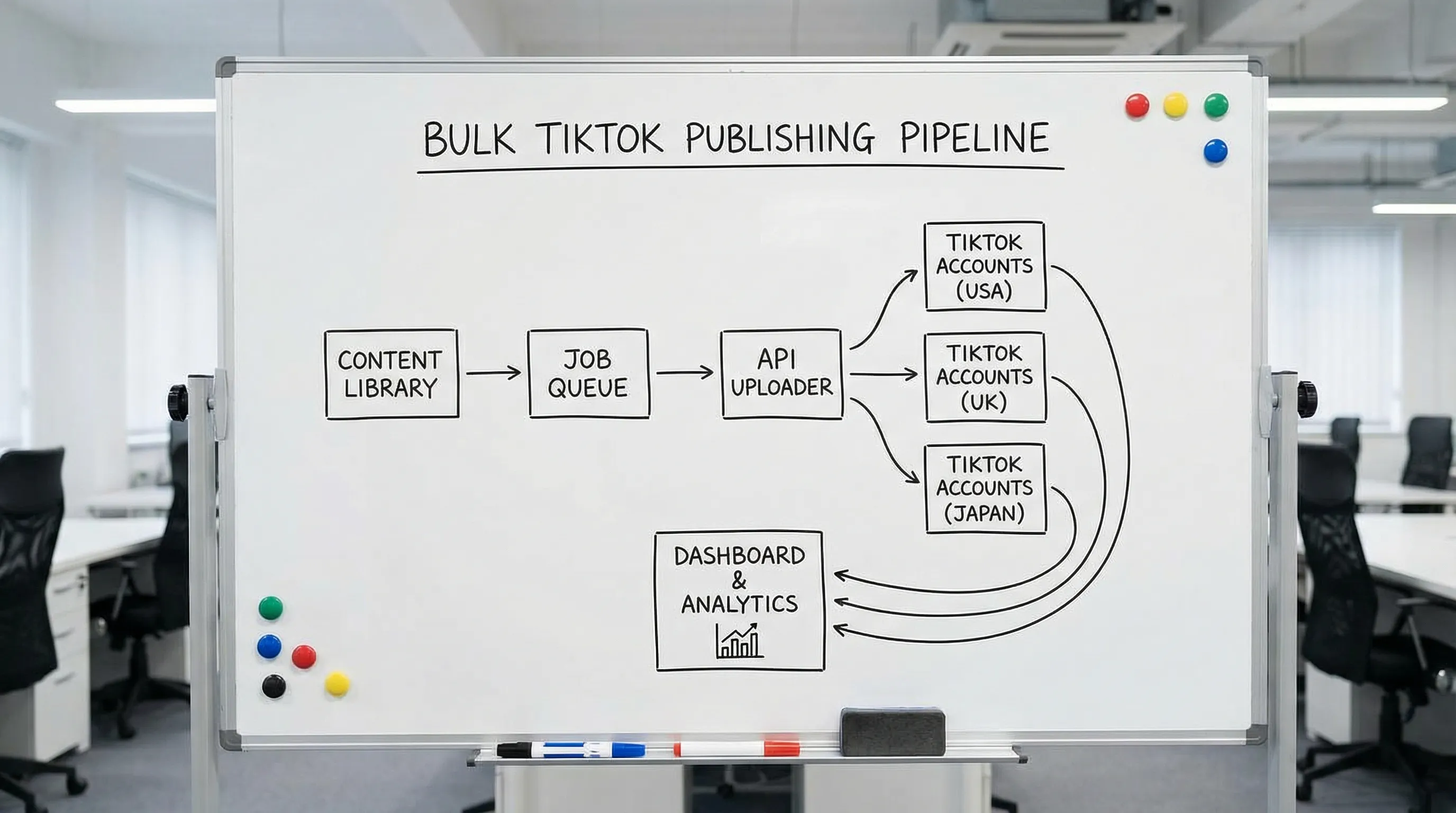
When you publish at volume, failures stop being rare. A stable system assumes:
A queue with retry logic turns “random failures” into “normal operations.”
This is the playbook most agencies and growth teams converge on.
Before the API touches anything, standardize inputs so you do not debug chaos.
Define:
hookA_en_US_v3.mp4)Bulk posting breaks when captions are handcrafted per upload.
Instead, build rules:
Keep it simple. Your goal is repeatability.
At scale, scheduling is a localization problem even if the video is the same.
Two reliable approaches:
Your queue items should include only what the publisher needs:
Most posting systems separate:
Even if your provider abstracts this, your internal logic should treat these as distinct steps.
If a post underperforms or disappears, you want answers in minutes.
Log:
This is your audit trail for operations and compliance.
Uploading in bulk to one account is straightforward. Uploading in bulk to dozens of accounts is where systems win.
A scalable team routes content based on rules:
TikTok can detect near-duplicates, especially if you blast the same asset everywhere at once.
Mitigations:
If you are scaling UGC distribution, treat “variation” as part of the pipeline, not a last-minute edit.
APIs do not remove responsibility. They increase your ability to ship, which means mistakes scale too.
Focus on:
If you operate across markets, align with your legal and policy stakeholders early, then bake checks into your workflow.
Posting faster is only valuable if you learn faster.
Track performance per account and per country:
The goal is to turn your system into a content testing lab, then scale winners.
If your plan involves multiple countries, multiple accounts, and consistent volume, you typically need more than “an endpoint that posts.” You need infrastructure.
TokPortal is built for exactly that scenario:
TokPortal positions itself as a reliable alternative to VPN-based workflows, and states a 3+ year track record with zero bans and 30,000+ accounts created successfully.
If you want the fastest path to implementation, start with their Quick Guide, then evaluate fit and volume on the Pricing page.

Can you bulk upload videos to TikTok using an API? Yes, you can automate uploads and publishing using approved APIs or an API-enabled platform. At scale, you also need queues, retries, scheduling, and logging.
Does TikTok have an official API for posting videos? TikTok offers official developer products, and posting capabilities may be available depending on eligibility, permissions, and app review. Check TikTok for Developers for current requirements.
What is the biggest risk with bulk API posting? Reliability and account safety. Systems that rely on spoofing or unstable automation can cause posting failures or account restrictions. Build for rate limits, retries, and compliance.
How do agencies post to 50+ TikTok accounts without hiring local teams? They use centralized infrastructure: a unified dashboard, bulk upload and scheduling, analytics per account, and sometimes API automation. The operational layer matters as much as the API.
Do I need different videos for different countries? Not always, but you usually need variants (hooks, captions, on-screen text, timing) to avoid duplication issues and to match local culture and language.
If you are ready to treat organic TikTok like a scalable channel, not a manual chore, TokPortal is designed for that exact operational problem.
Create local accounts, bulk upload and schedule across time zones, and automate publishing via API as your workflow matures.
Get started here: Sign up for TokPortal (or learn more on the TokPortal homepage).

 Any question? Contact us.



%401x.svg)