
On this page
Manage multiple TikTok accounts by giving each one a distinct audience and recurring format, assigning access and publishing owners, and budgeting enough original content. Keep an account register, verify published posts and review business outcomes before expanding an AGD network.
Give each TikTok account a distinct job before creating it
Sources & real examples
Public accounts, original posts and primary references. Each example is linked where it is discussed.
View all 4 sources and review notes
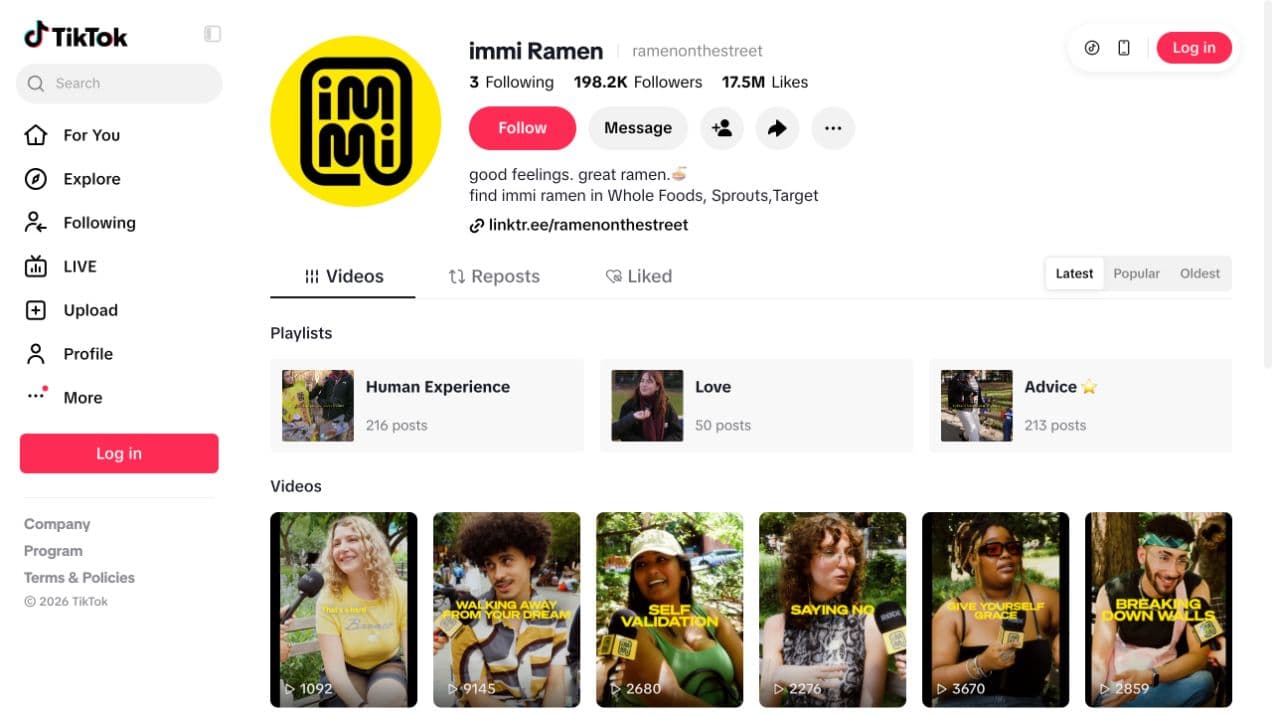
- immi Ramen on TikTok ↗
Public profile and linked videos inspected September 15, 2026. The analysis concerns visible editorial choices, not private performance or an asserted customer relationship.
- TikTok 2026 trend report ↗
Page 8 identifies immi's second channel as an example of a distinct brand expression. The report does not establish use of TokPortal or the AGD term.
- Instagram Trial Reels ↗
Meta's product announcement and source of the illustrated insights screen. Feature availability should be checked on the actual account.
- TikTok Business Center access ↗
Official permissions workflow for linked accounts in advertising. Advertising access must not be confused with unrestricted organic account management.
Running multiple TikTok accounts is an editorial and operations problem, not just an account-switching problem. Start with the reason each profile should exist. A new country, a different customer problem or a genuinely separate recurring show can justify another account. An unused device or a folder of duplicated videos is not an audience strategy.
Write a one-sentence promise for every proposed account: “This account helps [audience] do [specific job] through [repeatable format].” If two promises are interchangeable, combine them until you have evidence that they need separate homes. Your main brand account can remain the place for product announcements while a purpose-built account explores a narrower everyday problem.
This is where Account-Generated Distribution (AGD) fits. AGD is an organic growth model where content is distributed through a network of purpose-built social accounts instead of relying on a single brand account or external creators for reach. The asset you develop is an account with a coherent audience promise, together with the process that keeps its content useful.
A real example: immi Ramen's street-interview account
@ramenonthestreet gives viewers an immediately recognizable setting: street interviews, recurring questions and a branded microphone. Its public profile groups videos into Human Experience, Love and Advice. For a concrete starting point, open the “Walking away from your dream” video shown in the capture. Study the question, setting and relationship to the account promise rather than copying the interview.
TikTok's 2026 trend report, page 8, describes immi's second channel as an example of a brand developing another side through interviews about happiness. This is evidence of a distinct editorial proposition. It does not disclose immi's account infrastructure, acquisition costs or sales attribution, and we are not claiming that immi uses TokPortal or calls its approach AGD.
The transferable idea is to separate the reason someone watches from the moment you explain the product. For your own brand, list questions your audience already cares about, then identify which questions you can answer with genuine access, expertise or demonstrations. The recurring show should still have a credible relationship to the business; an unrelated viral account can attract an audience that never needs your offer.
Create an account map with ownership, access and content roles
Use a shared register before creating accounts. Record the platform, profile URL, audience, market, editor, approver, publishing operator and business destination. Store recovery information in your team's secure access system rather than the editorial spreadsheet. Make the handoff clear enough that another authorized teammate can identify who owns a failed publishing job.
Separate account creation from content scheduling. If you already control suitable accounts, evaluate the platform's own publishing tools or an authorized scheduler first. If you need local account creation and ongoing operation, that is a different scope. Read the phone farm and managed-operation comparison before committing to infrastructure.
For account setup, use the platform's current signup and account-management flow and valid details you control. Do not make a business plan depend on a supposed universal number of accounts allowed on one phone: account switching, business permissions and publishing integrations are different features, and restrictions can change. Document the actual account access available to your team.
Copy a multi-account register
Account / platform / profile URL:
Audience and one-sentence promise:
Market and language:
Recurring format and three original episode ideas:
Editor / approver / publishing operator:
Access owner and secure recovery location (no passwords here):
Rights and disclosure requirements:
Approved asset folder and publishing queue:
Landing page + account-specific tracking:
Weekly production budget:
Review date and next decision:
Request team access through the right TikTok workflow
For the Business Center advertising workflow, TikTok's account-management instructions describe Assets → TikTok accounts → Request access. An administrator chooses the required permission, generates a QR code and has the account owner authorize it in TikTok. Members can then be assigned access to the linked account. Inspect the actual permissions rather than assuming that advertising access also grants every organic publishing action.
This is a practical distinction for agencies: permission to use an account's identity in an ad campaign is not the same deliverable as a managed organic publishing service. Record the action each person is authorized to perform and confirm that it matches the job in your content queue. For an existing-account scheduler, test the account connection and supported publishing formats before moving the whole calendar.
Plan original content for three accounts: a worked example
Illustrative example: a meal-planning app serves busy professionals, parents and people learning to cook. One account could demonstrate lunches prepared in 15 minutes; another could show family meal planning around leftovers; the third could teach one basic cooking technique at a time. The product is the same, but the questions, examples and footage should differ.
For the professional account, record an actual planning workflow from an empty week to a shopping list. For the family account, show a realistic leftover ingredient and how it changes the plan. For the beginner account, film the technique and use the app only where it helps. These are three pieces of useful content, not the same commercial with three usernames.
Keep an asset register with the original source footage, permitted uses and approved versions. Reusing a shot you own can be efficient, but ask whether the finished post teaches something different. Changing a border, crop or hashtag is not a meaningful new audience proposition. The goal of content isolation in AGD is distinct execution and context, not cosmetic changes intended to disguise duplication.
Batch work where the substance permits it: collect several genuine audience questions, film demonstrations in one session, then edit each episode around its own answer. Keep room for follow-up posts based on actual comments. A calendar full of generic tips may meet a numerical target while teaching the team nothing about demand.
Calculate how many accounts your team can actually maintain
Can your team feed this account network?
Adjust the planning assumptions. Include scripting, editing, captions and review in the time per post. These are workload calculations, not recommended posting limits or reach predictions.
- Finished posts needed
- 48
- Production hours / week
- 9.0
Shortfall: 1.0 hours each week. Reduce the network or cadence, or increase production time. Your production budget supports 2 accounts at this cadence.
The default example requires 48 posts over four weeks: three accounts, four posts per account each week. At 45 minutes per finished post, production alone takes nine hours a week. If the team has eight hours available, opening more accounts increases the shortfall. Reduce the proposed cadence, simplify the production process or allocate more time before expanding.
The inputs are planning assumptions, not a recommended TikTok frequency or a platform limit. A documentary-style interview may take much longer than a product screen recording. Replace the default with your own logged time from several completed posts. Include review and rework so that the budget reflects what publishing actually costs your team.
Use Instagram Trial Reels when the question is about a format
A new Instagram account is not the only way to test a new content idea. Meta's Trial Reels let eligible users show a reel to non-followers first and inspect early engagement before deciding whether to share it more widely. Meta describes insights becoming available after roughly 24 hours and an optional automatic sharing decision based on views within 72 hours. Check what your own account offers.
Use this distinction when planning a TikTok and Instagram network. If you want to test whether a different format interests new people, an existing account's testing feature may answer the question. If you need a durable editorial identity for a different audience or market, a separate account may be appropriate. A format test and an account strategy are different decisions.
Run a weekly review that connects posts to business outcomes
Review one row per account, with a consistent reporting window. Track the number of completed posts, typical performance among comparable posts, qualified comments, attributable visits and the conversion you selected. Keep a separate note for unusually strong posts so one outlier does not hide a weak recurring series. Compare posts at similar ages and distinguish paid amplification from organic distribution.
A useful review ends with an editorial decision. For example: “People ask whether the meal plan works for one person; next week we will demonstrate that exact setup.” A less useful review ends with “post more.” You need a testable explanation for what to change: the question, proof, presentation, audience or destination.
When an account struggles, inspect the published item and any visible platform status before changing infrastructure. Confirm that the asset is correct, the opening is understandable, the profile promise matches the content and the landing page works. Do not diagnose a shadowban solely from a handful of low-view posts. The reach-drop guide provides a separate troubleshooting path.
When to add, combine or pause accounts
Add an account when you can describe a distinct audience need, supply original episodes and assign someone to review the results. Combine accounts on your planning board when their promises overlap and neither needs a separate identity. Pause expansion when the current operation regularly misses approvals, repeats itself or cannot connect content to the business destination.
For a new market, validate product availability and the local brief first. The US TikTok account guide separates account location from audience geography. For a new creative supplier, check the rights and handoff described in the UGC distribution comparison. Those checks prevent an account network from becoming a collection of disconnected purchases.
Document the reason for every expansion in a short decision log: the audience question, evidence from existing content, planned production hours and the date of the next review. This makes scaling repeatable without pretending that the same number of accounts works for every brand.
Multi-account TikTok and Instagram FAQ
How do I manage multiple TikTok accounts for one brand?+
Should I post the same video on every account?+
How many TikTok accounts should a business start with?+
Does operating several accounts guarantee more reach?+
Turn your account map into a launch plan
Choose your platforms and available markets, prepare your profiles and review the account and publishing quote in TokPortal.

Written by
Vincent Tellenne
Co-founder & CEO
Vincent is a co-founder and CEO of TokPortal. He works on the infrastructure and operating model behind scaled organic social media distribution.
Learn more about this topic with AI
Related Resources
Best Platforms to Distribute AI UGC Videos
Compare UGC production, creator posts, schedulers, paid ads and managed AGD accounts. Real examples, rights checklist and an interactive content planner.
How to Create a US TikTok Account From Abroad
Create a US TikTok account from abroad: local setup, audience geography, real product screenshots and a practical launch brief for AGD.
TikTok Phone Farm Alternatives for Managing Multiple Accounts
Compare TikTok phone farm alternatives: physical devices, cloud phones, schedulers and managed AGD accounts. Includes costs, screenshots and a capacity calculator.
Related Countries
Put your AGD strategy to work
You make the content.
TokPortal runs the account operations.
Create and operate TikTok and Instagram accounts in your target market. Local operators handle the account work and native publishing. You control the brief, content and campaign from the dashboard, API or MCP.
- 01Choose your market
- 02Define each account
- 03Schedule your content
Review market availability and pricing before ordering. No reach forecast is built into your plan.